Two waves of frequencies $20 Hz$ and $30 Hz.$ Travels out from a common point. The phase difference between them after $0.6 sec$ is
Medium


Download our appand get started for free
Experience the future of education. Simply download our apps or reach out to us for more information. Let's shape the future of learning together!No signup needed.*
Similar Questions
- 1The tension in a wire is decreased by $19 \%$. The percentage decrease in frequency will be ......... $\%$View Solution
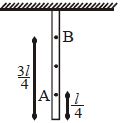
- 2A string of mass $m$ and length $l$ hangs from ceiling as shown in the figure. Wave in string moves upward. $v_A$ and $v_B$ are the speeds of wave at $A$ and $B$ respectively. Then $v_B$ isView Solution
- 3An organ pipe $P_1$ closed at one end vibrating in its first overtone. Another pipe $P_2$ open at both ends is vibrating in its third overtone. They are in a resonance with a given tuning fork. The ratio of the length of $P_1$ to that of $P_2$ is :View Solution
- 4Equation of travelling wave on a stretched string of linear density $5\,g/m$ is $y = 0.03\,sin\,(450\,t -9x)$ where distance and time are measured in $SI$ united. The tension in the string is ... $N$View Solution
- 5In Quincke’s tube a detector detects minimum intensity. Now one of the tube is displaced by $5 \,\,cm$. During displacement detector detects maximum intensity $10$ times, then finally a minimum intensity (when displacement is complete). The wavelength of sound is .... $cm$View Solution
- 6The equation of a plane progressive wave is given by $y = 0.025\sin (100t + 0.25x)$. The frequency of this wave would beView Solution
- 7A vibrating string of certain length $l$ under a tension $T$ reasonates with a mode corresponding to the first overtone (third harmonic) of an air column of length $75$ $cm$ inside a tube closed at one end. The string also generates $4$ beats per second when excited along with a tuning fork of frequency $n$. Now when the tension of the string is slightly increased the number of beats reduces to $2$ per second. Assuming the velocity of sound in air to be $340$ $m/s$, the frequency $n$ of the tuning fork in $Hz $ isView Solution
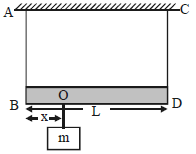
- 8A massless rod of length $L$ is suspended by two identical strings $AB$ and $CD$ of equal length. A block of mass $m$ is suspended from point $O$ such that $BO$ is equal to $‘x’$. Further it is observed that the frequency of $1^{st}$ harmonic in $AB$ is equal to $2^{nd}$ harmonic frequency in $CD$. $‘x’$ isView Solution
- 9A source of sound $S$ is moving with the velocity of $50\,m/s$ towards a stationary observer. The observer measures the frequency of the sound as $1000\,Hz.$ What will be the apparent frequency of the source when it is moving away from the observer after crossing him ... $Hz$ ? (Take velocity of sound in air is $350\,m/s$ )View Solution
- 10The clocktower ("ghantaghar") of Dehradun is famous for the sound of its bell, which can be heard, albeit faintly, upto the outskirts of the city $8 \,km$ away. Let the intensity of this faint sound be $30 \,dB$. The clock is situated $80 \,m$ high. The intensity at the base of the tower is .............$\,dB$View Solution