MCQ
Two waves of wavelengths $99\, cm$ and $100\, cm$ both travelling with velocity $396\, m/s$ are made to interfere. The number of beats produced by them per second is
  • A
    $1$
  • B
    $2$
  • $4$
  • D
    $8$

Answer

Correct option: C.
$4$
c
Velocity of wave $\mathrm{v}=\mathrm{n} \lambda$

where $\mathrm{n}=$ frequency of wave $\Rightarrow \mathrm{n}=\frac{\mathrm{v}}{\lambda}$

$\mathrm{n}_{2}=\frac{\mathrm{v}_{2}}{\lambda_{2}}=\frac{396}{100 \times 10^{-2}}=396 \mathrm{Hz}$

no. of beats $=n_{1}-n_{2}=4$

Need a full question paper?

Generate a complete, print-ready paper with questions like this in minutes — across 16+ boards, with answer keys.
Start Generating Free

Similar questions

A copper pipe of length $10 \,m$ carries steam at temperature $110^{\circ} C$. The outer surface of the pipe is maintained at a temperature $10^{\circ} C$. The inner and outer radii of the pipe are $2 \,cm$ and $4 \,cm$, respectively. The thermal conductivity of copper is $0.38 kW / m /{ }^{\circ} C$. In the steady state, the rate at which heat flows radially outward through the pipe is closest to ............. $\,kW$
Two water pipes of diameters $2\ cm$ and $4\ cm$ are connected with the main supply line. The velocity of flow of water in the pipe of $2\ cm$ diameter is:
The coefficient of performance of a refrigerator is $5.$ If the temperature inside freezer is $-20^o C,$ the temperature of the surroundings to which it rejects heat is ........ $^oC$
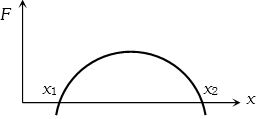
The force acting on a body moving along $x-$axis varies with the position of the particle as shown in the fig.The body is in stable equilibrium at
Hooke's law is applicable for ....
In carbon monoxide molecules, the carbon and the oxygen atoms are separated by distance $1.2 \,\mathring A$. The distance of the centre of mass, from the carbon atom is ........  $\mathring A$
The value of critical temperature in terms of Vander Waal’s constant $a$ and $b$ is
$A$ particle of mass $0.5\, kg$ is rotating in a circular path of radius $2m$ and centrepetal force on it is $9$ Newtons. Its angular momentum (in $J·sec$) is:
The acceleration due to gravity at a place is ${\pi ^2}\,m/se{c^2}$. Then the time period of a simple pendulum of length one metre is
When an object is at rest