Two wires $A$ and $B$ are of same materials. Their lengths are in the ratio $1 : 2$ and diameters are in the ratio $2 : 1$ when stretched by force ${F_A}$ and ${F_B}$ respectively they get equal increase in their lengths. Then the ratio ${F_A}/{F_B}$ should be
Medium
Download our app for free and get started
(d) $F = Y \times A \times \frac{l}{L}$$⇒$ $F \propto \frac{{{r^2}}}{L}$ $(Y$ and $l$ are constant$)$
$\frac{{{F_A}}}{{{F_B}}} = {\left( {\frac{{{r_A}}}{{{r_B}}}} \right)^2} \times \left( {\frac{{{L_B}}}{{{L_A}}}} \right) = {\left( {\frac{2}{1}} \right)^2} \times \left( {\frac{2}{1}} \right) = \frac{8}{1}$

Download our appand get started for free
Experience the future of education. Simply download our apps or reach out to us for more information. Let's shape the future of learning together!No signup needed.*
Similar Questions
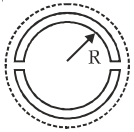
- 1A wooden wheel of radius $R$ is made of two semicircular part (see figure). The two parts are held together by a ring made of a metal strip of cross section area $S$ and length $L$. $L$ is slighly less than $2\pi R$. To fit the ring on the wheel, it is heated so that its temperature rises by $\Delta T$ and it just steps over the wheel.As it cools down to surronding temperature, it presses the semicircular parts together. If the coefficint of linear expansion of the metal is $\alpha$, and its young's modulus is $Y$, the force that one part of wheel applies on the other part isView Solution
- 2A metallic rod of length $I$ and cross-sectional area $A$ is made of a material of Young's modulus $Y$. If the rod is elongated by an amount $y$, then the work done is proportional to ......View Solution
- 3Two wire $A$ and $B$ are stretched by same force. If, for $A$ and $B, Y_A: Y_B=1: 2, r_A: r_B=3: 1$ and $L_A: L_B=4: 1$, then ratio of their extension $\left(\frac{\Delta L_A}{\Delta L_B}\right)$ will be .............View Solution
- 4A steel wire of length ' $L$ ' at $40^{\circ}\,C$ is suspended from the ceiling and then a mass ' $m$ ' is hung from its free end. The wire is cooled down from $40^{\circ}\,C$ to $30^{\circ}\,C$ to regain its original length ' $L$ '. The coefficient of linear thermal expansion of the steel is $10^{-5} { }^{\circ}\,C$, Young's modulus of steel is $10^{11}\, N /$ $m ^2$ and radius of the wire is $1\, mm$. Assume that $L \gg $ diameter of the wire. Then the value of ' $m$ ' in $kg$ is nearlyView Solution
- 5When a certain weight is suspended from a long uniform wire, its length increases by one cm. If the same weight is suspended from another wire of the same material and length but having a diameter half of the first one then the increase in length will be ........ $cm$View Solution
- 6The length of a wire is $1.0\, m$ and the area of cross-section is $1.0 \times {10^{ - 2}}\,c{m^2}$. If the work done for increase in length by $0.2\, cm$ is $0.4\, joule$, then Young's modulus of the material of the wire isView Solution
- 7Compressibility per unit atm. pressure of water is $'\sigma '$ and if due to pressure $P$ there is decrement in volume $V$, find change is volumeView Solution
- 8Young's modulus is determined by the equation given by $\mathrm{Y}=49000 \frac{\mathrm{m}}{\ell} \frac{\text { dyne }}{\mathrm{cm}^2}$ where $\mathrm{M}$ is the mass and $\ell$ is the extension of wre used in the experiment. Now error in Young modules $(\mathrm{Y})$ is estimated by taking data from $M-\ell$ plot in graph paper. The smallest scale divisions are $5 \mathrm{~g}$ and $0.02$ $\mathrm{cm}$ along load axis and extension axis respectively. If the value of $M$ and $\ell$ are $500 \mathrm{~g}$ and $2 \mathrm{~cm}$ respectively then percentage error of $\mathrm{Y}$ is :View Solution
- 9The length of a rod is $20\, cm$ and area of cross-section $2\,c{m^2}$. The Young's modulus of the material of wire is $1.4 \times {10^{11}}\,N/{m^2}$. If the rod is compressed by $5\, kg-wt$ along its length, then increase in the energy of the rod in joules will beView Solution
- 10A steel wire of length $3.2 m \left( Y _{ S }=2.0 \times 10^{11}\,Nm ^{-2}\right)$ and a copper wire of length $4.4\,M$ $\left( Y _{ C }=1.1 \times 10^{11}\,Nm ^{-2}\right)$, both of radius $1.4\,mm$ are connected end to end. When stretched by a load, the net elongation is found to be $1.4\,mm$. The load applied, in Newton, will be. (Given $\pi=\frac{22}{7}$)View Solution