Question
Under certain circumstances, a nucleus can decay by emitting a particle more massive than an $\alpha$particle. Consider the following decay processes:
$^{223}_{88}\text{Ra}\rightarrow^{209}_{82}\text{Pb}+^{14}_{6}\text{C}$
$^{223}_{88}\text{Ra}\rightarrow^{219}_{86}\text{Rn}+^{4}_{2}\text{He}$
Calculate the Q-values for these decays and determine that both are energetically allowed.
Answer

Take a $^{14}_{6}\text{C}$ emission nuclear reaction:
$^{223}_{88}\text{Ra}\rightarrow^{209}_{82}\text{Pb}+^{14}_{6}\text{C}$
We know that:
Mass of $^{223}_{88}\text{Ra},\ \text{m}_1=223.01850\text{ u}$
Mass of $^{209}_{82}\text{Pb},\ \text{m}_2=208.98107\text{ u}$
Mass of $^{14}_{6}\text{C },\text{m}_3=14.00324\text{ u}$
Hence, the Q-value of the reaction is given as:
$\text{Q}=(\text{m}_1-\text{m}_2-\text{m}_3)\text{c}^2$
$= (223.01850 - 208.98107 - 14.00324)c^2$
$= (0.03419 c^2)$ u
But $1$ u$ = 931.5 MeV/c^2$
$\therefore\ \text{Q}=0.03419\times931.5$
= 31.848 MeV
Hence, the Q-value of the nuclear reaction is 31.848 MeV. Since the value is positive, the reaction is energetically allowed.
Now take a $^{4}_{2}\text{He}$ emission nuclear reaction:
$^{223}_{88}\text{Ra}\rightarrow^{219}_{86}\text{Rn}+^{4}_{2}\text{He}$
We know that:
Mass of $^{223}_{88}\text{Ra},\ \text{m}_1=223.01850$
Mass of $^{219}_{82}\text{Rn},\ \text{m}_2=219.00948$
Mass of $^{4}_{2}\text{He },\text{m}_3=4.00260$
Q-value of this nuclear reaction is given as:
$\text{Q}=(\text{m}_1-\text{m}_2-\text{m}_3)\text{c}^2$
$= (223.01850 - 219.00948 - 4.00260)C^2$
$= (0.00642 c^2) u$
$= 0.00642 \times 931.5 = 5.98\ MeV$
Hence, the Q value of the second nuclear reaction is 5.98 MeV. Since the value is positive, the reaction is energetically allowed.

Need a full question paper?

Generate a complete, print-ready paper with questions like this in minutes — across 16+ boards, with answer keys.

Start Generating Free

Similar questions

When the sun is directly overhead, the surface of the earth receives $1.4 \times 10^3$ W m$^{-2}$ of sunlight. Assume that the light is monochromatic with average wavelength 500nm and that no light is absorbed in between the sun and the earth's surface. The distance between the sun and the earth is $1.5 \times 10^{11}m$.
  1. Calculate the number of photons falling per second on each square metre of earth's surface directly below the sun.
  2. How many photons are there in each cubic metre near the earth's surface at any instant?
  3. How many photons does the sun emit per second?
Define power and explain the following points (a) Instantaneous power (b) average power (c) power factor
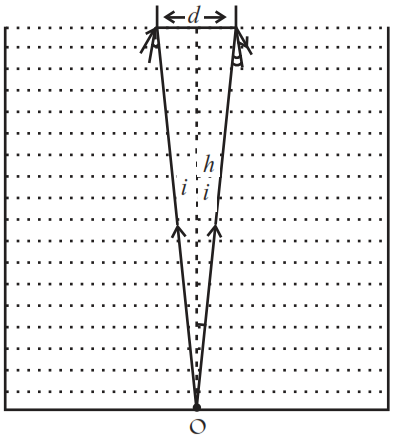
A jar of height h is filled with a transparent liquid of refractive index μ (Fig). At the centre of the jar on the bottom surface is a dot. Find the minimum diameter of a disc, such that when placed on the top surface symmetrically about the centre, the dot is invisible.
Find the mass, the kinetic energy and the momentum of an electron moving at O.8c.
Obtain expression for force on unit length of two straight parallel current carrying conductors. Under what conditions is this force attractive or repulsive? Define the standard unit of electric current.
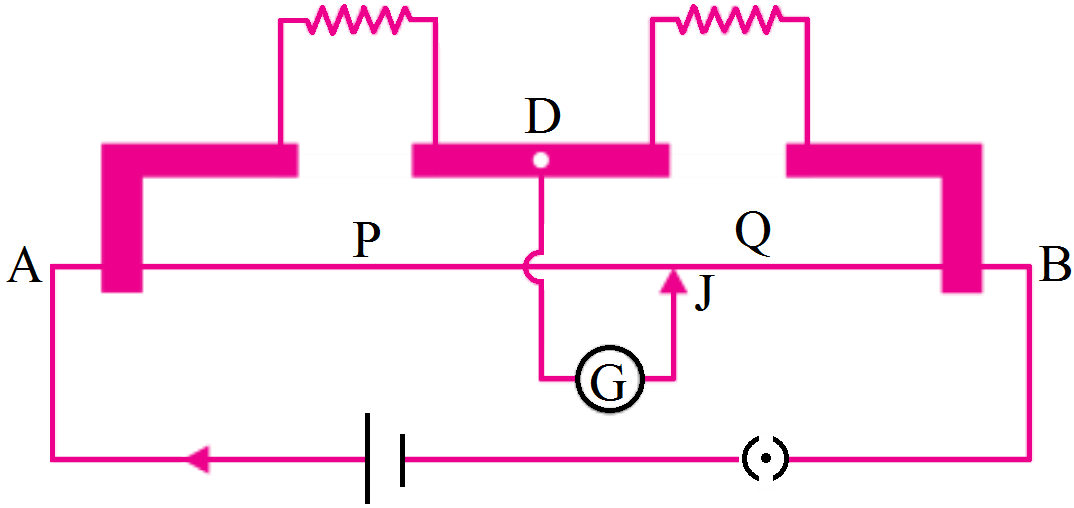
In a practical Wheatstone bridge circuit, wire AB is 2m long. When resistance Y = 2.0W and jockey is in position J such that AJ = 1.20m, there is no current in galvanometer, find the value of unknown resistance X. The resistance per unit length of wire AB = 0.01W/cm. Also calculate the current drawn by the cell of emf 4.0V and negligible internal resistance.
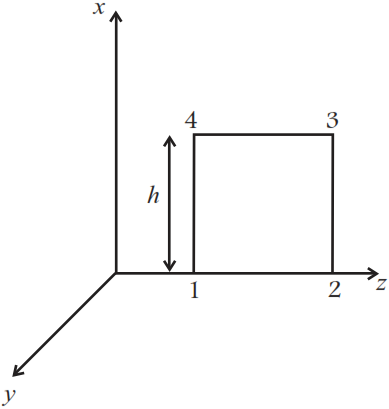
A plane EM wave travelling in vacuum along z direction is given by $\text{E}=\text{E}_0\sin(\text{kz}-\omega\text{t})\hat{\text{i}}\text{ and }\text{B}=\text{B}_0\sin(\text{kz}-\omega\text{t})\hat{\text{j}}$.
  1. Evaluate $\oint\text{E.dl}$ over the rectangular loop 1234 shown in Fig.
  2. Evaluate $\int\text{B.ds}$ over the surface bounded by loop 1234.
  3. Use equation $\oint\text{E.dl}=\frac{-\text{d}\phi_\text{B}}{\text{dt}}$ to prove $\frac{\text{E}_0}{\text{B}_0}=\text{c}$.
  4. By using similar process and the equation $\oint\text{B.dl}=\mu_0\text{I}+\in_0\frac{\text{d}\phi_\text{E}}{\text{dt}}$, prove that $\text{c}=\frac{1}{\sqrt{\mu_0\in_0}}$.
​​​​​​​
Obtain the relation for equivalence in series combination of capacitors. Make a circuit diagram.
What is a transformer? It is of how many types? Explain the principle, construction and working of any transformer.
What will be the path difference between two light waves $y_1=a_1 \sin \omega t$ and $y_2=a_2 \cos (\omega t+$ $\phi)$ ?