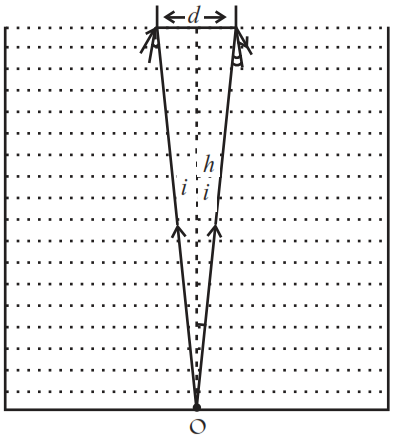
A jar of height h is filled with a transparent liquid of refractive index μ (Fig). At the centre of the jar on the bottom surface is a dot. Find the minimum diameter of a disc, such that when placed on the top surface symmetrically about the centre, the dot is invisible.
Download our app for free and get started
Key concept:
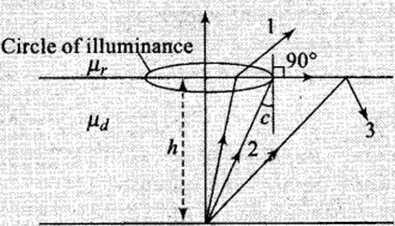
In the figure, ray 1 strikes the surface at an angle less than critical angle c and gets refracted in rarer medium. Ray 2 srtikes the surface at critical angle and grazes the interface. Ray 3 strikes the surface making an angle greater than the crirical angle and gets internally reflected. The locus of points where ray strikes at critical angle is a circlr, called circle of illuminance (C.O.I). All light rays striking inside the circle of illuminance get refracted in the rarer medium. If an observer is in the rarer mecdium, he/she will see light coming out only from within the circle of illuminance. If a circular opaque plate covers the circle of illuminance, no ligth will get refraced in the rarer medium and then the object cannot be seen from the rarer medium. In figure, O is a smll dot at the bottom of the jar. the ray from the dot emerges out of a circular pathc of water surface of diameter AB till the angle of incidence for the rays OA and OB exceeds the critical angle $(i_C).$
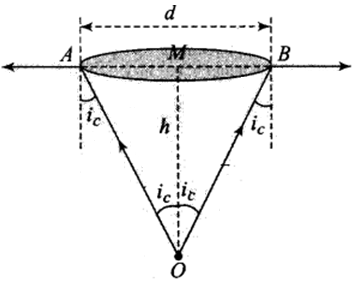
Rays of light incident at an angle greater than $i_C$, are totally reflected within water and consequently cannot emerge out of the water surface. As $\sin\text{i}_\text{C}=\frac{1}{\mu}\Rightarrow\ \tan\text{i}_\text{C}=\frac{1}{\sqrt{\mu^2-1}}$ Now, $\frac{\frac{\text{d}}{2}}{\text{h}}=\tan\text{i}_\text{C}$ $\Rightarrow\ \frac{\text{d}}{2}=\text{h}\tan\text{i}_\text{c}=\text{h}\frac{1}{\sqrt{\mu^2-1}}$ $\Rightarrow\ \text{d}=\frac{2\text{h}}{\sqrt{\mu^2-1}}$ Thsi is the required expression of d.
In the figure, ray 1 strikes the surface at an angle less than critical angle c and gets refracted in rarer medium. Ray 2 srtikes the surface at critical angle and grazes the interface. Ray 3 strikes the surface making an angle greater than the crirical angle and gets internally reflected. The locus of points where ray strikes at critical angle is a circlr, called circle of illuminance (C.O.I). All light rays striking inside the circle of illuminance get refracted in the rarer medium. If an observer is in the rarer mecdium, he/she will see light coming out only from within the circle of illuminance. If a circular opaque plate covers the circle of illuminance, no ligth will get refraced in the rarer medium and then the object cannot be seen from the rarer medium. In figure, O is a smll dot at the bottom of the jar. the ray from the dot emerges out of a circular pathc of water surface of diameter AB till the angle of incidence for the rays OA and OB exceeds the critical angle $(i_C).$
Rays of light incident at an angle greater than $i_C$, are totally reflected within water and consequently cannot emerge out of the water surface. As $\sin\text{i}_\text{C}=\frac{1}{\mu}\Rightarrow\ \tan\text{i}_\text{C}=\frac{1}{\sqrt{\mu^2-1}}$ Now, $\frac{\frac{\text{d}}{2}}{\text{h}}=\tan\text{i}_\text{C}$ $\Rightarrow\ \frac{\text{d}}{2}=\text{h}\tan\text{i}_\text{c}=\text{h}\frac{1}{\sqrt{\mu^2-1}}$ $\Rightarrow\ \text{d}=\frac{2\text{h}}{\sqrt{\mu^2-1}}$ Thsi is the required expression of d.

Download our appand get started for free
Experience the future of education. Simply download our apps or reach out to us for more information. Let's shape the future of learning together!No signup needed.*
Similar Questions
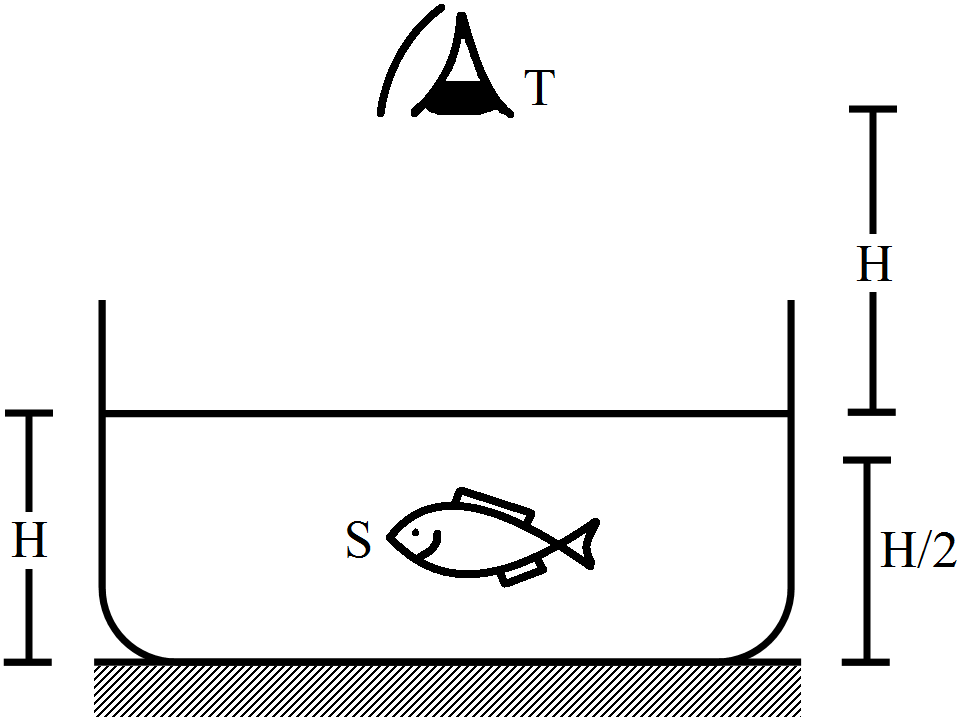
- 1View SolutionConsider the situation in figure. The bottom of the pot is a reflecting plane mirror, S is a small fish and T is a human eye. Refractive index of water is.
- At what distance(s) from itself will the fish see the image(s) of the eye?
- At what distance(s) from itself will the eye see the image(s) of the fish.
- 2View SolutionA converging lens of focal length 15cm and a converging mirror of focal length 10cm are placed 50cm apart. If a pin of length 2.0cm is placed 30cm from the lens farther away from the mirror, where will the final image form and what will be the size of the final image?
- 3View SolutionAn angular magnification (magnifying power) of 30X is desired using an objective of focal length 1.25 cm and an eyepiece of focal length 5 cm. How will you set up the compound microscope?
- 4View SolutionA converging lens of focal length 15cm and a converging mirror of focal length 10cm are placed 50cm apart with common principal axis. A point source is placed in between the lens and the mirror at a distance of 40cm from the lens. Find the locations of the two images formed.
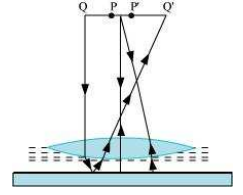
- 5View Solutionequiconvex lens (of refractive index 1.50) in contact with a liquid layer on top of a plane mirror. A small needle with its tip on the principal axis is moved along the axis until its inverted image is found at the position of the needle. The distance of the needle from the lens is measured to be 45.0 cm. The liquid is removed and the experiment is repeated. The new distance is measured to be 30.0 cm. What is the refractive index of the liquid?
- 6View SolutionA convex lens has a focal length of 10cm. Find the location and nature of the image if a point object is placed on the principal axis at a distance of:
- 9.8cm
- 10.2cm from the lens.
- 7View Solution
- Derive the mathematical relation between refractive indices $n_1$ and $n_2 $ of two radii and radius of curvature R for refraction at a convex spherical surface. Consider the object to be a point since lying on the principle axis in rarer medium of refractive index $n_1$ and a real image formed in the denser medium of refractive index $n_{2}$.Hence, derive lens maker's formula.
- Light from a point source in air falls on a convex spherical glass surface of refractive index 1.5 and radius of curvature 20 cm. The distance of light source from the glass surface is 100 cm. At what position is the image formed?
- 8View Solution
- For a ray of light travelling from a denser medium of refractive index $n_1$ to a rarer medium of refractive index $n_2$ prove that $\frac{\text{n}_{2}}{\text{n}_{1}} = \sin \text{i}_{c} ,$ where $i_c$ is the critical angle of incidence for the media.
- Explain with the help of a diagram, how the above principle is used for transmission of video signals using optical fibres.
- 9View SolutionA compound microscope consists of an objective of focal length 1cm and an eyepiece of focal length 5cm. An object is placed at a distance of 0.5cm from the objective. What should be the separation between the lenses so that the microscope projects an inverted real image of the object on a screen 30cm behind the eyepiece?
- 10View SolutionFigure shows a transparent hemisphere of radius 3.0cm made of a material of refractive index 2.0.
- A narrow beam of parallel rays is incident on the hemisphere as shown in the figure. Are the rays totally reflected at the plane surface?
- Find the image formed by the refraction at the first surface.
- Find the image formed by the reflection or by the refraction at the plane surface.
- Trace qualitatively the final rays as they come out of the hemisphere.