Question
Use molecular orbital theory to explain why the $\mathrm{Be}_2$ molecule does not exist.

Answer

The electronic configuration of Beryllium is $1 \mathrm{~s}^2 2 \mathrm{~s}^2$ The molecular orbital electronic configuration for $\mathrm{Be}_2$ molecule can be written as:
$\sigma_{1 \mathrm{~s}}^2 \sigma_{1 \mathrm{~s}}^2 \sigma_{2 \mathrm{~s}}^2 \sigma_{2 \mathrm{~s}}^2$
Hence, the bond order for $\mathrm{Be}_2$ is $\frac{1}{2}\left(\mathrm{~N}_{\mathrm{b}}-\mathrm{N}_{\mathrm{a}}\right)$.
Where
$N_b=$ Number of electrons in bonding orbitals
$N_a=$ Number of electrons in anti-bonding orbitals
$\therefore$ Bond order of $\mathrm{Be}_2=\frac{1}{2}(4-4)=0$
A negative or zero bond order means that the molecule is unstable. Hence, $\mathrm{Be}_2$ molecule does not exist.

Need a full question paper?

Generate a complete, print-ready paper with questions like this in minutes — across 16+ boards, with answer keys.

Start Generating Free

Similar questions

The average molar mass of a mixture of methane ($CH_4$) and ethane ($C_2H_4$​​​​​​​) present in the ratio of a : b is found to be 20.0g $mol^{-1}​​​​​​​$​​​​​​​. If the ratio were reversed, what would be the molar mass of the mixture?
The order of basicity of amines expected on the basis of inductive effect is $NH _3< RNH _2< R _3 N$. However, the observed order of basicity is $NH _3< RNH _2< R _2 NH > R _3 N$. How will you account for the difference?
Give the structures of A and B.
Calculate the mass percent of different elements present in sodium sulphate ($\mathrm{Na}_2 \mathrm{SO}_4$).
Complete the following reactions:
  1. $8\text{LiH}+\text{AlCl}_6\xrightarrow{\ \ \ \ \ \ \ \ \ }$
  2. $2\text{LiH}+\text{B}_2\text{H}_6\xrightarrow{\ \ \ \ \ \ \ \ \ }$
  3. $2\text{NaH}+\text{B}_2\text{H}_6\xrightarrow{\ \ \ \ \ \ \ \ \ }$
How does $\mathrm{H}_2 \mathrm{O}_2$ behave as a bleaching agent?
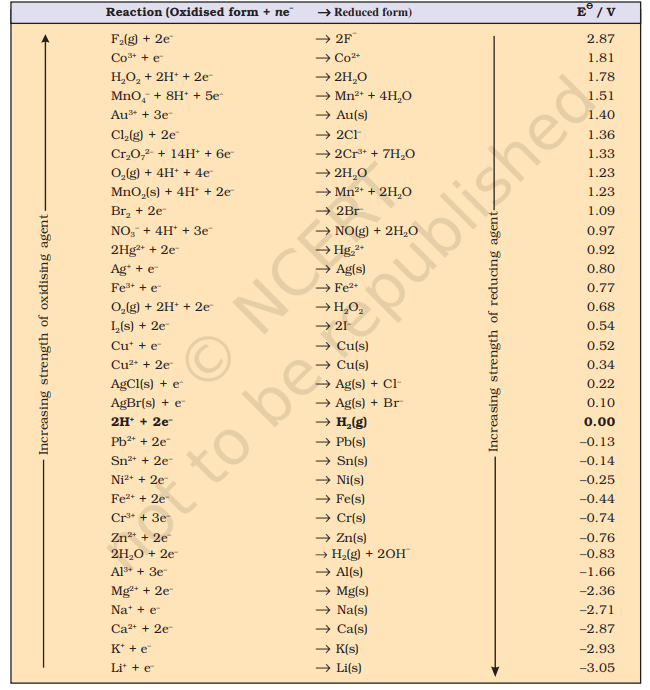
Using the standard electrode potentials given in the Table, predict if the reaction between the following is feasible:
$\mathrm{Ag}^{+}(\mathrm{aq})$ and $\mathrm{Cu}(\mathrm{s})$.
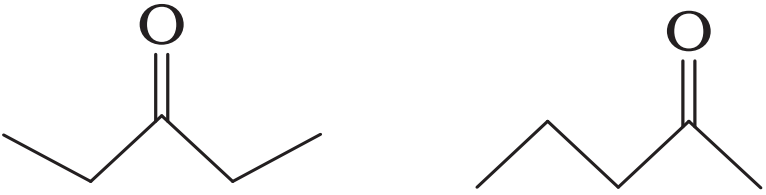
What is the relationship between the members of following pairs of structures? Are they structural or geometrical isomers or resonance contributors?
Calculate the mass of ferric oxide that will be obtained by complete oxidation of 2g of Fe. [Atomic weights of Fe = 56u, 0 = 16u]
Commercially available concentrated hydrochloric acid $( HCl )$ contains $38 \% HCI$ by mass.
1. What is the molarity $( M )$ of the solution (density of solution $=1.19 g mL ^{-1}$ )
2. What volume required of concentrated HCI is required to make 1.0 L of an 0.10 M HCI ?