Question
Using Bohr's total postulates, derive the expression for the total energy of the electron in the stationary states of hydrogen atom.

Answer

According to Bohr's postulates, in a hydrogen atom, a single electron revolves around a nucleus of charge $+e$.
For an electron moving with a uniform speed in a circular orbit of a given radius, the centripetal force is provided by Coulomb force of attraction between the electron and the nucleus.
The gravitational attraction may be neglected as the mass of electron and proton is very small.
So,
$m v^2 / r = ke ^2 / r ^2\left(\right.$ where, $\left.k =1 / 4 \pi \varepsilon_0\right)$
or $m v^2= ke ^2 / r$.
where $, m =$ mass of electron $, r =$ radius of electronic orbit $, v =$ velocity of electron
Again, by Bohr's second postulates
$mvr = nh / 2 \pi$
where, $n=1,2,3, \ldots$ or $v=n h / 2 \pi m r$
Putting the value of $v$ in Eq. $(i)$
$m\left(\frac{n h}{2 \pi m r}\right)^2=\frac{k r^2}{r} $
$\Rightarrow r=\frac{n^2 h^2}{4 \pi^2 k m e^2}$
Kinetic energy of electron ,
$E_K=\frac{1}{2} m v^2=\frac{k e^2}{2 r}\left(\because \frac{m v^2}{r}=\frac{k e^2}{r^2}\right)$
Using Eq $(ii),$ we get
$E_K=\frac{k \kappa^2}{2} \frac{4 \pi^2 k m c^2}{n^2 h^2}$
$=\frac{2 \pi^2 k^2 m c^4}{n^2 h^2}$
Potential energy of electron,
$E_P=-\frac{k(e) \times(e)}{r}=-\frac{k x^2}{r}$
Using Eq $(ii),$ we get
$E_P=-k e^2 \times \frac{4 \pi^2 k m c^2}{n^2 h^2}$
$=-\frac{4 \pi^2 k^2 m e^4}{n^2 h^2}$
Hence, total energy of the electron in the $n ^{ th }$ orbit
$E=E_P+E_K=-\frac{4 \pi^2 k^2 m e^4}{n^2 h^2}+\frac{2 \pi^2 k^2 m e^4}{n^2 h^2}$
$=-\frac{2 \pi^2 k^2 m e^4}{n^2 h^2}$

Need a full question paper?

Generate a complete, print-ready paper with questions like this in minutes — across 16+ boards, with answer keys.
Start Generating Free

Similar questions

An object is placed at $ (i) 10 \ cm, (ii) 5 \ cm$ in front of a concave mirror of radius of curvature $15 \ cm$. Find the position, nature, and magnification of the image in each case.
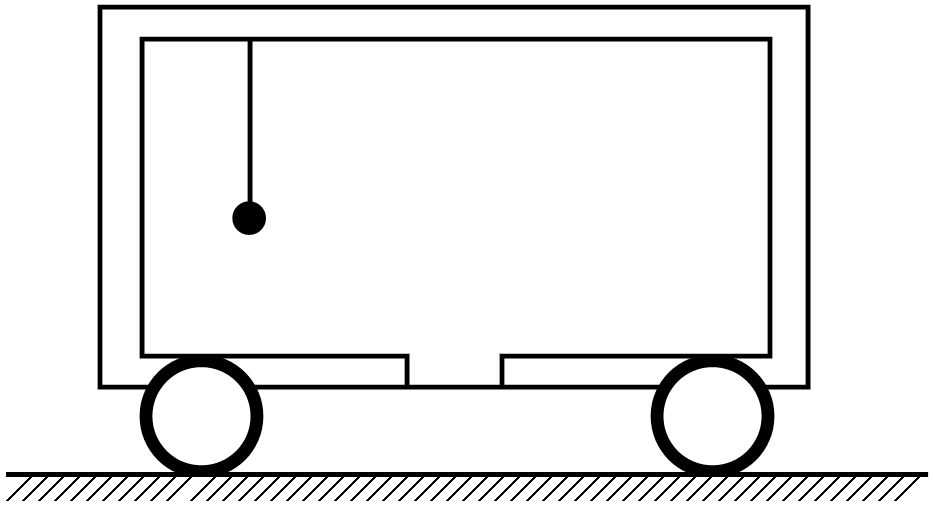
A cart of mass M is at rest on a frictionless horizontal surface and a pendulum bob of mass m hangs from the roof of the cart. The string breaks, the bob falls on the floor, makes several collisions on the floor and finally lands up in a small slot made in the floor. The horizontal distance between the string and the slot is L. Find the displacement of the cart during this process.
  1. State Biot – Savart law and express this law in the vector form.
  2. Two identical circular coils, P and Q each of radius R, carrying currents 1 A and $\sqrt{3}$ A respectively, are placed concentrically and perpendicular to each other lying in the XY and YZ planes. Find the magnitude and direction of the net magnetic field at the centre of the coils.
We have valence electrons and conduction electrons in a semiconductor. Do we also have 'valence holes' and 'conduction holes'?
A ceiling fan has a diameter (of the circle through the outer edges of the three blades) of 120cm and rpm 1500 at full speed. Consider a particle of mass 1g sticking at the outer end of a blade. How much force does it experience when the fan runs at full speed? Who exerts this force on the particle? How much force does the particle exert on the blade along its surface?
The stopping potential in a photoelectric experiment is linearly related to the inverse of the wavelength $\Big(\frac{1}{\lambda}\Big)$ of the light falling on the cathode. The potential difference applied across an $X-$ray tube is linearly related to the inverse of the cutoff wavelength$\Big(\frac{1}{\lambda}\Big)$ of the $X-$ray emitted. Show that the slopes of the lines in the two cases are equal and find its value.
A long, cylindrical tube of inner and outer radii a and b carries a current i distributed uniformly over its cross section. Find the magnitude of the magnetic field at a point (a) just inside the tube (b) just outside the tube.
Prove that the current density of a metallic conductor is directly proportional to the drift speed of electrons.
  1. A rod of length l is moved horizontally with a uniform velocity ‘v’ in a direction perpendicular to its length through a region in which a uniform magnetic field is acting vertically downward. Derive the expression for the emf induced across the ends of the rod.
  2. How does one understand this motional emf by invoking the Lorentz force acting on the free charge carriers of the conductor? Explain.
Two small bodies of masses 2.00kg and 4.00kg are kept at rest at a separation of 2.0m. Where should a particle of mass 0.10kg be placed to experience no net gravitational force from these bodies? The particle is placed at this point. What is the gravitational potential energy of the system of three particles with usual reference level?