Prove that the current density of a metallic conductor is directly proportional to the drift speed of electrons.
CBSE DELHI - SET 1 2008
Download our app for free and get started
Total number of free electrons, $N = n A.$
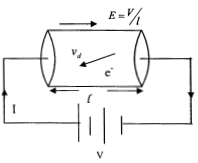
$\therefore$ Total Charge $Q = N e$
$= nAel$
$\tau = \frac{1}{\text{v}_{d}}$
$\therefore$ $\text{I} = \frac{Q}{\tau} = \frac{\text{nAel}}{l}\text{v}_{d} $
$= nAev_d$
$J =$ current dencity $= \frac{\text{I}}{\text{A}}$
$\therefore$ $\text{J} = \frac{nAev_d}{A} = \text{nev}_{d}$
$\therefore$ $\text{J} \propto \text{V}_{d}$
$\therefore$ Total Charge $Q = N e$
$= nAel$
$\tau = \frac{1}{\text{v}_{d}}$
$\therefore$ $\text{I} = \frac{Q}{\tau} = \frac{\text{nAel}}{l}\text{v}_{d} $
$= nAev_d$
$J =$ current dencity $= \frac{\text{I}}{\text{A}}$
$\therefore$ $\text{J} = \frac{nAev_d}{A} = \text{nev}_{d}$
$\therefore$ $\text{J} \propto \text{V}_{d}$

Download our appand get started for free
Experience the future of education. Simply download our apps or reach out to us for more information. Let's shape the future of learning together!No signup needed.*
Similar Questions
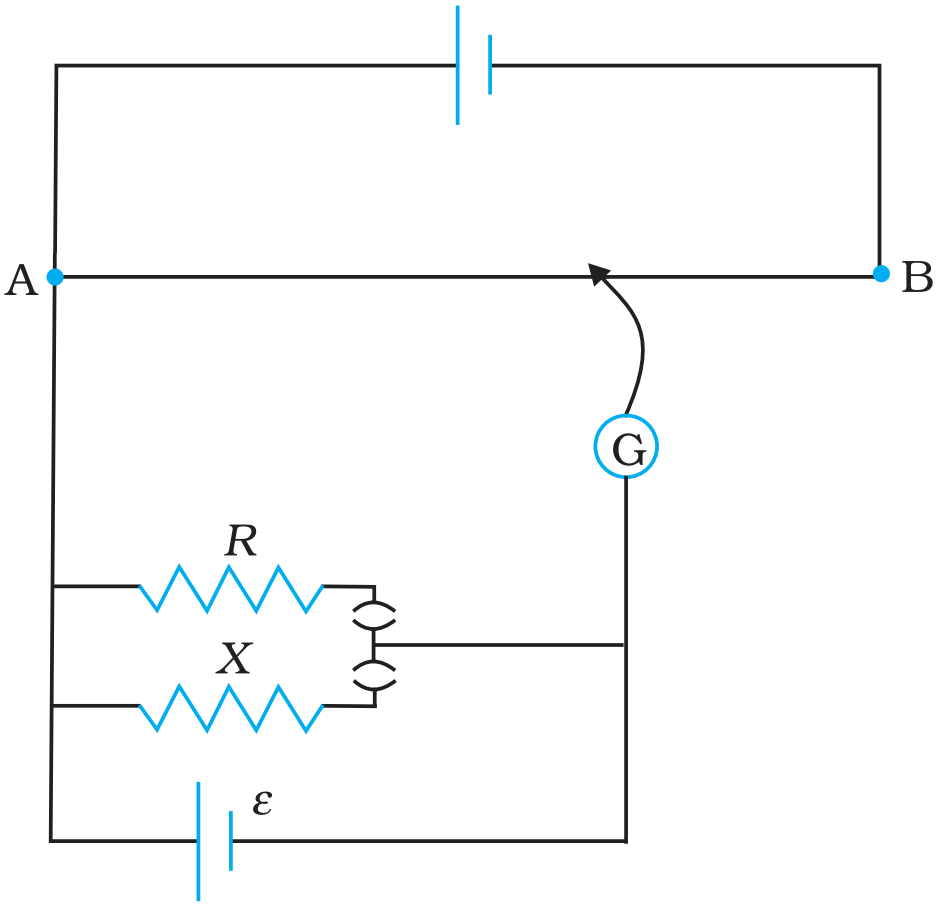
- 1Figure shows a potentiometer circuit for comparison of two resistances. The balance point with a standard resistor $\text{R}=10.0\ \Omega$ is found to be $58.3 \ cm,$ while that with the unknown resistance $X$ is $68.5 \ cm$. Determine the value of $X$. What might you do if you failed to find a balance point with the given cell of emf $\varepsilon?$View Solution
- 2View SolutionAnswer the following:
- Why are the connections between the resistors in a meter bridge made of thick copper strips?
- Why is it generally preferred to obtain the balance point in the middle of the meter bridge wire?
- Which material is used for the meter bridge wire and why?
- 3View SolutionFor the potentiometer circuit shown in the given figure, points X and Y reprensent the two terminals of an unknown emf E'. A student observed that when the jockey in moved from the end A to the end B of the potentiometer wire, the deflection in the galvanometer remains in the same direction.

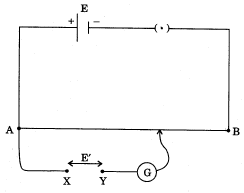 What may be the two possible faults in the circuit that could result in this obsevation?
If the galvanometer deflection at the end B is (i) more, (ii) less, than that at the end A, which of the two faults, listed above, would be there in the circuit?
Give reasons in support of your answer in each case. - 4View SolutionDefine relaxation time of the free electrons drifting in a conductor. How is it related to the drift velocity of free electrons? Use this relation to deduce the expression for the electrical resistivity of the material.
- 5View SolutionTwo heater coils made of same material are connected in parallel across the mains. The length and diameter of the wire of one of coils are double that of the other. Which one of them will produce more heat?
- 6n-identical cells, each of emf $\varepsilon,$ internal resistance r connected in series are charged by a dc source of emf $\varepsilon'$ using a resistance R.View Solution
- Draw the circuit arrangement.
- Deduce expressions for (a) the charging current and (b) the potential difference across the combination of cells.
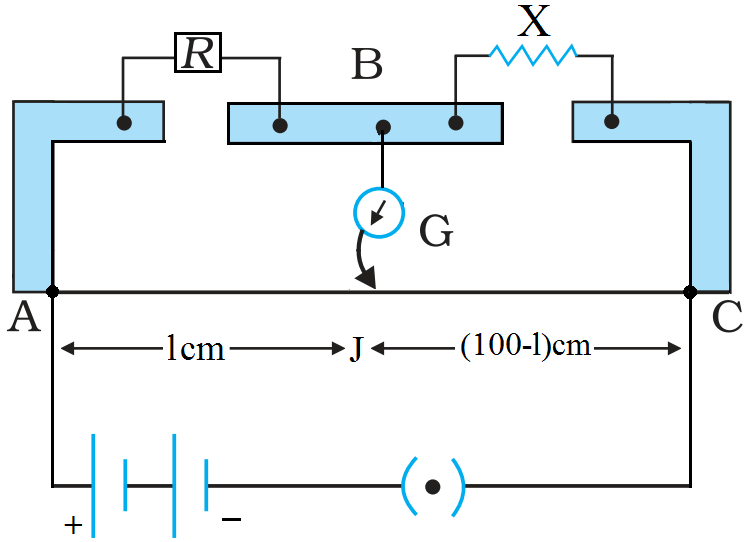
- 7A resistance $\text{R}=4\Omega$ is connected to one of the gaps in a meter bridge, which uses a wire of length 1m. An unknown resistance $\text{x}>4\Omega$ is connected in the other gap as shown in the figure. The balance point is noticed at ‘l’ cm from the positive end of the battery. On interchanging R and X, it is found that the balance point further shifts by 20cm (away from the end A). Neglecting the end correction calculate the value of unknown resistance ‘X’ used.View Solution
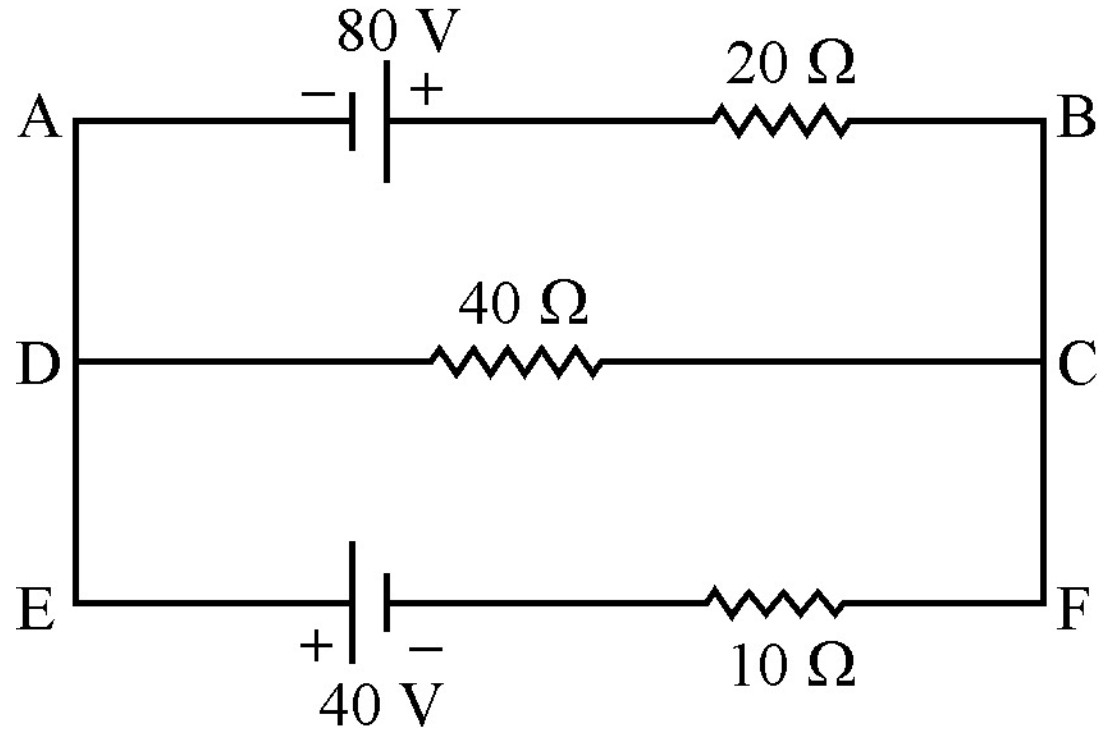
- 8Using Kirchhoff’s rules, calculate the current through the $40\Omega$ and $20\Omega$ resistors in the following circuit:View Solution
- 9View SolutionTwo electric bulbs have the following specifications.
- 100W at 220V.
- 1000W at 220V.
- 10View SolutionTwo heated wires of the same dimensions are first connected in series and then in parallel to a source of supply. What will be the ratio of heat produced in the two cases?