Question
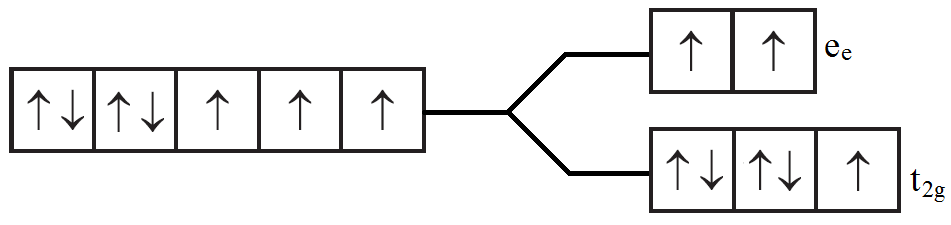
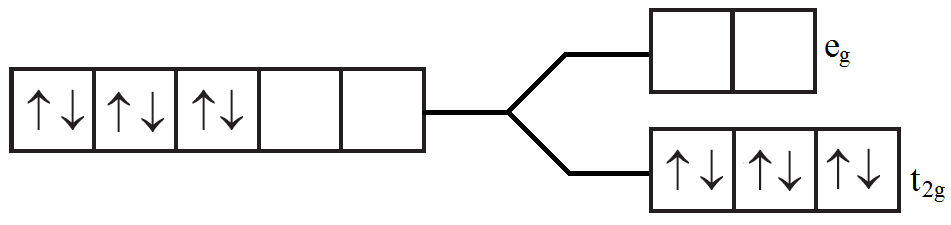
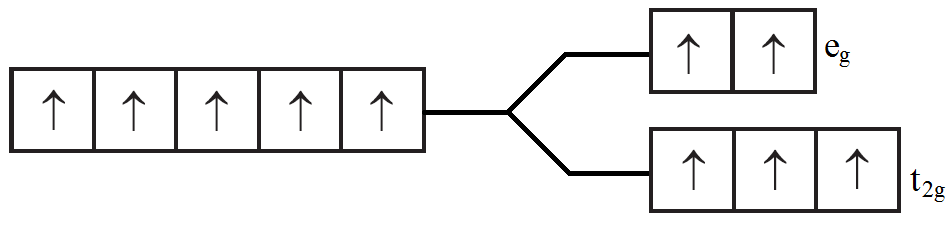
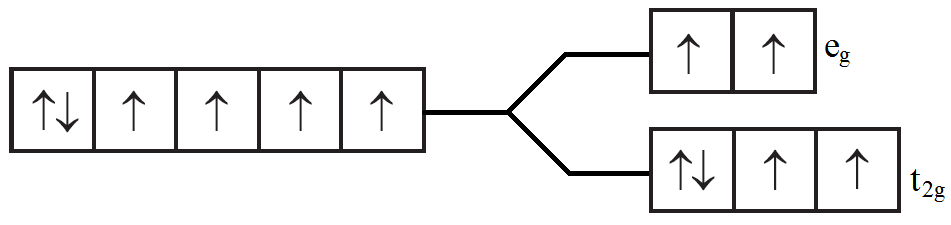
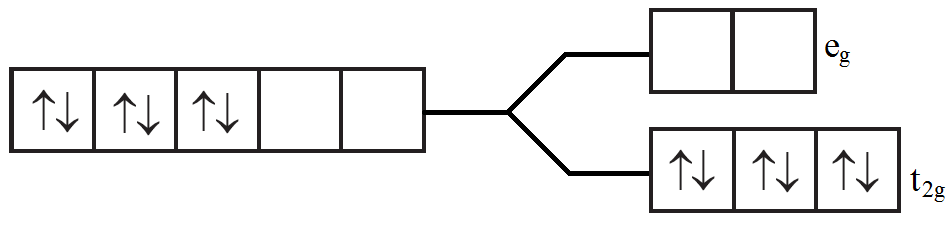
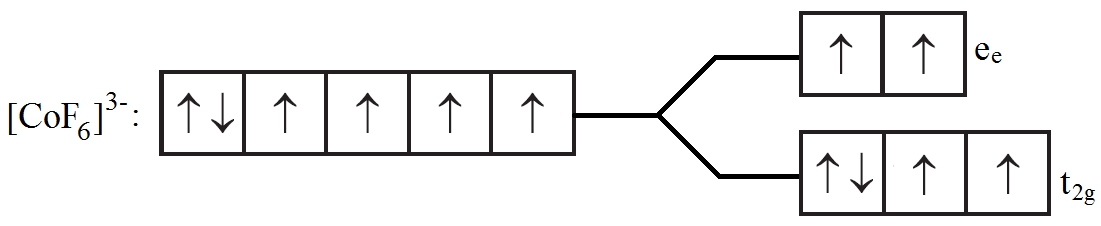
Using crystal field theory, draw energy level diagram, write electronic configuration of the central metal atom/ion and determine the magnetic moment value in the following:
  1. $[\text{CoF}_6]^{3-}, [\text{Co(H}_2\text{O})_6]^{2+}, [\text{Co(CN)}_6]^{3-}$
  2. $[\text{FeF}_6]^{3-}, [\text{Fe(H}_2\text{O})_6]^{2+}, [\text{Fe(CN})_6]^{4-}$
Need a full question paper?

Generate a complete, print-ready paper with questions like this in minutes — across 16+ boards, with answer keys.

Start Generating Free

Similar questions

Decinormal solution of NaCl developed an osmotic pressure of 4.6 atm at 300 K. Calculate the degree of dissociation.
For the decomposition of azoisopropane to hexane and nitrogen at 543 K , the following data is obtained :
$t( sec )$$P$ (mm of Hg )
035.0
36054.0
72063.0

Calculate the rate constant.
Explain relationship between $E _{\text {cell }}^{\circ}$ and equilibrium constant with the help of Nernst equation.
Give the oxidation state, d-orbital occupation and coordination number of the central metal ion in the following complexes:
i. $K_3\left[ Co \left( C _2 O _4\right)_3\right]$
ii. cis- $\left[ Cr (e n)_2 Cl _2\right] Cl$
iii. $\left( NH _4\right)_2\left[ CoF _4\right]$
iv. $\left[ Mn \left( H _2 O \right)_6\right] SO _4$
Attempt any five of the following:
(a) Define native state in reference to proteins.
(b) Define the following terms:
    a. Polysaccharides
    b. Nucleotides
(c) Deficiency of which vitamin causes scurvy?
(d) What happens when D-glucose is treated with the following? Give equations to support your answer.
    a. HI
    b. HNO3
(e) Name the disaccharide which on hydrolysis gives glucose and galactose.
(f) Write the products obtained after hydrolysis of lactose.
(g) Give the reaction of glucose with hydrogen cyanide. Presence of which group is confirmed by this reaction?
What are the similarities between lanthanoids and actinoids?
Describe the reactions of carboxylic acids in which C-OH bond is broken.
Match the items of Column I and Column II.
 
Column I
 
Column II
i.
Lechlanche cell
a.
Cell reaction 2H2 + O2 ⎯→ 2H2O
ii.
Ni–Cd cell
b.
Does not involve any ion in solution and is used in hearing aids.
iii.
Fuel cell
c.
Rechargeable.
iv.
Mercury cell
d.
Reaction at anode, Zn ⎯→ Zn2+ + 2e-
 
 
e.
Converts energy of combustion into electrical energy.
  1. Account for the following:
  1. Mn2O7 is acidic whereas MnO is basic.
  2. Though copper has completely filled d-orbital (d10) yet it is considered as a transition metal.
  3. Actinoids show wide range of oxidation states.
  1. Write the preparation of potassium permanganate from pyrolusite ore (MnO2).
Describe the physical properties of amines.