Question
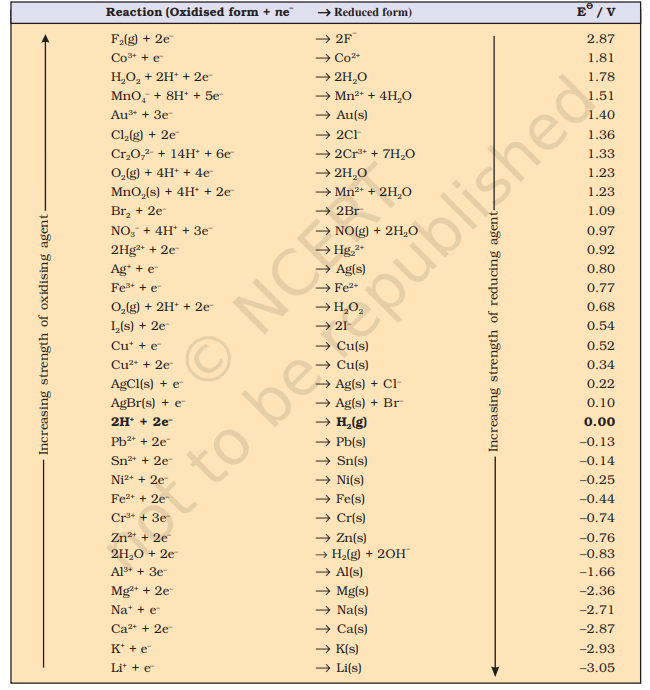
Using the standard electrode potentials given in the Table, predict if the reaction between the following is feasible:
$\mathrm{Fe}^{3+}(\mathrm{aq})$ and $\mathrm{I}^{-}(\mathrm{aq})$.

Answer

The possible reaction between $\mathrm{Fe}^{3+}(\mathrm{aq})$ + $\mathrm{I}^{-}(\mathrm{aq})$. is given by, $2\text{Fe}^{3+}_{(\text{aq})}+2\text{I}^-_{(\text{aq})}\rightarrow2\text{Fe}^{2+}_{(\text{aq})}+\text{I}_{2(\text{s})}$$\text{Oxidation half equation:}\ \ \ \ \ \ \ \ \ \ 2\text{I}^-_{(\text{aq})}\xrightarrow{\ \ \ \ \ \ \ }\text{I}_{2(\text{s})}+2\text{e}^-;\ \ \text{E}^\circ=-0.54\text{V}\\\text{Reduction half equation:}\ [\text{Fe}^{3+}_{(\text{aq})}+\text{e}^-\xrightarrow{\ \ \ \ \ \ }\text{Fe}^{2+}_{(\text{aq})}]\times2;\ \ \text{E}^\circ=+0.77\text{V}\\\overline{\ \ \ \ \ \ \ \ \ \ \ \ \ \ \ \ \ \ \ \ \ \ \ \ \ \ \ \ \ \ \ \ \ \ \ \ \ \ \ \ \ \ \ \ \ \ \ \ \ \ \ \ \ \ \ \ \ \ \ \ \ \ \ \ \ \ \ \ \ \ \ \ \ \ \ \ \ \ \ \ \ \ \ \ \ \ \ \ \ \ \ \ \ \ \ \ \ \ \ \ \ \ \ \ \ \ \ \ \ \ \ \ \ \ \ \ \ \ }\\ \ \ \ \ \ \ \ \ \ \ \ \ \ \ \ \ \ \ \ \ \ \ \ \ \ \ \ \ \ \ \ \ \ \ \ \ \ \ 2\text{Fe}^{3+}_{(\text{aq})}+2\text{I}^-_{(\text{aq})}\xrightarrow{\ \ \ \ \ \ \ \ }2\text{Fe}^{2+}_{(\text{aq})}+\text{I}_{2(\text{s})};\ \ \text{E}^\circ=+0.23\text{V}$
E° for the overall reaction is positive. Thus, the reaction between $\text{Fe}^{3+}_{(\text{aq})}$ and $\text{I}^-_{(\text{aq})}$ is feasible.

Need a full question paper?

Generate a complete, print-ready paper with questions like this in minutes — across 16+ boards, with answer keys.

Start Generating Free

Similar questions

$\begin{matrix}\text{A }\rightleftharpoons\text{ B }&\text{K}_1=1&\text{B }\rightleftharpoons\text{ C}&\text{K}_2=2\\\text{C }\rightleftharpoons\text{ D}&\text{K}_3=3&\text{D }\rightleftharpoons\text{ E}&\text{K}_4=4\end{matrix}$
What is value of K for $\text{A }\rightleftharpoons\text{ E}?$
Predict the formulas of the stable binary compounds that would be formed by the combination of the following pairs of elements.
  1. Lithium and oxygen.
  2. Magnesium and nitrogen.
  3. Aluminium and iodine.
  4. Silicon and oxygen.
  5. Phosphorus and fluorine.
  6. Element 71 and fluorine.
The dipole moment of a molecule AB is 0.54D and the bond distance is $1.41\mathring{\text{A}}.$ Calculate the fractional change $\delta$ on A and B atom in AB molecule (electronic charge, $\mathrm{e}=4.8 \times 10^{-10} \mathrm{esu}$.)
What happens when :
(i) ethylene dibromide is heated with zinc.
(ii) solution of sodium succinate is electrolysed.
(iii) ethylene dichloride is heated with zinc.
Calculate the wavelength of the spectral line obtained in the spectrum of $Li^{2+}$ ion when the transition takes place between two levels whose sum is 4 and the difference is 2.
The unpaired electrons in Al and Si are present in 3p orbital. Which electrons will experience more effective nuclear charge from the nucleus?
What will be the value of $\Delta\text{G}\text{ and }\Delta\text{G}^\circ$ for the reaction, $\text{A}+\text{B}\rightleftharpoons\text{C}+\text{D}\text{ at }27^\circ\text{C}$ for which $\text{K}=10^2$. Predict the extent of reaction.
A sample of HI(g) is placed in flask at a pressure of 0.2 atm. At equilibrium the
partial pressure of HI(g) is 0.04 atm.
What is $\text{K}_\text{p}$ for the given equilibrium?
$\text{2HI (g)}\rightleftharpoons\text{H}_2\text{ (g) + I}_2\text{ (g)}$
Can an element with atomic number 126, if discovered, be accommodated in the present Un set up of the long form of periodic table?
What is the importance of heavy water?