Question
Verify the conservation of mechanical energy by obtaining expressions for the potential energy, kinetic energy and total energy of a particle in simple harmonic motion.

Answer

SELF

Need a full question paper?

Generate a complete, print-ready paper with questions like this in minutes — across 16+ boards, with answer keys.
Start Generating Free

Similar questions

A rectangular box lies on a rough inclined surface. The coefficient of friction between the surface and the box is $\mu$. Let the mass of the box be m.
  1. At what angle of inclination $\theta$ of the plane to the horizontal will the box just start to slide down the plane?
  2. What is the force acting on the box down the plane, if the angle of inclination of the plane is increased to a $\theta>$?
  3. What is the force needed to be applied upwards along the plane to make the box either remain stationary or just move up with uniform speed?
  4. What is the force needed to be applied upwards along the plane to make the box move up the plane with acceleration a?
A $16cm^3$ volume of water flows per second through a capillary tube of radius r сm and of length 1cm when connected to a pressure head of h cm of water. If a tube of the same length and radius $\frac{\text{r}}{2}$ is connected to the same pressure head, find the mass of water flowing per minute through the tube.
One end of a long string of linear mass density $8.0 \times 10^{–3}kg m^{–1}$ is connected to an electrically driven tuning fork of frequency $256Hz$. The other end passes over a pulley and is tied to a pan containing a mass of $90kg$. The pulley end absorbs all the incoming energy so that reflected waves at this end have negligible amplitude. At $t = 0$, the left end (fork end) of the string $x = 0$ has zero transverse displacement $(y = 0)$ and is moving along positive y-direction. The amplitude of the wave is $5.0cm$. Write down the transverse displacement y as function of x and t that describes the wave on the string.
Find the change in the internal energy of 2kg of water as it is heated from $0^\circ C$ to $4^\circ C$. The specific heat capacity of water is $4200Jkg^{-1} K^{-1}$ and its densities at $0^\circ C$ and $4^\circ C$ are $999.9kgm^{-3}$ and $1000kgm^{-3}$ respectively. Atmospheric pressure = $10^{-6}Pa$.
The volume of a glass vessel is $1000 cc$ at $20^{\circ} \mathrm{C}$. What volume of mercury should be poured into it at this temperature so that the volume of the remaining space does not change with temperature? Coefficients of cubical expansion of mercury and glass are $1.8 \times 10^{-4}{ }^{\circ} \mathrm{C}$ and $9.0 \times 10^{-6}{ }^{\circ} \mathrm{C}^{-1}$ respectively.
One day in the morning, Ramesh filled up 1/ 3 bucket of hot water from geyser, to take bath. Remaining 2/ 3 was to be filled by cold water (at room temperature) to bring mixture to a comfortable temperature. Suddenly Ramesh had to attend to something which would take some times, say 5-10 minutes before he could take bath. Now he had two options:
  1. Fill the remaining bucket completely by cold water and then attend to the work.
  2. First attend to the work and fill the remaining bucket just before taking bath. Which option do you think would have kept water warmer? Explain.
What is called degree of freedom? How many types are there? Explain to them.
Draw velocity$-$time graph of uniformly accelerated motion in one dimension. From the velocity time graph of uniform accelerated motion, deduce the equations of motion in distance and time.
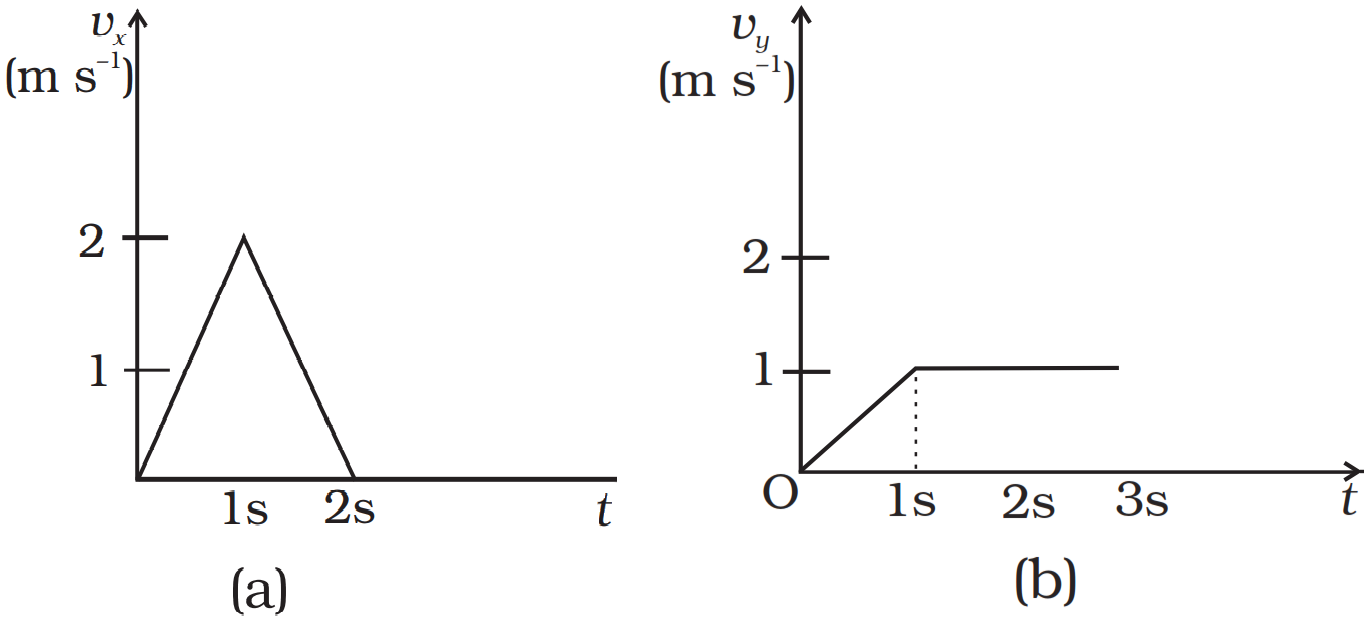
$(v_{x,} t),$ and $(v_{y,} t)$ diagrams for a body of unit mass. Find the force as a function of time.
Two trains A and B of length $400m$ each are moving on two parallel tracks with a uniform speed of $72km h^{–1}$ in the same direction, with A ahead of B. The driver of B decides to overtake A and accelerates by $1m s^{–2}$. If after $50s$, the guard of B just brushes past the driver of A, what was the original distance between them?