Question
Wavefront is a locus of points which vibratic in same phase. A ray of light is perpendicular to the wavefront. According to Huygens principle, each point of the wavefront is the source of a secondary disturbance and the wavelets connecting from these points spread out in all directions with the speed of wave.
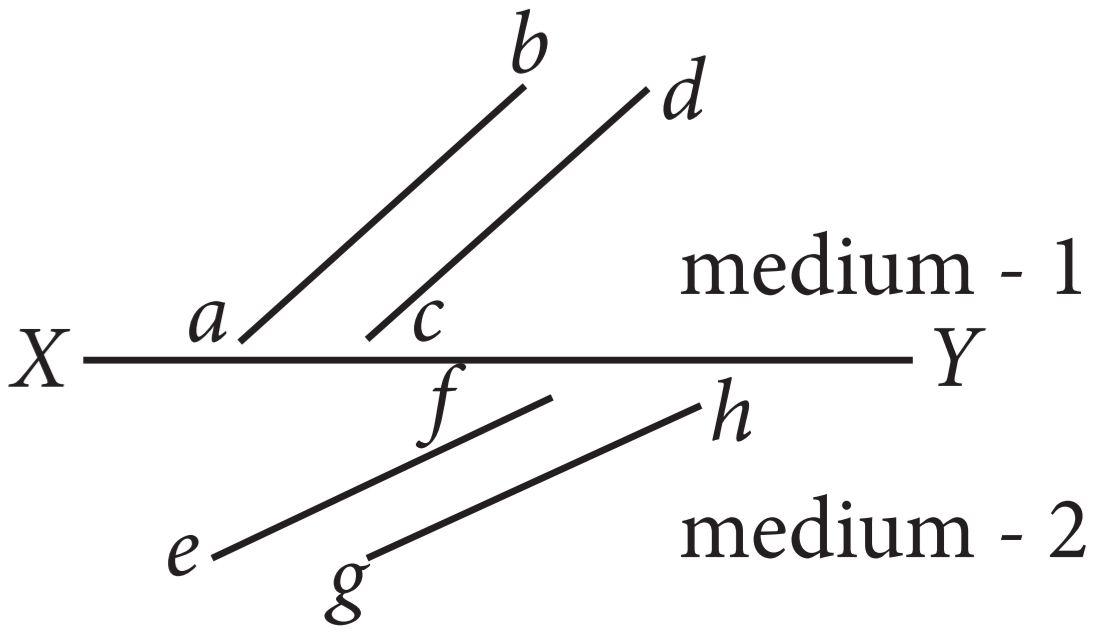
The figure shows a surface XY separating two transparent media, medium-I and medium-2. The lines ab and cd represent wavefronts of a light wave travelling in medium- 1 and incident on XY. The lines ef and gh represent wavefronts of the light wave in medium-2 after refraction.
  1. Light travels as a:
  1. Parallel beam in each medium.
  2. Convergent beam in each medium.
  3. Divergent beam in each medium.
  4. Divergent beam in one medium and convergent beam in the other medium.
  1. The phases of the light wave at c, d, e and f are $\phi_\text{c},\phi_\text{d},\phi_\text{e}$ and $\phi_\text{f}$ respectively. It is given that $\phi_\text{c}\not=\phi_\text{f}$
  1. $\phi_\text{c}$ cannot be equal $\phi_\text{d}$
  2. $\phi_\text{d}$ cannot be equal $\phi_\text{e}$
  3. $(\phi_\text{d}-\phi_\text{f})$ is equal to $(\phi_\text{c}-\phi_\text{e})$
  4. $(\phi_\text{d}-\phi_\text{c})$ is not equal to $(\phi_\text{f}-\phi_\text{e})$
  1. Wavefront is the locus of all points, where the particles of the medium vibrate with the same.
  1. Phase
  2. Amplitude
  3. Frequency
  4. Period
  1. A point source that emits waves uniformly in all directions, produces wavefronts that are:
  1. Spherical
  2. Elliptical
  3. Cylindrical
  4. Planar
  1. What are the types of wavefronts?
  1. Spherical
  2. Cylindrical
  3. Plane
  4. All of these.

Answer

  1. (a) Parallel beam in each medium.

Explanation:

Since the path difference between two waveform is equal, light traves as parallel beam in each medium.

  1. (c) $(\phi_\text{d}-\phi_\text{f})$ is equal to $(\phi_\text{c}-\phi_\text{e})$

Explanation:

Since all points on the wavefront are in the same phase,

$\phi_\text{d}=\phi_\text{c}$ and $\phi_\text{f}=\phi_\text{e}$

$\therefore\phi_\text{d}-\phi_\text{f}=\phi_\text{c}-\phi_\text{e}$

  1. (a) Phase

Explanation:

Wavefront is the locus of all points, where the particles of the medium vibrate with the same phase.

  1. (a) Spherical
  1. (d) All of these.

Need a full question paper?

Generate a complete, print-ready paper with questions like this in minutes — across 16+ boards, with answer keys.

Start Generating Free

Similar questions

A player hits a baseball at some angle. The ball goes high up in space. The player runs and catches the ball before it hits the ground. Which of the two (the player or the ball) has greater displacement?
There are materials which absorb photons of shorter wavelength and emit photons of longer wavelength. Can there be stable substances which absorb photons of larger wavelength and emit light of shorter wavelength.
A metallic loop is placed in a nonuniform magnetic field. Will an emf be induced in the loop?
Derive the formula for electric potential due to an electric dipole at a point having position vector $\bar{r}$ with respect to the mid-point of the dipole and discuss the electric potential on
(a) equator
(b) axis
A child has near point at 10cm. What is the maximum angular magnification the child can have with a convex lens of focal length 10cm?
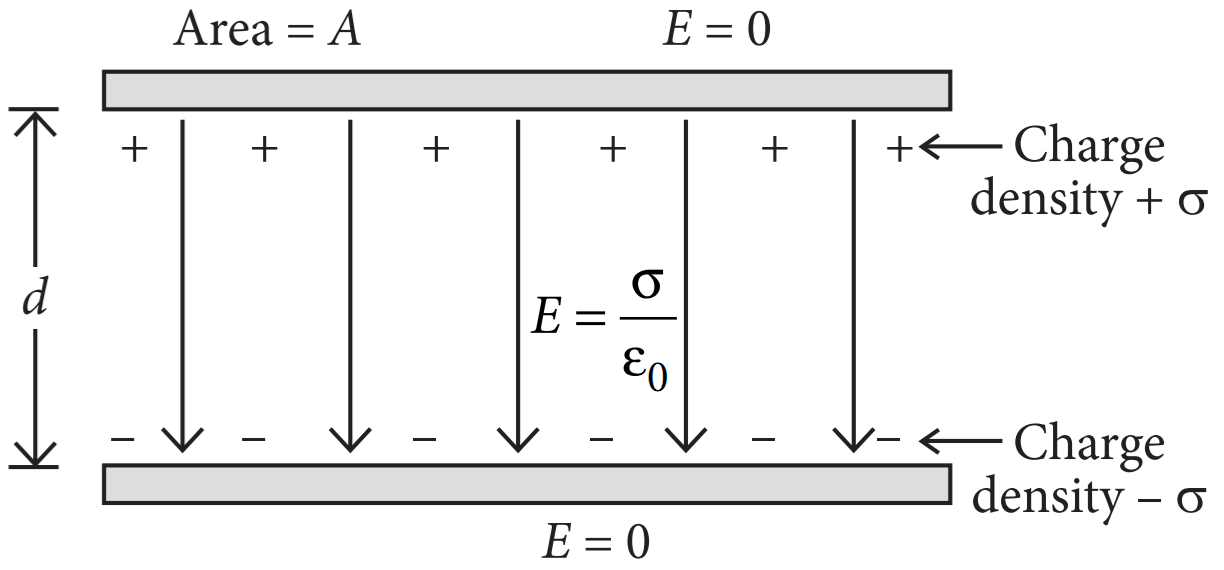
The simplest and the most widely used capacitor is the parallel plate capacitor. It consists of two large plane parallel conducting plates, separated by a small distance.

In the outer regions above the upper plate and below the lower plate, the electric fields due to the two charged plates cancel out. The net field is zero.

In the inner region between the two capacitor plates, the electric fields due to the two charged plates add up. The net field is $\frac{\sigma}{\in_0}.$

For a uniform electric field, potential difference between the plates = Electric field x distance between the plates. Capacitance of the parallel plate capacitor is the charge required to supplied to either of the conductors of the capacitor so as to increase the potential difference between then by unit amount.

  1. A parallel plate capacitor is charged and then isolated. The effect of increasing the plate separation on charge, potential and capacitance respectively are:
  1. Increases, decreases, decreases.
  2. Constant, increases, decreases.
  3. Constant, decreases, decreases.
  4. Constant, decreases, increases.
  1. In a parallel plate capacitor, the capacity increases if:
  1. Area of the plate is decreases.
  2. Distance between the plates increases.
  3. Area of the plate is increases.
  4. Dielectric constant decreases.
  1. A parallel plate capacitor has two square plates with equal and opposite charges. The surface charge densities on the plates are $+\sigma$ and $-\sigma$ respectively. In the region between the plates the magnitude of the electric field is:
  1. $\frac{\sigma}{2\in_0}$

  2. $\frac{\sigma}{\in_0}$

  3. 0
  4. None of these.
  1. If a parallel plate air capacitor consists of two circular plates of diameter 8cm. At what distance should the plates be held so as to have the same capacitance as that of sphere of diameter 20cm?
  1. 9mm
  2. 4mm
  3. 8mm
  4. 2mm
  1. If a charge of + 2.0 × 10-8C is placed on the positive plate and a charge of - 1.0 × 10-8C on the negative plate of a parallel plate capacitor of capacitance $1.2\times10^{-3}\mu\text{F},$ then the potential difference developed between the plates is:
  1. 6.25V
  2. 3.0V
  3. 12.5V
  4. 25V
When the electron orbiting in hydrogen atom in its ground state moves to the third excited state, show how the de Broglie wavelength associated with it would be affected.
ln Young's double slit experiment, the width of the central bright fringe is equal to the distance between the first dark fringes on the two sides of the central bright fringe.
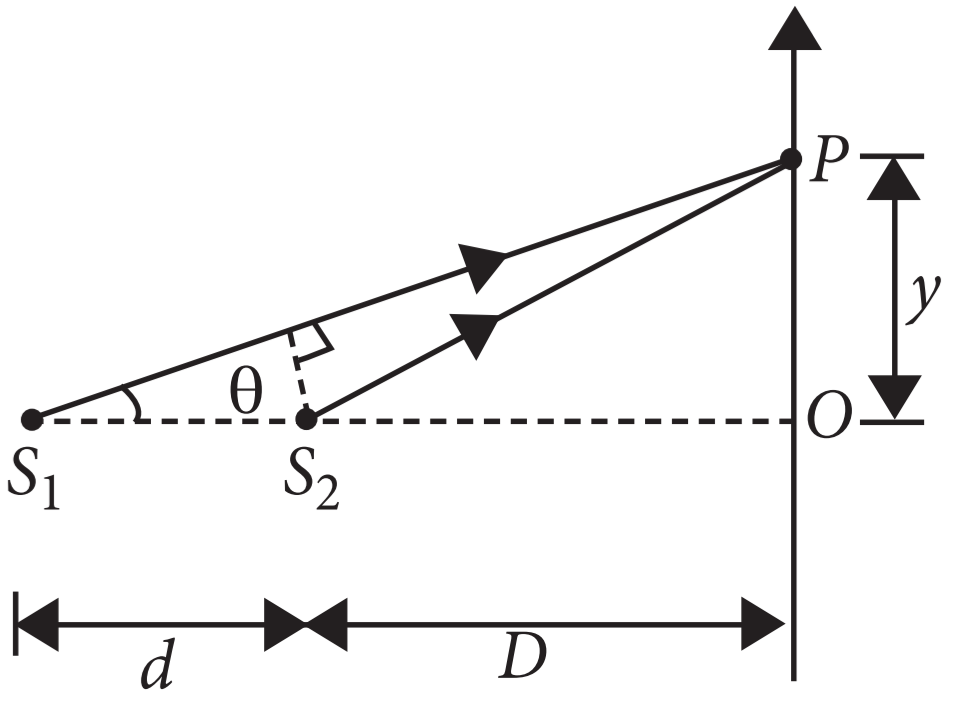
ln given figure below a screen is placed normal to the tine joining the two point coherent source S1 and S2. The interference pattern consists of concentric circles.

  1. The optical path difference at P is:
  1. $\text{d}\Big[1+\frac{\text{y}^2}{2\text{D}}\Big]$
  2. $\text{d}\Big[1+\frac{2\text{D}}{\text{y}^2}\Big]$
  3. $\text{d}\Big[1-\frac{\text{y}^2}{2\text{D}^2}\Big]$
  4. $\text{d}\Big[2\text{D}-\frac{1}{\text{y}^2}\Big]$
  1. Find the radius of the nth bright fringe.
  1. $\text{D}\sqrt{1\Big(1-\frac{\text{n}\lambda}{\text{d}}\Big)}$
  2. $\text{D}\sqrt{2\Big(1-\frac{\text{n}\lambda}{\text{d}}\Big)}$
  3. $2\text{D}\sqrt{2\Big(1-\frac{\text{n}\lambda}{\text{d}}\Big)}$
  4. $\text{D}\sqrt{2\Big(1-\frac{\text{n}\lambda}{2\text{d}}\Big)}$
  1. If $\text{d}=0.5\text{mm}.\lambda=5000\mathring{\text{A}}$ and D = 100cm, find the value of n for the closest second bright fringe.
  1. 888
  2. 830
  3. 914
  4. 998
  1. The coherence of two light sources means that the light waves emitted have.
  1. Same frequency.
  2. Same intensity.
  3. Constant phase difference.
  4. Same velocity.
  1. The phenomenon of interference is shown by:
  1. Longitudinal mechanical waves only.
  2. Transverse mechanical waves only.
  3. Electromagnetic waves only.
  4. All of these.
An astronomical telescope is an optical instrument which is used for observing distinct images of heavenly bodies libe stars, planets etc. It consists of two lenses. In normal adjustment of telescope, the final image is formed at infinity. Magnifying power of an astronomical telescope in normal adjustment is defined as the ratio of the angle subtended at the eye by the angle subtended at the eye by the final image to the angle subtended at the eye, by the object directly, when the final image and the object both lie at infinite distance from the eye. It is given by, $\text{m}=\frac{\text{f}_0}{\text{f}_\text{g}}.$ To increase magnifying power of an astronomical telescope in normal adjustment, focal length of objective lens should be large and focal length of eye lens should be small.
  1. An astronomical telescope of magnifying power 7 consists of the two thin lenses 40cm apart, in normal adjustment. The focal lengths of the lenses are
  1. 5cm, 35cm
  2. 7cm, 35cm
  3. 17cm, 35cm
  4. 5cm, 30cm
  1. An astronomical telescope has a magnifying power of 10. In normal adjustment, distance between the objective and eye piece is 22cm. The focal length of objective lens is:
  1. 25cm
  2. 10cm
  3. 15cm
  4. 20cm
  1. In astronomical telescope compare to eye piece, objective lens has:
  1. Negative focal length.
  2. Zero focal length.
  3. Small focal length.
  4. Large focal length.
  1. To see stars, use:
  1. Simple microscope.
  2. Compound microscope.
  3. Endoscope.
  4. Astronomical telescope.
  1. For large magnifying power of astronomical telescope.
  1. f0 << fe
  2. f0 << fe
  3. f0 << fe
  4. None of these.
The household supply of electricity is at 220V (rms value) and 50Hz. Find the peak voltage and the least possible time in which the voltage can change from the rms value to zero.