Question
What are carbohydrates?
Generate a complete, print-ready paper with questions like this in minutes — across 16+ boards, with answer keys.
| Column I (Function) | Column II (Part of excretory system) | ||
| i. | Ultrafiltration | a. | Henle’s loop |
| ii. | Concentration of urine | b. | Ureter |
| iii. | Transport of urine | c. | Urinary bladder |
| iv. | Storage of urine | d. | Malpighian corpuscle |
| v. | e. | Proximal convoluted tubule |
| Column I | Column II |
| 1. Prophase | (a) Chromatids moving to opposite poles. |
| 2. Metaphase | (b) Nuclear membrane starts disappearing. |
| 3. Anaphase | (c) Chromosomes at equatorial plane of the cell. |
| 4. Telophase | (d) Nuclear membrane reappears |
| Column I (Organism) | Column II (Characteristic Feature) |
| 1. Euplectella | (a) Exoskeleton formed of placoid scales |
| 2. Periplaneta | (b) Presence of mantle |
| 3. Sepia | (c) Water canal system |
| 4. Scoliodon | (d) Jointed appendages |
| 5. Clarias | (e) Exoskeleton formed of cycloid scales |
| i. | Descending limb of Henle’s loop | a. | Reabsorption of salts only |
| ii. | Proximal convoluted tubule | b. | Reabsorption of water only |
| iii. | Ascending limb of Henle’s loop | c. | Conditional reabsorption of sodium ions and water |
| iv. | Distal convoluted tubule | d. | Reabsorption of ions, water and organic nutrients |
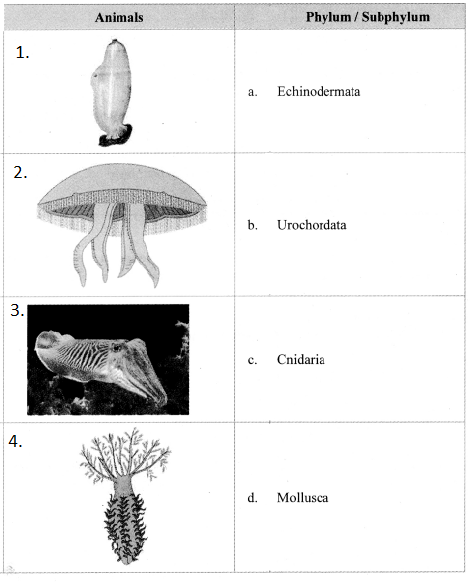
| Column I | Column II |
| 1. Protoxylem | (a) Xylem with larger vessels |
| 2. Endarch Xylem | (b) Protoxylem arranged towards pith |
| 3. Metaxylem | (c) Metaxylem arranged towards pith |
| 4. Exarch xylem | (d) First formed xylem vessels |
| Column I | Column II | |
| i. | Cardiac Sphincter Pyloric | a. Regulates the flow of food from stomach to small intestine. |
| ii. | sphincter | b. Controls the passage of food from oesophagus into the stomach. |
| iii. | Gastro-oesophageal sphincter | c. Prevents back flow of food from stomach to oesophagus. |
| ‘A’ Group | ‘B’ Group |
| 1. Muscle | (a) Perichondrium |
| 2. Bone | (b) Sarcolemma |
| 3. Nerve cell | (c) Periosteum |
| 4. Cartilage | (d) Neurilemma |
| Column $I$ | Column $II$ |
| $1. \ G:$ Phase | $(a) \ 1-3$ Hours |
| $2. \ G_i$ Phase | $(b) \ 2-5$ Hours |
| $3. \ M$ Phase | $(c) \ 6-8$ Hours |
| $4. \ S$ Phase | $(d) \ 8$ Hours |