Pond Ecosystem : The ecosystem is a basic unit in ecology, formed by the interaction of plants, animals and microorganisms forming biotic factors with their physical environment or the abiotic factors.
A pond ecosystem refers to the freshwater ecosystem where there are communities of organisms that are dependent on each other and with the prevailing water environment for their nutrients and survival. Usually, ponds are shallow (hardly 12-15 feet) water bodies in which sunlight can reach to its bottom, permitting the growth of the plants that grow there. On the basis of water depth and types of vegetation and animals there may be three zones in a lake or pond. The different zones are as follows :
(i) Littoral, (ii) Limnetic, (iii) Pro-fundal.
 (i) Littoral Zone :
 It is the shallow water region which is usually occupied by rooted plants.
(ii) Limnetic Zone : Ranges from the shallow to the depth of effective light penetration and associated organisms are small crustaceans, rotifers, insects and their larvae and algae.
(iii) Pro-fundal Zone : It is the deep-water parts where there is no effective light penetration. The associated organisms are mussels, crab, worms etc. The organisms inhabiting this freshwater ecosystem include algae, fungi, microorganisms, plants and fish. These organisms can be further classified as producers, consumers and decomposers, based on their mode of obtaining nutrition. The energy in an ecosystem flows from the producers to the consumers. Decomposers, on
the other hand, get nutrients from the dead organisms by decomposing them.
Two main components of pond ecosystems are as follows :
(i) Biotic component
(ii) Abiotic component
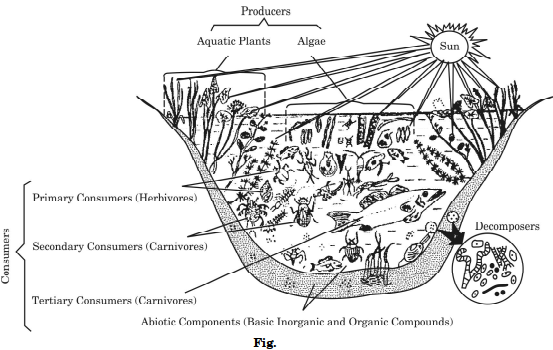
(i) Biotic component : It includes producers, consumers, decomposers and transformers, i.e., acquatic organism are included.
Producers : The main producers in pond or lake ecosystem are algae and other aquatic plants, such as Azolla, Hydrilla, Potamogeton, Pistia, Wolffia, Lemna, Eichhornia, Nymphaea, Jussiaea, etc. These are either floating or suspended or rooted at the bottom. The green plants convert the radiant energy into chemical energy through photosynthesis. The chemical energy stored in the form of food is utilized by all the organisms. Oxygen evolved by producers in photosynthesis is utilized by all the living organisms in respiration.
Consumers : In a pond ecosystem, the primary consumers are tadpole larvae of frogs, fishes and other aquatic animals which consume green plants and algae as their food. These herbivorous aquatic animals are the food of secondary consumers. Frogs, big fishes, water snakes, crabs are secondary consumers. In the pond, besides the secondary consumers, there are consumers of highest order, such as water-birds, turtles, etc.
Decomposers and Transformers : When aquatic plants and animals die, a large number of bacteria and fungi attack their dead bodies and convert the complex organic substances into simpler inorganic compounds and elements. These microorganisms are called decomposers chemical elements liberated by decomposers are again utilized by green plants in their nutrition.
(ii) Abiotic Components : Abiotic factors are non-living factors that can have an impact on the ecosystem. The main factors of ponds include water quality, temperature, light, soil and seasonal change. Water is an important abiotic factor. The quality of water is crucial for living organisms in the pond. pH is also taken into consideration because too low or too high of acidity in the water can clog a fish’s gills and reproduction will be more challenging. The lay of the land and the soil is of importance as well. The soil needs to contain enough moisture to keep the surrounding plants alive. If the soil or ground is dry, it is less likely to sustain a live or growing plant in comparison to moist, fertile soil that will help the plant stay alive. Light is also an abiotic factor in this ecosystem. The plants need light for photosynthesis so they can produce oxygen not only above the water but below as well to sustain healthy oxygen levels for aquatic organisms. Fish also need light in the form of heat from the sun to keep the water at a regular temperature. The change of seasons has an impact on the pond. Spring and winter are the seasons that keep the ecosystem healthy and the risk of negative effects on the organisms that inhabit the environment very low. In the summer, the temperature of the water can become too warm and again hold less oxygen for the aquatic organisms. Too much sunlight can impact the pond because the algae are growing too fast therefore crowding space for the fish.