Question
What does a soda-acid type fire extinguisher contain? How does it work?
Explain the working of a soda- acid fire extinguisher with the help of a labelled diagram.
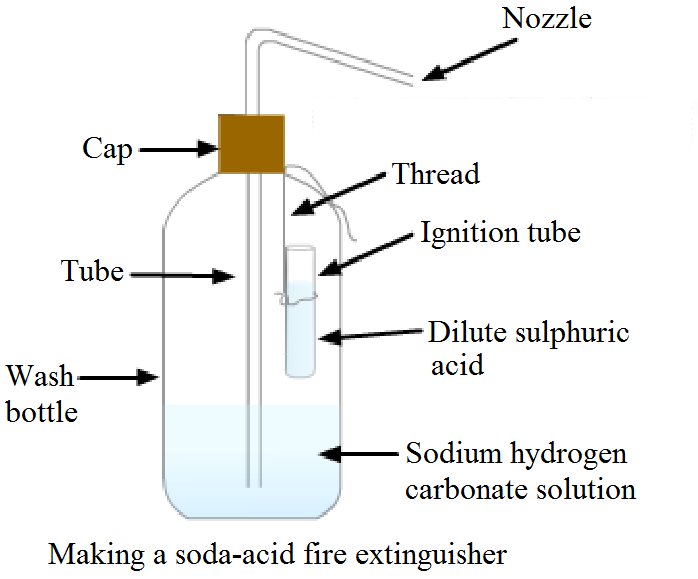
Answer

Working: A soda-acid type fire extinguisher contains a solution of sodium hydrogencarbonate and sulphuric acid in separate containers in separate containers inside them. When the knob of the fire extinguisher is pressed, then sulphuric acid mixes with sodium hydrogencarbonate solution to produce carbon dioxide gas which forms a blanket around the burning substance and cuts off the supply of air to burning substance; this stops the process of burning and fire gets extinguished.

Need a full question paper?

Generate a complete, print-ready paper with questions like this in minutes — across 16+ boards, with answer keys.

Start Generating Free

Similar questions

What are hydrocarbons? Write the name and general formula of,

  1. Saturated hydrocarbons.
  2. Unsaturated hydrocarbons.

Draw the structure of one hydrocarbon of each type. How can an unsaturated hydrocarbon be made saturated?

You are given samples of three metals — sodium, magnesium and copper. Suggest any two activities to arrange them in order of their decreasing reactivities.
An element X (atomic number 17) reacts with an element Y (atomic number 20) to form a divalent halide.
  1. Where in the periodic table are elements X and Y placed?
  2. Classify X and Y as metal (s), non-metal (s) or metalloid (s)
  3. What will be the nature of oxide of element Y? Identify the nature of bonding in the compound formed.
  4. Draw the electron dot structure of the divalent halide.
Compounds such as alcohol and glucose also contain hydrogen but are not categorised as acids. Describe an activity to prove it.
What happens when an iron strip is put into separate beakers containing aqueous solutions of copper sulphate and zinc sulphate? Where is iron placed in the activity series with respect to copper and zinc? Describe the steps involved in the extraction of zinc from its sulphide and carbonate ores. Support your answer with balanced chemical equation for the chemical reactions involved in the process.
Draw the possible isomers of the compound with molecular formula C3H6O and also give their electron dot structures.
State and explain the various methods for preventing or retarding rancidity of food.
In the reaction represented by the following equation:
$\text{CuO(s)}\ +\ \text{H}_2(\text{g})\xrightarrow{\ \ \ \ \ \ \ \ \ \ \ \ }\text{Cu(s)}\ +\ \text{H}_2\text{O(1)}$
  1. Name the substance oxidised.
  2. Name the substance reduced.
  3. Name the oxidising agent.
  4. Name the reducing agent
What are micelles? Why does it form when soap is added to water? Will a micelle be formed in other solvents such as ethanol also? State briefly how the formation of micelles help to clean the clothes having oily spots.
Write the chemical formula of ammonium chloride. Explain why an aqueous solution of ammonium chloride is acidic in nature? Illustrate your answer with the help of a chemical equation.