Question
What happens when hydrogen gas is added to copper oxide?

Answer

If hydrogen gas is passed over heated copper oxide (CuO), the black coating on the surface turns brown as the reverse reaction takes place and copper is obtained. The chemical reaction is as follows:$\text{CuO}+\text{H}_2\rightarrow\text{Cu}+\text{H}_2\text{O}$
The second reaction is called oxidation-reduction reaction or redox reaction. As during this reaction the copper(II) oxide is losing oxygen and is being reduced. The hydrogen is gaining oxygen and is being oxidised.In other words, one reactant gets oxidised while the other gets reduced.

Need a full question paper?

Generate a complete, print-ready paper with questions like this in minutes — across 16+ boards, with answer keys.
Start Generating Free

Similar questions

$i$. How do you classify elements into metals and non $-$ metals on the basis of their electronic configuration ? Choose metal and non $-$ metal out of the following : ${ }_{11}^{23} A,{ }_9^{19} B,{ }_{12}^{24} C,{ }_{15}^{31} D,{ }_{17}^{35} E$
$ii$. What type of bond will be formed if
$a.\ 'A\ '$ combines with $'B\ '$ ?
$b.\ 'A\ ' $ combines with $'E\ '$ ?
$c.\ 'C\ ' $ combines with $'E\ '$ ?
$d.\ 'D\ '$  combines with $'E\ '$ ?
Calculate the power used in the $2Ω$ resistor in each of the following circuits:
  1. A 6V battery in series with $1Ω$ and $2Ω$ resistors.
  2. A 4V battery in parallel with $12Ω$ and $2Ω$ resistors.
2mL of sodium hydroxide solution is added to a few pieces of granulated zinc metal taken in a test tube. When the contents are warmed, a gas evolves which is bubbled through a soap solution before testing. Write the equation of the chemical reaction involved and the test to detect the gas. Name the gas which will be evolved when the same metal reacts with dilute solution of a strong acid.
How are the areas of study – evolution and classification – interlinked?
What are the two causes of speciation between two population?
When an object is placed 20cm from a concave mirror, a real image magnified three times is formed. Find:
  1. The focal length of the mirror.
  2. Where must the object be placed to give a virtual image three times the height of the object?
Explain why, a solution of cane sugar does not conduct electricity but a solution of common salt is a good conductor of electricity.
An object is 2m from a lens which forms an erect image one-fourth (exactly) the size of the object. Determine the focal length of the lens. What type of lens is this?
A 2.0cm tall object is place perpendicular to the principal axis of a concave lens of focal length 15cm. At what distance from the lens, should the object be placed so that it forms an image 10cm from the lens? Also find the nature and the size of image formed.
a. What is the focal length of the lens used in sunglasses?
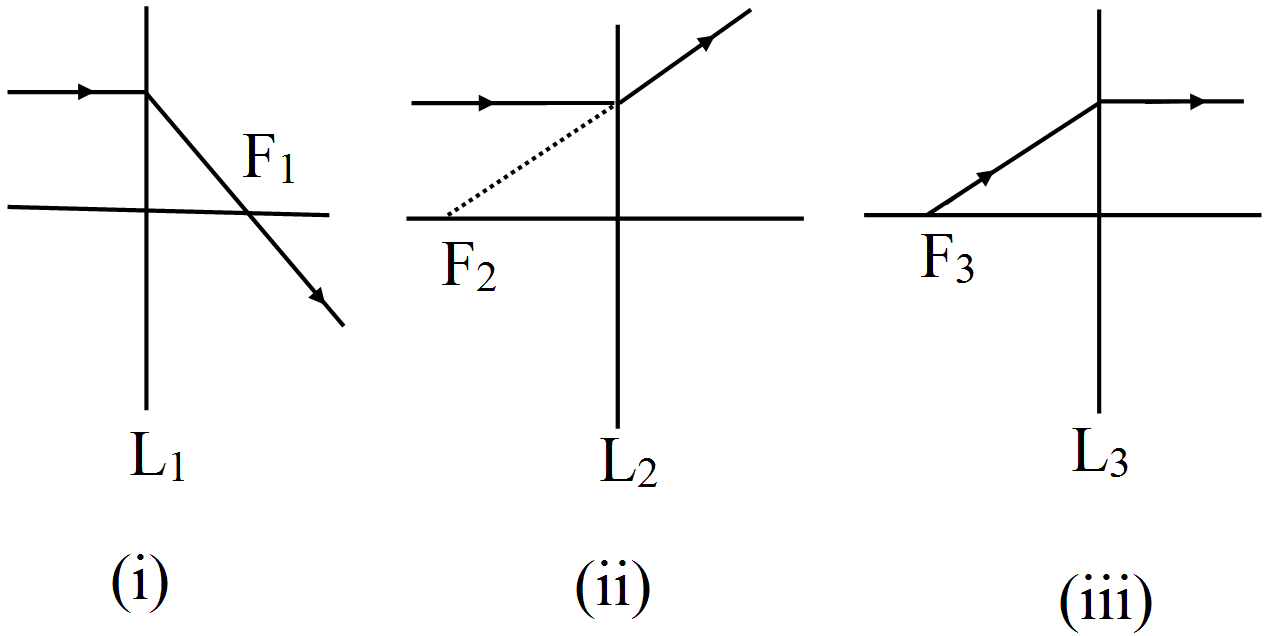
b. The following figures show the path of light rays through three lenses marked $L_1, L_2$, and $L_3$ and their focal points $F_1, F_2$, and $F_3$, respectively. Identify the nature of lenses.