Question
What is an ammeter? How can we convert any galvanometer into an ammeter of given range? Explain.###Describe briefly that how and when any galvanometer is converted into an ammeter?

Answer

SELF

Need a full question paper?

Generate a complete, print-ready paper with questions like this in minutes — across 16+ boards, with answer keys.
Start Generating Free

Similar questions

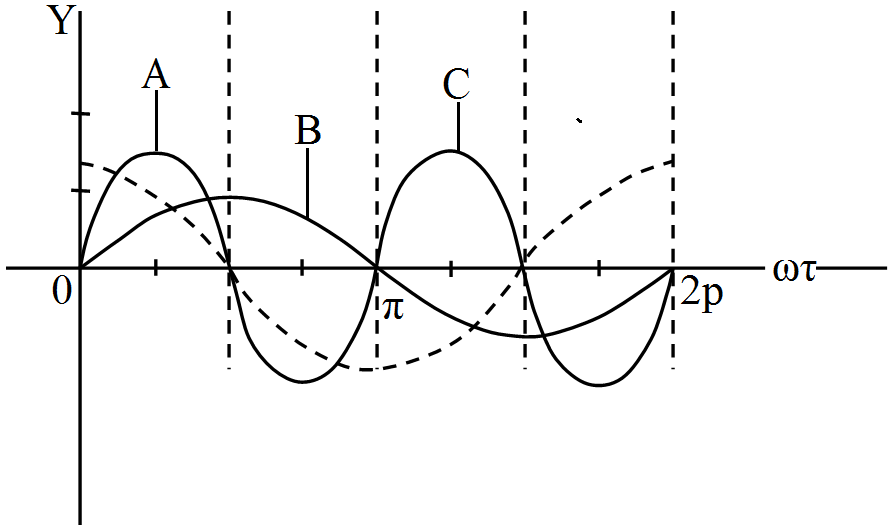
A device ‘X’ is connected to an ac source $\text{V = V}_0\sin\omega\text{t}.$ The variation of voltage, current and power in one cycle is show in the following graph:
  1. Identify the device ‘X’.
  2. Which of the curves, A, B and C represent the voltage, current and the power consumed in the circuit? Justify your answer.
  3. How does its impedance vary with frequency of the ac source? Show graphically.
  4. Obtain an expression for the current in the circuit and its phase relation with ac voltage.
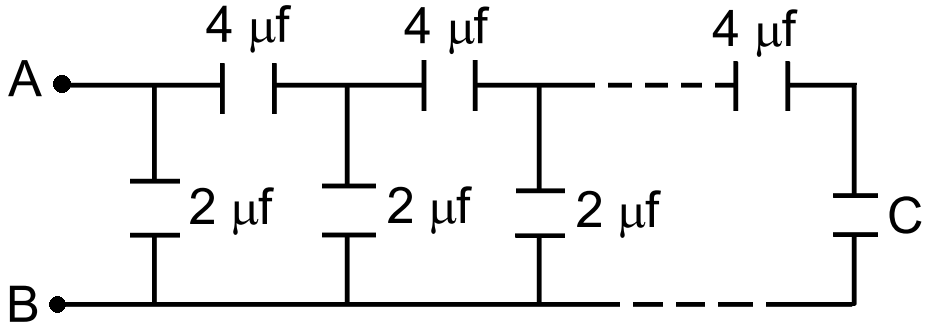
A finite ladder is constructed by connecting several sections of $2\mu\text{F},\ 4\mu\text{F}$ capacitor combinations as shown in figure. It is terminated by a capacitor of capacitance C. What value should be chosen for C, such that the equivalent capacitance of the ladder between the points A and B becomes independent of the number of sections in between?
  1. A point object is placed on the principal axis of a convex spherical surface of radius of curvature R, which separates the two media of refractive indices $n_1$ and $n_2(n_2 > n_1)$. Draw the ray diagram and deduce the relation between the object distance (u), image distance (v) and the radius of curvature (R) for refraction to take place at the convex spherical surface from rarer to denser medium.
  2. A converging lens has a focal length of 20 cm in air. It is made of a material of refractive index 1.6. If it is immersed in a liquid of refractive index 1.3, find its new focal length.
A metre scale made of steel reads accurately at $20^{\circ} \mathrm{C}$. In a sensitive experiment, distances accurate up to 0.055 mm in 1 m are required. Find the range of temperature in which the experiment can be performed with this metre scale. Coefficient of linear expansion of steel $=11 \times 10^{-6}{ }^{\circ} \mathrm{C}^{-1}$.
In a Young's double slit experiment, the separation between the slits = 2.0mm, the wavelength of the light = 600nm and the distance of the screen from the slits = 2.0m. If the intensity at the centre of the central maximum is $0.20W/ m^2,$ what will be the intensity at a point 0.5cm away from this centre along the width of the fringes?
Critically analyse bar magnet and solenoid and calculate the value of magnetic field generated on the axial point of the solenoid.
Consider an excited hydrogen atom in state n moving with a velocity u(ν << c). It emits a photon in the direction of its motion and changes its state to a lower state m. Apply momentum and energy conservation principles to calculate the frequency ν of the emitted radiation. Compare this with the frequency $ν_0$ emitted if the atom were at rest.
Ten positively charged particles are kept fixed on the x-axis at points $x = 10cm, 20cm, 30cm, ..., 100cm$. The first particle has a charge $1.0 \times 10^{-8}C$, the second $8 \times 10^{-8}C$, the third $27 \times 10^{-8}C$ and so on. The tenth particle has a charge $1000 \times 10^{-8}C$. Find the magnitude of the electric force acting on a 1C charge placed at the origin.
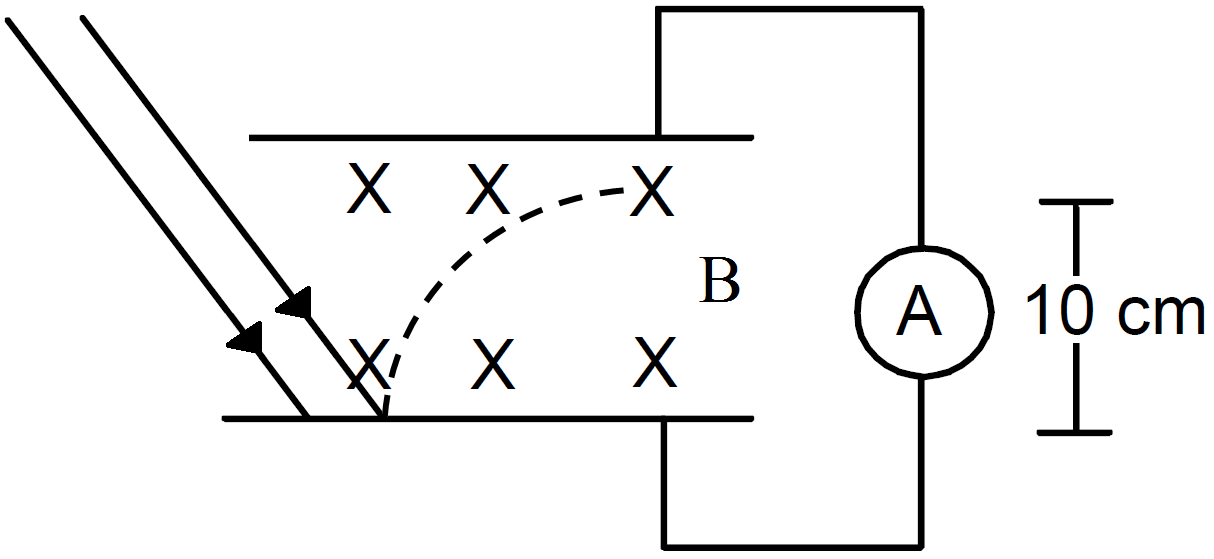
In an experiment on photoelectric effect, the emitter and the collector plates are placed et a separation of 10cm and are connected through en ammeter without any cell A magnetic field B exists parallel to the plates. The work function of the emitter is 2.39eV and the light incident on it has wavelengths between 400nm and 600nm. Find the minimum value of B for which the current registered by the ammeter is zero. Neglect any effect of space charge.
In a plane electromagnetic wave, the electric field oscillates sinusoidally at a frequency of $2.0 \times 10^{10} $Hz and amplitude $48\ V\ m^{-1}.$
  1. What is the wavelength of the wave?
  2. What is the amplitude of the oscillating magnetic field?
  3. Show that the average energy density of the E field equals the average energy density of the B field. $[c = 3 \times 10^8\ m\ s^{-1}.]$