Question
What is an impurity defect? What are its types? Explain the formation of vacancies through aliovalent impurity with example.
Answer

Impurity defect : This defect arises when foreign atoms, that is, atoms different from the host atoms are present in the crystal lattice.There are two types of impurity defects namely
  1. Substitutional defects and
  2. Interstitial defects.
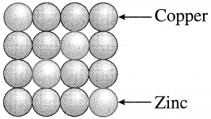
(1) Substitutional defects : These defects arises when foreign atoms occupy the lattice sites in place of host atoms, due to their displacements.
Examples : Solid solutions of metals (alloys). For example. Brass in which host atoms are of Cu which are replaced by impurity of Zn atoms. In this Zn atoms occupy regular sites while Cu atoms occupy substituted sites.
Image
Brass
Vacancy through aliovalent impurity :
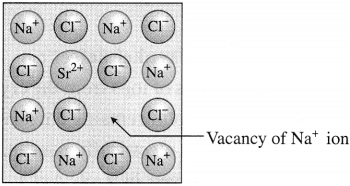
By addition of impurities of aliovalent ions :
Image
Vacancy through aliovalent ion
When aliovalent ion like $Sr ^{2+}$ in small amount is added by additing $SrCl _2$ to NaCl during its crystallisation, each $Sr ^{2+}$ ion (oxidation state $2+$ ) removes $2 Na ^{+}$ions from their lattice points, to maintain electrical neutrality. Hence one of vacant lattice site is occupied by $Sr ^{2+}$ ion while other site remains vacant.
Interstitial impurity defect:
Image
Stainless steel
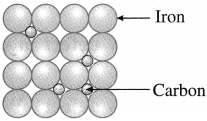
A defect in solid in which the impurity atoms occupy interstitial vacant spaces of lattice structure is called interstitial impurity defect.
For example, in steel, normal lattice sites are occupied by Fe atoms but interstitial spaces are occupied by carbon atoms.

Need a full question paper?

Generate a complete, print-ready paper with questions like this in minutes — across 16+ boards, with answer keys.

Start Generating Free

Similar questions