Question
What is called extrinsic semiconductor? Explain doping process.

Answer

Extrinsic semiconductor : The conductivity of intrinsic semiconductors is very low at room temperature. Therefore, to increase the conductivity, a small amount of certain element of the third or fifth group is added to the semiconductor. The semiconductor obtained in this way is called impurity semiconductor or extrinsic semiconductor.
Doping : The process of introducing impurity atoms into a intrinsic semiconductor is called doping.
To obtain extrinsic semiconductor, approximately from $(10)^6$ to $(10)^{10}$ atoms are one atom is of impurity element in intrinsic semiconductor.

Need a full question paper?

Generate a complete, print-ready paper with questions like this in minutes — across 16+ boards, with answer keys.
Start Generating Free

Similar questions

A long cylindrical wire of radius b carries a current i distributed uniformly over its cross-section. Find the magnitude of the magnetic field at a point inside the wire at a distance a from the axis.
  1. Consider an arbitrary electrostatic field configuration. A small test charge is placed at a null point (i.e., where E = 0) of the configuration. Show that the equilibrium of the test charge is necessarily unstable.
  2. Verify this result for the simple configuration of two charges of the same magnitude and sign placed a certain distance apart.
In a Coolidge tube, electrons strike the target and stop inside it. Does the target get more and more negatively charged as time passes?
A capacitor of unknown capacitance, a resistor of 100 $\Omega$ and an inductor of self inductance L = $( 4 /\pi^{2})$henry are connected in series to an ac source of 200V and 50 Hz. Calculate the value of the capacitance and impedance of the circuit when the current is in phase with the voltage. Calculate the power dissipated in the circuit.
What is the effect on the interference fringes in Young’s double slit experiment due to each of the following operations? Justify your answers.
  1. The screen is moved away from the plane of the slits.
  2. The separation between slits is increased.
  3. The source slit is moved closer to the plane of double slit.
The magnifying power of a converging lens used as a simple microscope is $\Big(1+\frac{\text{D}}{\text{f}}\Big).$ A compound microscope is a combination of two such converging lenses. Why don't we have magnifying power $\Big(1+\frac{\text{D}}{\text{f}_\text{o}}\Big) \Big(1+\frac{\text{D}}{\text{f}_\text{o}}\Big)?$ In other words, why can the objective not be treated as a simple microscope but the eyepiece can?
Explain Electric Flux.
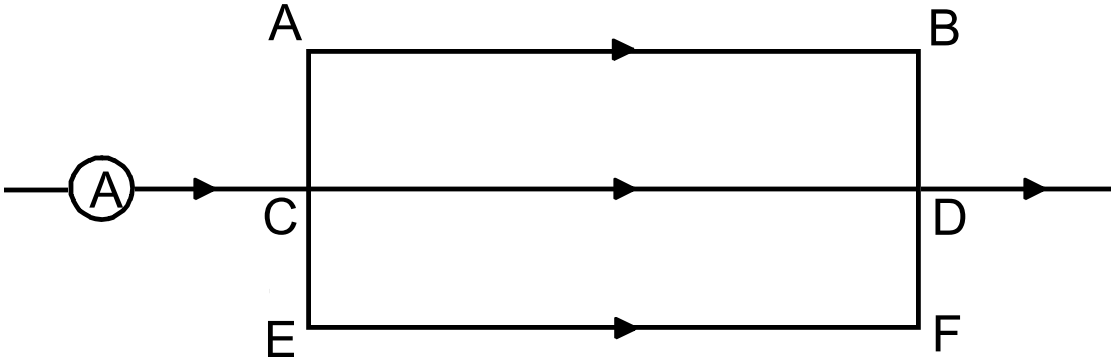
Figure shows a part of an electric circuit. The wires AB, CD and EF are long and have identical resistances. The separation between the neighbouring wires is 1.0cm. The wires AE and BF have negligible resistance and the ammeter reads 30A. Calculate the magnetic force per unit length of AB and CD.
A cube of ice of edge 4cm is placed in an empty cylindrical glass of inner diameter 6cm. Assume that the ice melts uniformly from each side so that it always retains its cubical shape. Remembering that ice is lighter than water, find the length of the edge of the ice cube at the instant it just leaves contact with the bottom of the glass.
A proton describes a circle of radius 1cm in a magnetic field of strength 0.10T. What would be the radius of the circle described by an α-particle moving with the same speed in the same magnetic field?