Question
What is Pandas NumPy array?
Generate a complete, print-ready paper with questions like this in minutes — across 16+ boards, with answer keys.
(a) To insert a new row in the HOSPITAL table with the following data: 11,’ Kasif’, 37,’ENT’,’2018-02-25’, 300, ’M’.
(b) To set charges to NULL for all the patients in the Surgery department.
(c) To display patient details who are giving charges in the range 300 and 400 (both inclusive).
(d) To display the details of that patient whose name second character contains ‘a’.
(e) To display total charges of ENT Department.
(f) To display details of the patients who admitted in the year 2019.
(g) To display the structure of the table hospital.
(h) Write the command to create the above table.
Write a program which accepts a sequence of commaseparated numbers from console and generate a list and a tuple which contains every number.
Suppose the following input is supplied to the program:
23,45,67,78,89
Then, the output should be:
['23', '45', '67', '78', '89']
('23', '45', '67', '78', '89')
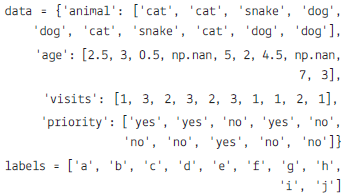
| animal | age | visits | priority | |
| a | cat | 2.5 | 1 | yes |
| b | cat | 3.0 | 3 | yes |
| c | snake | 0.5 | 2 | No |
| d | dog | NaN | 3 | yes |
| e | dog | 5.0 | 2 | No |
| f | cat | 2.0 | 3 | No |
| g | snake | 4.5 | 1 | No |
| h | cat | NaN | 1 | yes |
| i | dog | 7.0 | 2 | No |
| j | dog | 3.0 | 1 | No |
(a) To create the dataframe from the above dictionary and index is stored in label list.
(b) To display the Data frame.
(c) To calculate the sum of all visits (the total number of visits).
(d) Calculate the mean age for each different animal in df
(e) To Append a new row 'k' to df with your choice of values for each column.
(f) To delete the new entered row.
(g) To count the number of each type of animal in df.
(h) To sort df first by the values in the 'age' in descending order, then by the value in the 'visit' column in ascending order.
(i) To print the maximum values of each column.
(j) To display all the statistics.
(k) To sort the data according the index.
| class | order | max_speed | |
| falcon | bird | Falconiformes | 389.0 |
| parrot | bird | Psittaciformes | 24.0 |
| lion | mammal | Carnivora | 80.2 |
| monkey | mammal | Primates | NaN |
| leopard | mammal | Carnivora | 58.0 |
(i) To print the class wise sum.
(ii) To print the order wise mean
(iii) To sort the index.
(iv) To print the sum of the class wise along with orders columns indexing.
(v) To count the records.
Consider the following tables CARHUB and CUSTOMER and answer (a) and (b) parts of this question:
Table: CARHUB
| Vcode | VehicleName | Make | Color | Capacity | Charges |
| 100 | Innova | Toyota | WHITE | 7 | 15 |
| 102 | SX4 | Suzuki | BLUE | 4 | 14 |
| 104 | C Class | Mercedes | RED | 4 | 35 |
| 105 | A-Star | Suzuki | WHITE | 3 | 14 |
| 108 | Indigo | Tata | SILVER | 3 | 12 |
Table: CUSTOMER
| CCode | CName | VCode |
| 1 | Hemant Sahu | 101 |
| 2 | Raj Lal | 108 |
| 3 | Feroza Shah | 105 |
| 4 | Ketan Dhal | 104 |
(a) Write SQL commands for the following statements:
(i) To display the names of all white colored vehicles
(ii) To display name of vehicle, make and capacity of vehicles in ascending order of their sitting capacity
(iii) To display the highest charges at which a vehicle can be hired from CARHUB.
(iv) To display the customer name and the corresponding name of the vehicle hired by them.
(b) Give the output of the following SQL queries:
(i) Select count(distinct make) from cabhub;
(ii) Select max(charges), min(charges) from carhub;
(iii) Select count(*), make from carhub;
(Iv) Select vehiclename from carhub where capacity = 4;