Question
What is Rectifier?

Answer

From the V-I characteristic of a junction diode we see that it allows current to pass only when it is forward biased. So if an alternating voltage is applied across a diode, the current flows only in that part of the cycle when the diode is forward biased.
This property is used to rectify alternating voltages and the circuit used for this purpose is called a rectifier.
A rectifier converts AC energy in to DC energy.

Need a full question paper?

Generate a complete, print-ready paper with questions like this in minutes — across 16+ boards, with answer keys.
Start Generating Free

Similar questions

The charge on a proton is $+1.6 \times 10^{-19} \mathrm{C}$ and that on an electron is $-1.6 \times 10^{-19} \mathrm{C}$. Does it mean that the electron has a charge $3.2 \times 10^{-19} \mathrm{C}$ less than the charge of a proton?
Using Bohr’s postulates of the atomic model, derive the expression for radius of nth electron orbit. Hence obtain the expression for Bohr’s radius.
The plates of a parallel-plate capacitor are made of circular discs of radii 5.0cm each. If the separation between the plates is 1.0mm, what is the capacitance?
At what speed the volume of an object shrinks to half its rest value?
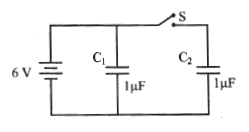
Figure shows two identical capacitors, $C_1$ and $C_2$, each of 1 μF capacitance connected to a battery of 6 V. Initially switch 'S' is closed. After sometime 'S' is left open and dielectric slabs of dielectric constant K = 3 are inserted to fill completely the space between the plates of the two capacitors. How will the (i) charge and (ii) potential difference between the plates of the capacitors be affected after the slabs are inserted?
A point source is placed at a depth h below the surface of water (refractive index = μ).
  1. Show that light escapes through a circular area on the water surface with its centre directly above the point source.
  2. Find the angle subtended by a radius of the area on the source.
The minimum deviations suffered by red, yellow and violet beams passing through an equilateral transparent prism are 38.4°, 38.7° and 39.2° respectively. Calculate the dispersive power of the medium.
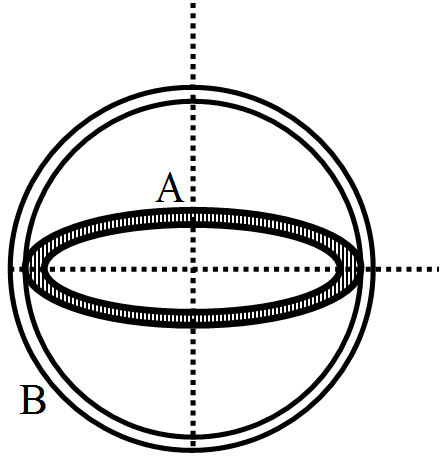
Two coils of wire A and B are placed mutually perpendicular as shown in figure. When current is changed in any one coil, will the current induce in another coil?
Describe schematically the equipotential surfaces corresponding to:
  1. a constant electric field in the z-direction.
  2. a field that uniformly increases in magnitude but remains in a constant (say, z) direction.
  3. a single positive charge at the origin, and.
  4. a uniform grid consisting of long equally spaced parallel charged wires in a plane.
A copper wire of diameter 1.6 mm carries 20A. Find the maximum magnitude of the magnetic field $\overrightarrow{\text{B}}$ due to this current.