Question
What is the angular velocity at any point on the equator so that the body feels weightlessness?

Answer

At any point on the surface of earth, the acceleration due to gravity is, $\text{g}'=\text{g}\Big(1-\frac{\text{R}\omega^2}{\text{g}}\cos^2\alpha\Big),$ where $\alpha$ is the latitude. For equator, $\alpha=0$ To feel weightlessness $\text{g}'=0$ $\therefore\text{g}\Big(1-\frac{\text{R}\omega^2}{\text{g}}\Big)=0$ $\therefore\omega=\sqrt{\frac{\text{g}}{\text{R}}}$

Need a full question paper?

Generate a complete, print-ready paper with questions like this in minutes — across 16+ boards, with answer keys.
Start Generating Free

Similar questions

A calorie is a unit of heat (energy in transit) and it equals about $4.2 J$ where $1J = 1kg m^2 s^{–2}$. Suppose we employ a system of units in which the unit of mass equals $\alpha\text{ kg},$ the unit of length equals $\beta\text{ m},$ the unit of time is $\gamma\text{ s}.$ Show that a calorie has a magnitude $4.2\ \alpha^{-1}\ \beta^{-2}\ \gamma^2$ in terms of the new units.
What is the direction of areal velocity of the earth around the sun?
Why the molecular motion of the molecules ceases at zero kelvin?
A uniform tube closed at one end, contains a pellet of mercury $10cm$ long. When the tube is kept vertically with the closed-end upward, the length of the air column trapped is $20cm$. Find the length of the air column trapped when the tube is inverted so that the closedend goes down. Atmospheric pressure = $75cm$ of mercury.
A body of mass 3kg makes an elastic collision with anthor body at rest and continues to move in the original direction with a speed equal to one-third of its original speed. Find the mass of the second body.
Equal torqueses are applied on a cylinder and a sphere. Both have same mass and radius. The cylinder rotates about its axis and the sphere rotates about one of its diameters. Which will acquire greater speed? Explain why.
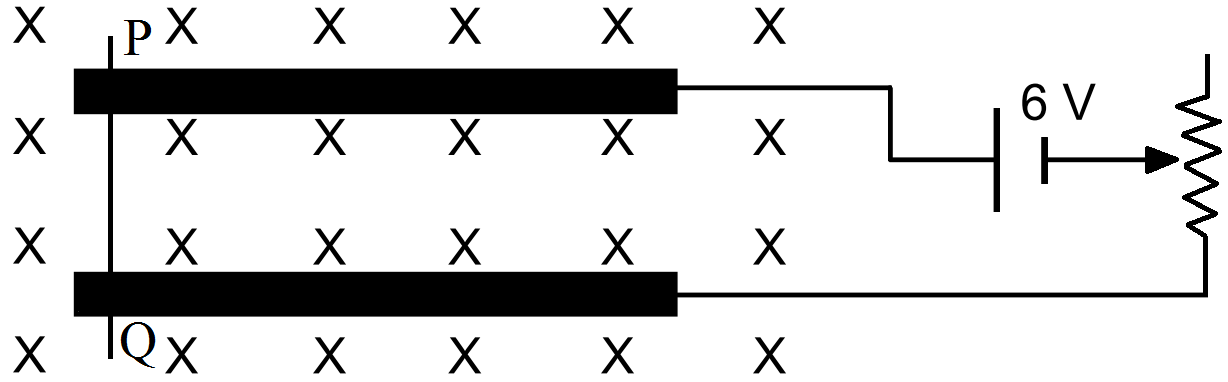
A metal wire PQ of mass 10g lies at rest on two horizontal metal rails separated by 4.90cm A vertically-downward magnetic field of magnitude 0.800T exists in the space. The resistance of the circuit is slowly decreased and it is found that when the resistance goes below 20.0Ω, the wire PQ starts sliding on the rails. Find the coefficient of friction.
A certain substance has a mass of $50 g /$ mole. When 300 J of heat is added to 25 g of sample of this material, its temperature rises from $25^{\circ} C$ to $45^{\circ} C$. Calculate
i. the thermal capacity,
ii. specific heat capacity, and
iii. molar heat capacity of the sample.
What is escape velocity. Derive an expression for the same.
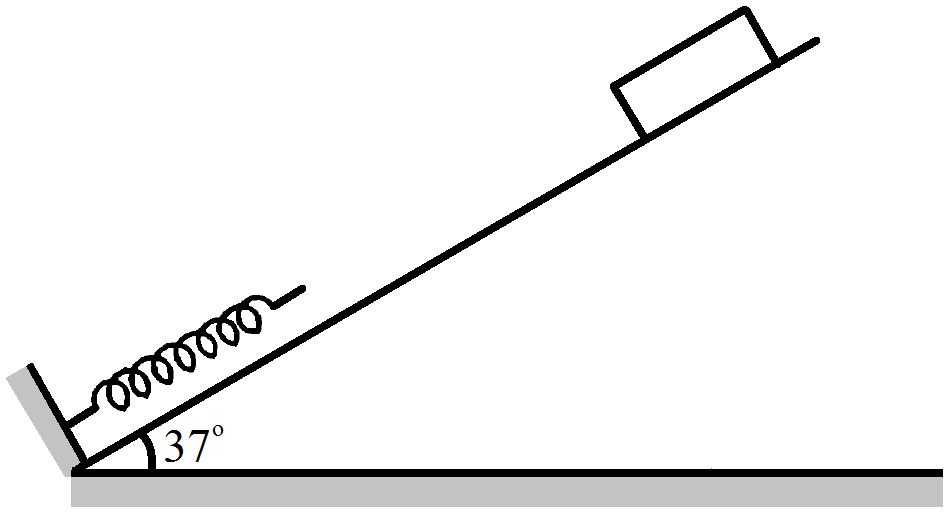
Figure shows a spring fixed at the bottom end of an incline of inclination $37^\circ $. A small block of mass $2\ kg$ starts slipping down the incline from a point $4.8m$ away from the spring. The block compresses the spring by $20\ cm$, stops momentarily and then rebounds through a distance of $1m$ up the incline. Find.
  1. The friction coefficient between the plane and the block.
  2. The spring constant of the spring. Take $g = 10m/s^2$​​​​​​​.