Question
What is the difference between distillation, distillation under reduced pressure and steam distillation?

Answer

The differences among distillation, distillation under reduced pressure, and steam distillation are given in the following table.
Distillation
Distillation under reduced pressure
Steam distillation
It is used for the purification of compounds that are associated with non-volatile impurities or those liquids, which do not decompose on boiling. In other words, distillation is used to separate volatile liquids from non-volatile impurities or a mixture of those liquids that have sufficient difference in boiling points.
This method is used to purify a liquid that tends to decompose on boiling. Under the conditions of reduced pressure, the liquid will boil at a low temperature than its boiling point and will, therefore, not decompose.
It is used to purify an organic compound, which is steam volatile and immiscible in water. On passing steam, the compound gets heated up and the steam gets condensed to water. After some time, the mixture of water and liquid starts to boil and passes through the condenser. This condensed mixture of water and liquid is then separated by using a separating funnel.
Mixture of petrol and kerosene is separated by this method.
Glycerol is purified by this method. It boils with decomposition at a temperature of 593K. At a reduced pressure, it boils at 453K without decomposition.
A mixture of water and aniline is separated by steam distillation.

Need a full question paper?

Generate a complete, print-ready paper with questions like this in minutes — across 16+ boards, with answer keys.
Start Generating Free

Similar questions

Explain different type of salt hydrolysis and various formulas of these from which amount of hydrolysis and pH of solution are determined.
  1. Consider the following endothermic reaction:
$\text{CH}_4(\text{g})+\text{H}_2\text{O}(\text{g})\rightleftharpoons\text{CO(g)}+3\text{H}_2(\text{g})$
  1. Write expression for $K_p$ for the above reaction.
  2. How will the values of $K_p$ and composition of equilibrium mixture be affected by.
  1. increasing the pressure.
  2. increasing the temperature.
  3. using a catalyst?
  1. Calculate the pH of the resultant mixture of $10$ml of $0.1$M $H_2SO_4 + 10$ ml of $0.1$M KOH.
Determine the solubilities of silver chromate, barium chromate, ferric hydroxide, lead chloride and mercurous iodide at $298K$ from their solubility product constants given in Table $7.9$. Determine also the molarities of individual ions.
What are the various factors due to which the ionization enthalpy of the main group elements tends to decrease down a group?
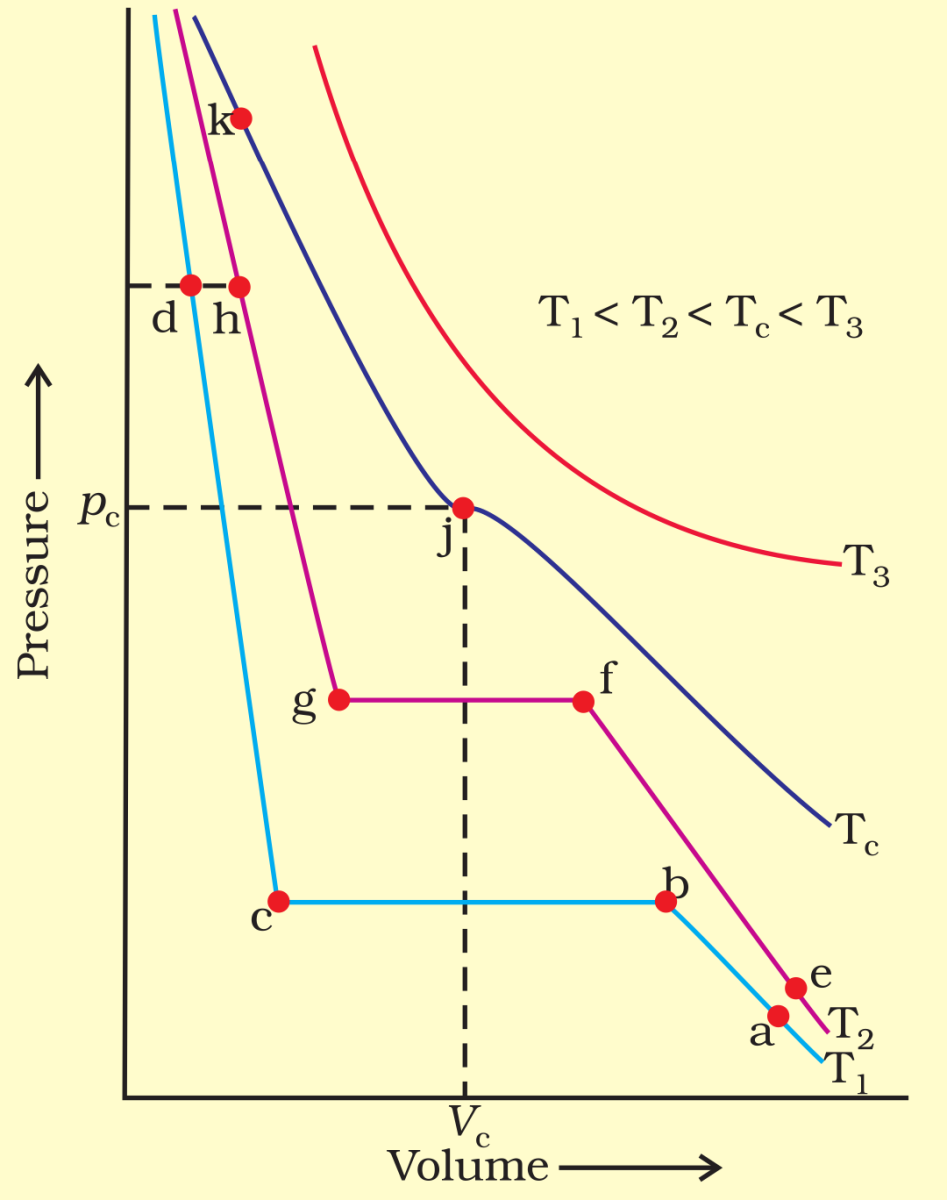
Isotherms of carbon dioxide gas are shown in Fig. Mark a path for changing gas into liquid such that only one phase (i.e., either a gas or a liquid) exists at any time during the change. Explain how the temperature, volume and pressure should be changed to carry out the change.
Illustrate by taking examples of transition elements and non-transition elements that oxidation states of elements are largely based on electronic configuration.
Explain the following.
  1. The boiling point of a liquid rises on increasing pressure.
  2. Drops of liquids assume spherical shape.
  3. The boiling point of water $(373K)$ is abnormally high when compared to that of $H_2S (211.2K).$
  4. The level of mercury in a capillary tube is lower than the level outside when a Se capillary tube is inserted in the mercury.
  5. Tea or coffee is sipped from a saucer when it is quite hot.
Although both $\mathrm{CO}_2$ and $\mathrm{H}_2 \mathrm{O}$ are triatomic molecules, the shape of $\mathrm{H}_2 \mathrm{O}$ molecule is bent while that of $\mathrm{CO}_2$ is linear. Explain this on the basis of dipole moment.
  1. Define solubility product. Write solubility product expression for $Zr_3(PO_4)_4$.
  2. Calculate the pH of $0.01 M CH_3COOH$ solution. $[K_a(CH_2COOH) = 1.74 \times 10^{-51}$
  3. Explain why NaCl is precipitated when HCl(g) is passed through the saturated solution of NaCl.
  1. How many electrons will present in sub-shell having spin quantum number value of $-\frac{1}{2}$ for n = 4?
  2. Which of the following transition will have minimum wavelength and why?
$\mathrm{n}_4 \rightarrow \mathrm{n}_1, \mathrm{n}_4 \rightarrow \mathrm{n}_2, \mathrm{n}_2 \rightarrow \mathrm{n}_1$.
  1. Give the number of radial nodes for 3s and 2p orbitals.