Question
What is the maximum energy that can be stored in a capacitor?

Answer

  1. Depends on the maximum electric field.
Explanation:
The maximum energy that can be desirably stored in a capacitor is depends on the maximum electric field that the dielectric can withstand without breaking down. Therefore, capacitors of the same type have about the same maximum energy density, i.e. joules of energy per cubic meter.

Need a full question paper?

Generate a complete, print-ready paper with questions like this in minutes — across 16+ boards, with answer keys.
Start Generating Free

Similar questions

The average e.m.f. induced in a coil in which the current changes from 2 ampere to 4 ampere in 0.05 second is 8 volt. What is the self inductance of the coil ?(a) 0.1 H(b) 0.2 H (c) 0.4 H(d) 0.8 H
       
Which of the following statement is true  (a) Velocity of light is constant in all media  (b) Velocity of light in vacuum is maximum
  (c) Velocity of light is same in all reference frames(d) Laws of nature have identical form in all reference frames


Two identical blocks are kept on a frictionless horizontal table connected by a spring of stiffness K and of original length $\ell_0$ A total charge Q is distributed on the block such that maximum elongation of sparing at equilibrium is equal to x value of q is:
In a dc motor, induced e.m.f. will be maximum(a) When motor takes maximum speed(b) When motor starts rotating(c) When speed of motor increases(d) When motor is switched off
   
   
To get an output Y=1 from the circuit above, the input must be:
In a transistor, a change of 8.0 mA in the emitter current produces a change of 7.8 mA in the collector current. What change in the base current is necessary to produce the same change in the collector current(a) 50 mA(b) 100 mA(c) 150 mA(d) 200 mA
       
$3$ identical bulbs are connected in series and these together dissipate a power $P.$ If now the bulbs are connected in parallel, then the power dissipated will be
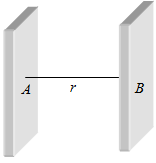
There are two equipotential surface as shown in figure. The distance between them is $r.$ The charge of $–q$ coulomb is taken from the surface $A$ to $B,$ the resultant work done will be
The graph drawn with object distance along abscissa & image as ordinate for a convex lens is
The momentum of a photon in an $X-$ray beam of  $10^{-10}$  metre wavelength is