Question
What is the nature of electromagnetic waves?

Answer

It is a three-dimensional wave which is emitted by an oscillating electric circuit in which electric field and magnetic field oscillate perpendicularly. These waves do not require any material medium for their propagation and they can travel through vacuum also. Hence, they are different from mechanical waves. They travel with maximum speed in vacuum which is equal to the speed of the light. These waves are transverse in nature and the properties of the medium remain unchanged through which they travel.

Need a full question paper?

Generate a complete, print-ready paper with questions like this in minutes — across 16+ boards, with answer keys.
Start Generating Free

Similar questions

If the bar magnet in exercise 5.13 is turned around by 180°, where will the new null points be located?
Explain the de-Broglie wavelength by explaining the waveform of matter.
  1. Show using a proper diagram how unpolarised light can be linearly polarised by reflection from a transparent glass surface.
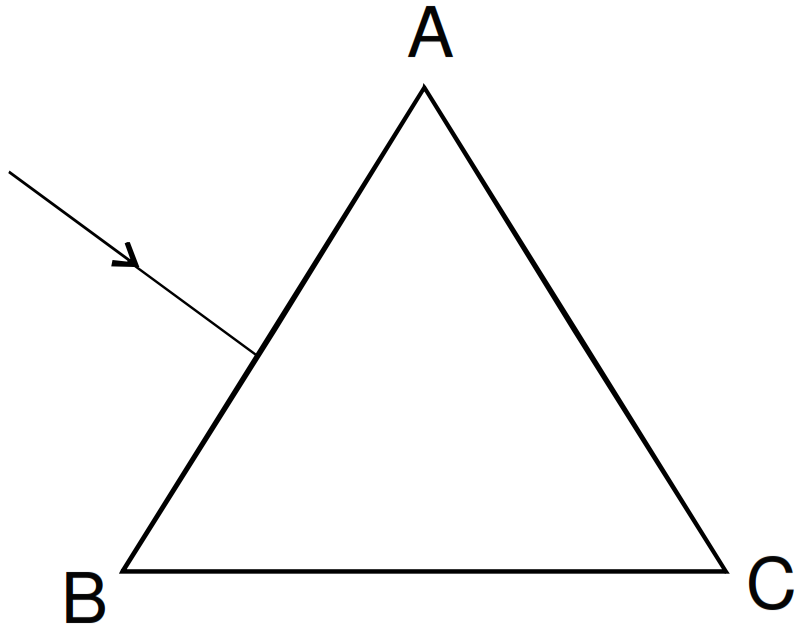
  2. The figure shows a ray of light falling normally on the face AB of an equilateral glass prism having refractive index $\frac{3}{2},$ placed in water of refractive index $\frac{4}{3}.$ Will this ray suffer total internal reflection on striking the face AC? Justify your answer.

  1. What characteristic property of nuclear force explains the constancy of binding energy per nucleon (BE/A) in the range of mass number 'A' lying 30 <A < 170?
  2. Show that the density of nucleus over a wide range of nuclei is constantindependent of mass numberA.
The gravitational force acting on a particle of 1g due to a similar particle is equal to 6.67 × 10⁻¹⁷N. Calculate the separation between the particles.
A thin prism of crown glass $(\mu_\text{r}=1.515,\mu_\text{v}=1.525)$ and a thin prism of flint glass $(\mu_\text{r}=1.612,\mu_\text{v}=1.632)$ are placed in contact with each other. Their refracting angles are 5.0° each and are similarly directed. Calculate the angular dispersion produced by the combination.
A point charge of 2.0 μC is at the centre of a cubic Gaussian surface 9.0 cm on edge. What is the net electric flux through the surface?
An air-cored solenoid with length 30cm, area of cross-section 25cm2 and number of turns 500, carries a current of 2.5A. The current is suddenly switched off in a brief time of 10–3s. How much is the average back emf induced across the ends of the open switch in the circuit? Ignore the variation in magnetic field near the ends of the solenoid.
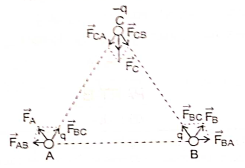
Consider the changes $q, q$ and $-q$ placed at the vertices of an equilateral triangle as shown in figure. What is the foree on each charge ?
Image
The near point and the far point of a child are at 10cm and 100cm. If the retina is 2.0cm behind the eye-lens, what is the range of the power of the eye-lens?