An electric charge $10^{-6} \mu \mathrm{C}$ is placed at origin $(0,0)$ $\mathrm{m}$ of $\mathrm{X}-\mathrm{Y}$ co-ordinate system. Two points $\mathrm{P}$ and $\mathrm{Q}$ are situated at $(\sqrt{3}, \sqrt{3}) \mathrm{m}$ and $(\sqrt{6}, 0) \mathrm{m}$ respectively. The potential difference between the points $P$ and $Q$ will be :
JEE MAIN 2024, Diffcult


Download our appand get started for free
Experience the future of education. Simply download our apps or reach out to us for more information. Let's shape the future of learning together!No signup needed.*
Similar Questions
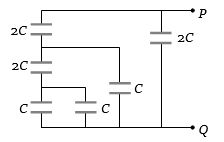
- 1View SolutionThe resultant capacitance of given circuit is
- 2An electric charge $10^{-8}\ C$ is placed at the point $ (4\,m, 7\,m, 2\,m)$. At the point $(1\,m, 3\,m, 2\,m)$, the electricView Solution
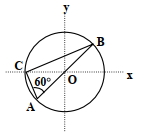
- 3Consider a system of three charges $\frac{\mathrm{q}}{3}, \frac{\mathrm{q}}{3}$ and $-\frac{2 \mathrm{q}}{3}$ placed at points $\mathrm{A}, \mathrm{B}$ and $\mathrm{C}$, respectively, as shown in the figure,View Solution
Take $\mathrm{O}$ to be the centre of the circle of radius $\mathrm{R}$ and angle $\mathrm{CAB}=60^{\circ}$
Figure:$Image$
- 4$512$ identical drops of mercury are charged to a potential of $2\, V$ each. The drops are joined to form a single drop. The potential of this drop is ......... $V.$View Solution
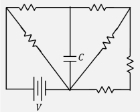
- 5View SolutionConsider the circuit shown in the figure below. All the resistors are identical. The charge stored in the capacitor, once it is fully charged is
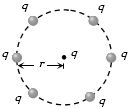
- 6A point charge is surrounded symmetrically by six identical charges at distance $r$ as shown in the figure. How much work is done by the forces of electrostatic repulsion when the point charge $q$ at the centre is removed at infinityView Solution
- 7View SolutionIn the following figure two parallel metallic plates are maintained at different potential. If an electron is released midway between the plates, it will move
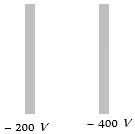
- 8Two identical parallel plate capacitors of capacitance $C$ each are connected in series with a battery of emf, $E$ as shown below. If one of the capacitors is now filled with a dielectric of dielectric constant $k$, then the amount of charge which will flow through the battery is (neglect internal resistance of the battery)View Solution
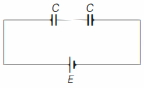
- 9The two plates $X $ and $Y$ of a parallel plate capacitor of capacitance $C$ are given a charge of amount $Q$ each. $X$ is now joined to the positive terminal and $Y$ to the negative terminal of a cell of $emf$ $E = Q/C$.View Solution
- 10A parallel plate capacitor has potential $20\,kV$ and capacitance $2\times10^{-4}\,\mu F$. If area of plate is $0.01\,m^2$ and distance between the plates is $2\,mm$ then find dielectric constant of mediumView Solution