Question
  1. What is thermit process ? Where is this process used? Write balanced chemical equation for the reaction involved.
  2. Where does the metal aluminium, used in the process, occurs in the reactivity series of metals?
  3. Name the substances that are getting oxidised and reduced in the process.
Answer

  1. In thermite reaction, iron oxide reacts with aluminium to produce molten iron. It is an exothermic process.
The following reaction of iron oxide with aluminium as:

$\text{Fe}_2\text{O}_3(\text{s})+2\text{Al}(\text{s})\rightarrow\text{2Fe(l)}+\text{Al}_2\text{O}_3(\text{s})+\text{heat}$

This is used to join railway tracks or cracked machine parts because the amount of heat evolved is so large that the metal is produced in the molten state.
  1. The reactivity series of metals as:
K > Na > Ca > Mg > Al > C > Zn > Fe > Sn > Pb.

As aluminium is more reactive than iron so it is placed above iron in the reactivity series.
  1. Oxidized → Al.
Reduced → $Fe_2O_3$.

Need a full question paper?

Generate a complete, print-ready paper with questions like this in minutes — across 16+ boards, with answer keys.

Start Generating Free

Similar questions

An object is placed 10cm from a lens of focal length 5cm. Draw the ray diagrams to show the formation of image if the lens is:
  1. Converging, and
  2. Diverging.
A non - metal X which is the largest constituent of air combines with hydrogen when heated in the presence of iron as catalyst to form a gas Y. When gas Y is treated with sulphuric acid, it forms a compound Z which is used as a chemical fertiliser.
  1. What are X, Y and Z?
  2. To which group of periodic table does X belong?
  3. Name the period of periodic table in which X is placed.
  4. Which element is placed just before X in the period?
  5. Which element is placed just after X in the period?
A $10 cm$ long pencil is placed $5 cm$ in front of a concave mirror having a radius of curvature of $40 cm$.
(i) Determine the position of the image formed by this mirror.
(ii) What is the size of the image?
(iii) Draw a ray diagram to show the formation of the image as mentioned in the part (i).
How do the following change on going from left to right in a period of the periodic table?
  1. Chemical reactivity of elements.
  2. Nature of oxides of elements Give examples in support of your answer.
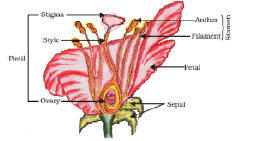
The labelled diagram of a flower is shown below:
Image

Using the above diagram, answer the following questions:
i. Where is the egg cell present in a flower?
ii. Which part of the flower produces pollen grains?
iii. What is the difference between a uni-sexual and a bisexual flower?
iv. What happens when a pollen grain falls on the stigma of the carpel?
v. How a zygote is formed in a flower?
An organism X having breathing organs A lives on land. When organism X goes under water, it cannot survive for a long time unless carrying an oxygen cylinder. On the other hand, the organism Y having breathing organs B always lives in water and if taken out of water, it dies after a short while. A third organism Z having breathing organs C and D which lives on the banks of ponds, lakes and rivers can survive on land as well as in water equally well.
  1. What could organism X be? Name the breathing organs A.
  2. What could organism Y be? Name the breathing organs B.
  3. What could organism Z be? Name the breathing organs C and D.
  4. Out of X, Y and Z, which organism is.
  1. Amphibian,
  2. Aquatic,
  3. Terrestrial?
The organisms A, B and C can obtain their food in three different ways. Organism A derives its food from the body of another living organism which is called its D, without killing it. The organism B takes in the solid food by the process of ingestion, digests a part of this food and throws out undigested food in the process called E. The organism C obtains its food from dead and decaying plants.
  1. What is the mode of nutrition of (i) organism A (ii) organism B, and (iii) organism C?
  2. What is the organism like D called?
  3. Name the process E.
  4. Give one example each of organisms like A, B and C.
  5. What is the general name of three modes of nutrition exhibited by organisms A, B and C?
Name various plant hormones. Also give their physiological effects on plant growth and development.
The image in a plane mirror is virtual and laterally inverted. What does this statement mean?
A non-metal A which is the largest constituent of air, when heated with $H _2$ in $1: 3$ ratio in the presence of catalyst (Fe) gives a gas B . On heating with $O _2$ it gives an oxide C . If this oxide is passed into water in the presence of air it gives an acid $D$ which acts as a strong oxidising agent.
1. Identify A, B, C and D.
2. To which group of periodic table does this non-metal belong?