Questions

[5 marks Questions]

🎯

Test yourself on this topic

46 questions · timed · auto-graded

Question 15 Marks
What happens when an iron strip is put into separate beakers containing aqueous solutions of copper sulphate and zinc sulphate? Where is iron placed in the activity series with respect to copper and zinc? Describe the steps involved in the extraction of zinc from its sulphide and carbonate ores. Support your answer with balanced chemical equation for the chemical reactions involved in the process.
Answer
When an iron strip is put into a beaker containing aqueous solution of copper sulphate, then displacement reaction takes place and the blue colour of the copper sulphate solution fades away. When an iron strip is put into a beaker containing aqueous solution of zinc sulphate, there does not take place any change. As per the above observations, iron is place above copper and below zinc in the activity series. It is easier to obtain a metal from its oxide therefore, prior to reduction, metal sulphide and carbonates ore are converted into metal oxides. The sulphide ore is converted into oxide by heating strongly in presence of excess air. The process is known as roasting$2\text{Zn S}_\text{(S)}+3\text{O}_{2\text{(g)}}\xrightarrow{\text{Heat}}2\text{ZnO}_{\text{(S)}}+2\text{SO}_{2(\text{g})}$
The carbonate ores are changed into oxides by heating strongly in limited air. The process is known as calcination.$\text{Zn CO}_{3(\text{S})}\xrightarrow{\text{Heat}}\text{Zn}_{\text{(S)}}+\text{CO}_{2\text{(g)}}$
The zince oxide is then reduced by using reducing agent the like carbon$\text{ZnO}_\text{(S)}+\text{C}_{\text{(S)}}\rightarrow \text{Zn}_\text{(S)}+\text{CO}_\text{(g)}$
The metal such obtained is not pure and is purified by electrolytic refining of the metal.
View full question & answer
Question 25 Marks
  1. Give an example of a metal which:
  1. Is a liquid at room temperature.
  2. Is kept immersed in kerosene for storing.
  3. Is both malleable and ductile.
  4. Is the best conductor of heat.
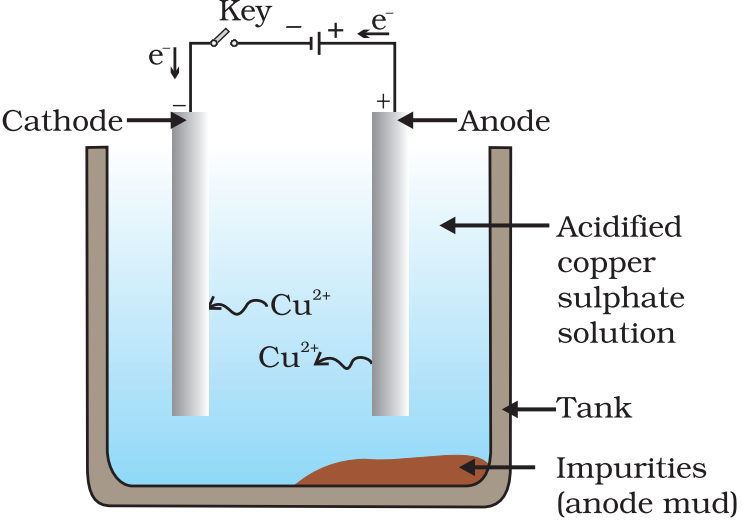
  1. Name the process of obtaining a pure metal from an impure metal through electrolysis. Suppose you have to refine copper using this process, then explain mentioning inwith the help of a labelled diagram the process of purification, brief the materials used as (i) anode, (ii) cathode and (iii) electrolyte.
Answer
  1.  
  1. Mercury (Hg) is the metal liquid at room temperature.
  2. Sodium (Na) being highly reactive is kept immersed in kerosene.
  3. Silver (Ag) is both malleable and ductile.
  4. Silver (Ag).
  1. Electrolytic refining of metal.


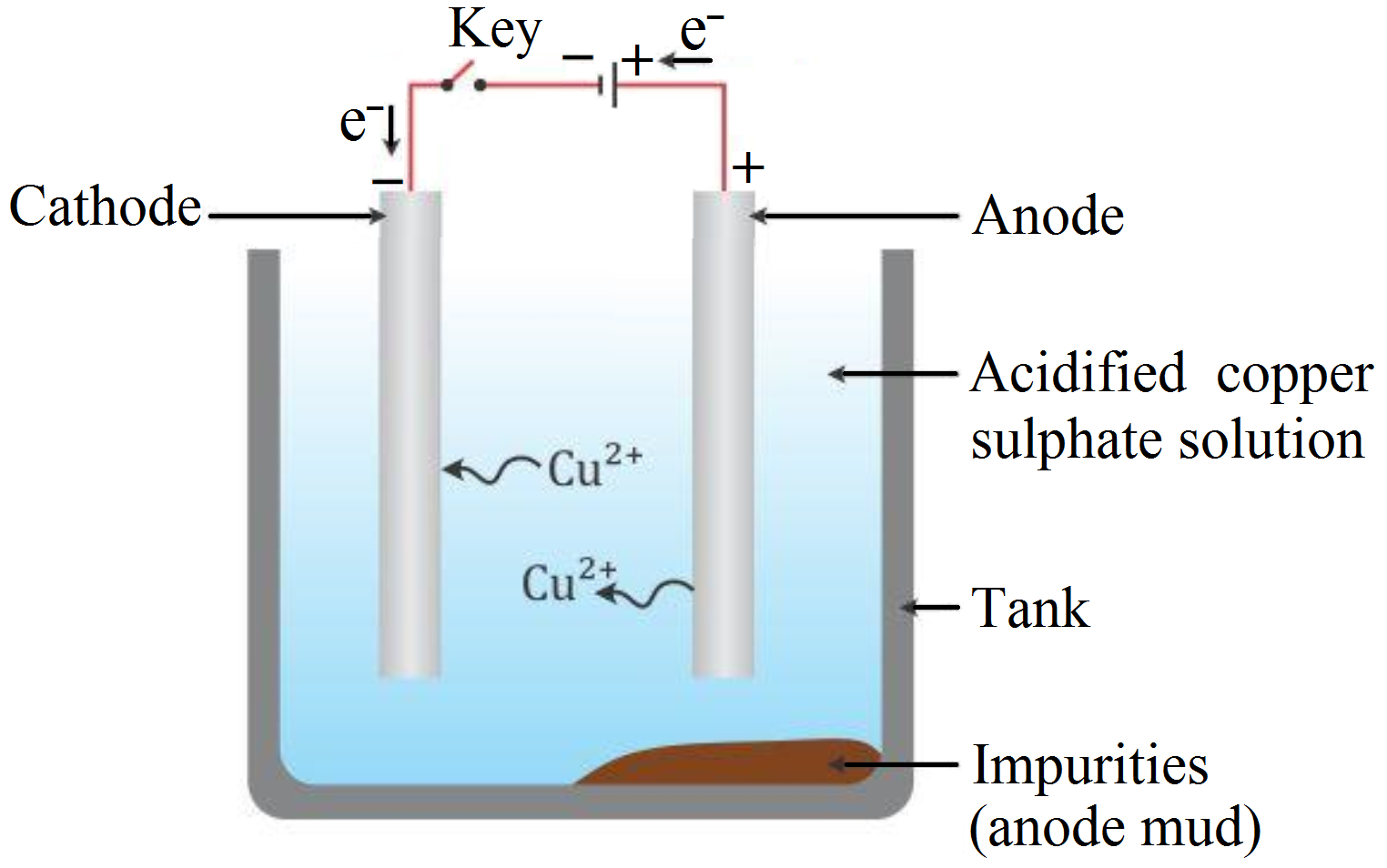
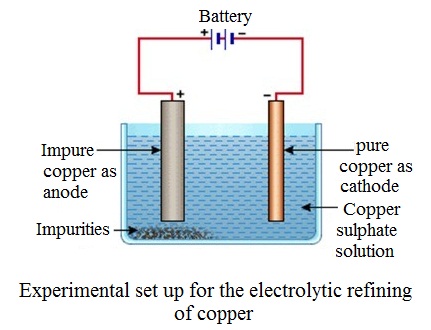
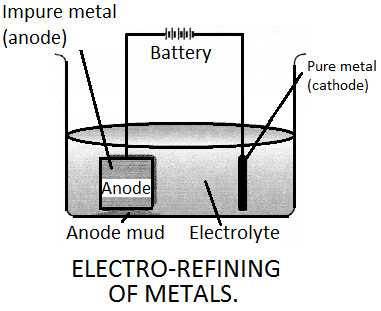
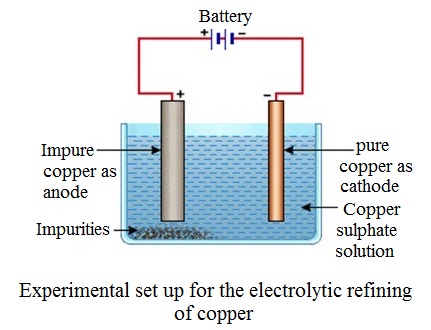
Many metals such as copper, zinc etc. are refined electrolytic ally. In this process, the impure copper metal is made anode and a thin strip of pure copper metal is made the cathode. A solution of copper sulphate is taken as electrolyte. The apparatus is set up as shown in the figure. On passing the current through the electrolyte, the pure metal from the anode dissolves into the electrolyte. An equivalent amount of pure metal from the electrolyte is deposited on the cathode the soluble impurities go into the solution whereas, the insoluble impurities settle down at the bottom of the anode and are known as anode mud.
View full question & answer
Question 35 Marks
  1. Explain how the following metals are obtained from their compounds by the reduction process:
  1. Metal M which is in the middle of the reactivity series.
  2. Metal N which is high up in the reactivity series.
Give one example of each type.
Answer
  1. By reduction of its oxide with a suitable reducing agent (C/CO/Al)
$\text{eg}: \text{Fe}_{2}\text{ O}_{3} + \text{CO}\rightarrow\text{2 Fe + 3 CO}_{2}$
  1. By electrolytic reduction (of its fused or mloiten salt) eg.:
$\DeclareMathOperator*{\median}{{\text{2 NaCl}}} \median_{\text{(Molten)}}\xrightarrow[{\text{Current}}]{\text{electric}}2 \text{ Na + Cl}_{2}$
View full question & answer
Question 45 Marks
  1. Distinguish between ‘roasting’ and ‘calcination’. Which of these two is used for sulphide ores and why?
  2. Write a chemical equation to illustrate the use of aluminium for joining cracked railway lines.
  3. Name the anode, the cathode and the electrolyte used in the electrolytic refining of impure copper.
Answer
  1. Roasting is a process in which the ores are heated to a temperature that is below its melting point. This happens in the presence of air in order to oxidize the impurities. They are usually removed as gaseous oxides.
Calcinations is a process in which the ores are heated below its melting point in the absence of air. Volatile impurities like arsenic are removed by this process.
Roasting is the method used for sulphide ores. Roasting is used because it is easier to purify the oxides of a substance than the other ores. Therefore, sulphide ores are also heated strongly in the presence of excess oxygen to form its oxides.
  1. $\text{Fe}_{2} \text{ O}_{3} + \text{2Al} \xrightarrow{\Delta} \text{2 Fe + Al}_{2} \text{ O}_{3}$
  2. In the electrolytic refining of impure copper,
    The anode used is - impure copper
    The cathode used is - pure copper sheetThe electrolyte used is - a bath of copper sulphate $\left( CuSO _4\right)$ and sulphuric acid $\left( H _2 SO _4\right)$.
View full question & answer
Question 55 Marks
What is meant by refining of a metals? Name the most widely used method of refining impure metals produced by various reduction processes. Describe with the help of a labelled diagram how this method may be used for refining of copper.
Answer
Refining of metals means the extraction of the major element from its ores and other compounds.Most common refining processes are:
  1. Roasting
  2. Calcinations
  3. Electrolytic refining
In the electrolytic refining of copper, the impure copper is made from the anode in an electrolyt bath of copper sulfate, $CuSO _4$, and sulfuric acid $H _2 SO _4$. The cathode is a sheet of very pure copper. As current is passed through the solution, positive copper ions, $Cu _2{ }^{+}$in the solution are attracted to the negative cathode, where they take on electrons and deposit themselves as neutral copper atoms, thereby building up more and more pure copper on the cathode. Meanwhile, copper atoms in the positive anode give up electrons and dissolve into the electrolyte solution as copper ions. But the impurities in the anode do not go into solution because silver, gold and platinum atoms are not as easily oxidized (converted into positive ions) as copper.
View full question & answer
Question 65 Marks
  1. Write the steps involved in the extraction of pure metals in the middle of the activity series from their carbonate ores.
  2. How is copper extracted from its sulphide ore? Explain the various steps supported by chemical equations. Draw labelled diagram for the electrolytic refining of copper.
Answer
  1. Extraction of Zn from its carbonate ore:
  1. Concentration: Concentration is done by the gravity separation method.
  2. Calcination: The ore is calcinated in the absence of air and gets converted to its oxide, i.e. $\text{ZnO}.\text{ZnCO}_3\xrightarrow{\ \ \Delta\ \ }\text{ZnO}+\text{CO}_2\uparrow$
  3. Reduction: Carbon is used as a reducing agent to reduce ZnO to Zn.
$\text{ZnO}+\text{C}\xrightarrow{\ \ \Delta\ \ }\text{Zn}+\text{CO}\uparrow$
  1. Electrolytic refining: The impure Zn metal is then purified by electrolysis.
  1. Extraction of Cu from its sulphide ore:
  1. Copper from its sulphide ore can be extracted by heating in air.
$2\text{Cu}_2\text{S}+3\text{O}_2\xrightarrow{\ \ \Delta\ \ }2\text{Cu}_2\text{O}+2\text{SO}_2$

$2\text{Cu}_2\text{O}+\text{Cu}_2\text{S}\xrightarrow{\ \ \Delta\ \ }6\text{Cu}+\text{SO}_2$
  1. Refining is then done by electrolysis:
​​​​​​​
View full question & answer
Question 75 Marks
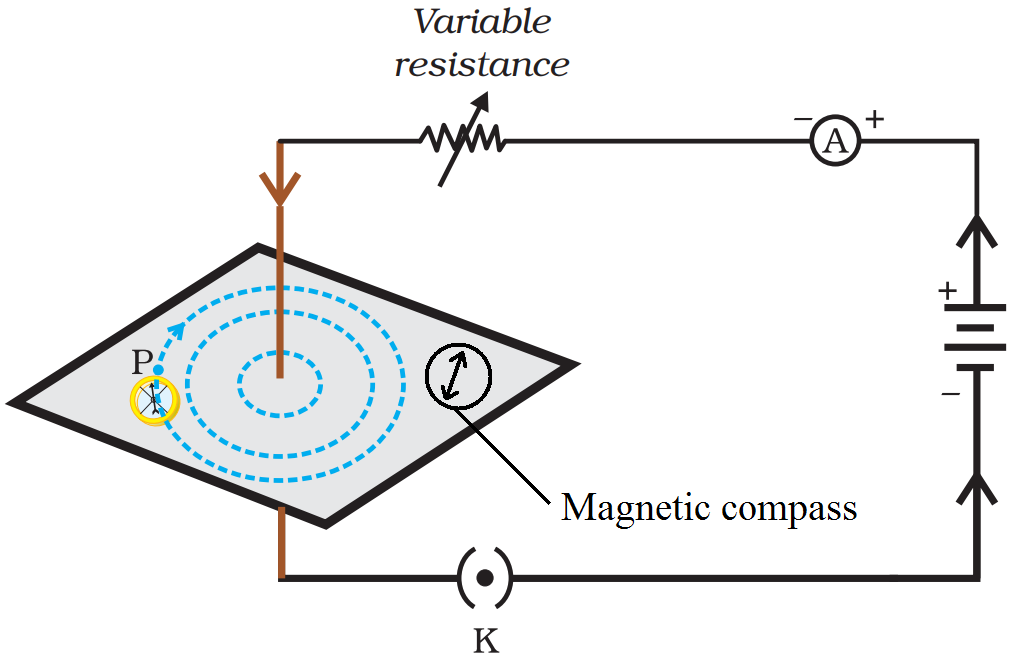
  1. Draw magnetic field lines produced around a current carrying straight conductor passing through a cardboard. Name, state and apply the rule to mark the direction of these field lines.
  2. How will be strenght of the magnetic field change when the point where magnetic field is to be determined is moved away from the stright wire carrying constant current? Justify your answer.
Answer
  1.  


Rule: Right hand thumb rule Imagine that you are holding a current-carrying straight conductor in your right hand such that the thumb points towards the direction of current. Then your fingers will wrap around the conductor in the direction of the field lines of the magnetic field.
  1. Strength decreases.
Reason: The concentric circles representing the magnetic field around a current-carrying straight wire become larger and longer as the distance increases.
View full question & answer
Question 85 Marks
  1. What is thermit process ? Where is this process used? Write balanced chemical equation for the reaction involved.
  2. Where does the metal aluminium, used in the process, occurs in the reactivity series of metals?
  3. Name the substances that are getting oxidised and reduced in the process.
Answer
  1. In thermite reaction, iron oxide reacts with aluminium to produce molten iron. It is an exothermic process.
The following reaction of iron oxide with aluminium as:

$\text{Fe}_2\text{O}_3(\text{s})+2\text{Al}(\text{s})\rightarrow\text{2Fe(l)}+\text{Al}_2\text{O}_3(\text{s})+\text{heat}$

This is used to join railway tracks or cracked machine parts because the amount of heat evolved is so large that the metal is produced in the molten state.
  1. The reactivity series of metals as:
K > Na > Ca > Mg > Al > C > Zn > Fe > Sn > Pb.

As aluminium is more reactive than iron so it is placed above iron in the reactivity series.
  1. Oxidized → Al.
Reduced → $Fe_2O_3$.
View full question & answer
Question 95 Marks
Write the chemical formula and name of the compound which is the active ingredient of all alcoholic drinks. List its two uses. Write chemical equation and name of the product formed when this compound reacts with-
  1. Sodium metal.
  2. Hot concentrated sulphuric acid.
Answer
Name of the compound which is the active ingredient of all alcoholic drinks is Ethanol and its chemical formula is $CH _3 CH _2 OH$..Uses-
  1. Ethanol is used in medical wipes/ swabs and antibacterial hand sanitizers.
  2. Ethanol is also used in body lotions as preservatives and stabilizer of its ingredients.
Chemical reactions of ethanol-
  1. $\text{CH}_3\text{CH}_2\text{OH}\ +\ \text{Na}\xrightarrow{\ \ \ \ \ \ \ }\text{CH}_3\text{CH}_2\text{O}^-\text{Na}^++\text{H}_2\\^\text{Ethanol}\ \ \ \ \ \ \ \ \ \ \ \ \ \ \ \ \ ^\text{Sodium}\ \ \ \ \ \ \ \ \ ^\text{Soidum ethoxide}\ \ \ \ \ \ ^\text{Hydrogen ges}$
  2. $\text{CH}_3\text{CH}_2\text{OH}\ +\ \text{H}_2\text{SO}_4(\text{conc.})\xrightarrow{\ \ \ \ \ \ \ }\text{C}_2\text{H}_4+\text{H}_2\text{O}\\^\text{Ethanol}\ \ \ \ \ \ \ \ \ \ \ \ \ \ \ \ \ ^\text{sulphuric acid}\ \ \ \ \ \ \ \ \ ^\text{ethene}\ \ \ \ \ \ ^\text{water}$
View full question & answer
Question 105 Marks
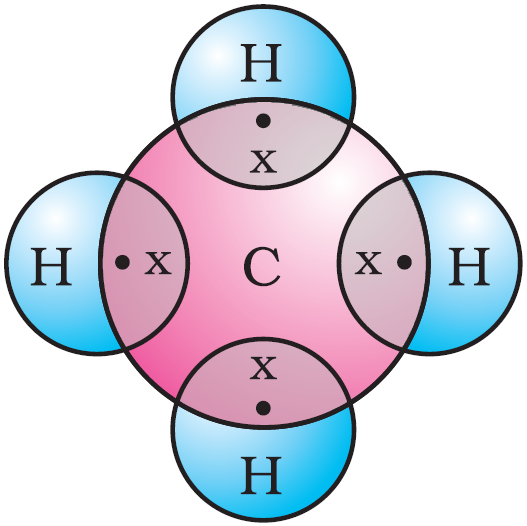
What is methane? Draw its electron dot structure. Name the type of bonds formed in this compound. Why are such compounds:
  1. Poor conductors of electricity?
  2. Have low melting and boiling points? What happens when this compound burns in oxygen?
Answer
Methane is a colourless, odourless and highly flammable gas which is the main component of natural gas. It is also called as marsh gas as it is produced when vegetation decomposes naturally in any swampy or marshlands. Electron Dot structure of methane is: The type of bonds present in methane are all covalent bonds between four hydrogen atoms and the single carbon atom at the center of the molecule.
  1. Methane is a poor conductor of electricity because in methane all bonds are covalent bonds and therefore no free electrons are present in the molecule that can help in the conduction of electricity.
  2. Covalent compounds have low intermolecular forces of attraction between the molecules and thus show low melting and boiling points. Since, methane is also a covalent compound thus methane has very low melting and low boiling point.
When methane is burned in the presence of Oxygen it forms Carbon dioxide gas and water as a product of the reaction.$\text{CH}_4\ +\ \text{O}_2\xrightarrow{ \ \ \ \ \ \ \ \ \ \ \ \ \ \\ \ \ }\text{CO}_2\ +\ \text{H}_2\text{O}\\^\text{Methane}\ \ ^\text{Water}\ \ \ \ \ ^\text{Carbon dioxide}\ \ \ ^\text{Water}$
View full question & answer
Question 115 Marks
Carbon cannot reduce the oxides of sodium, magnesium and aluminium to their respective metals. Why? Where are these metals placed in the reactivity series? How are these metals obtained from their ores? Take an example to explain the process of extraction along with chemical equations.
Answer
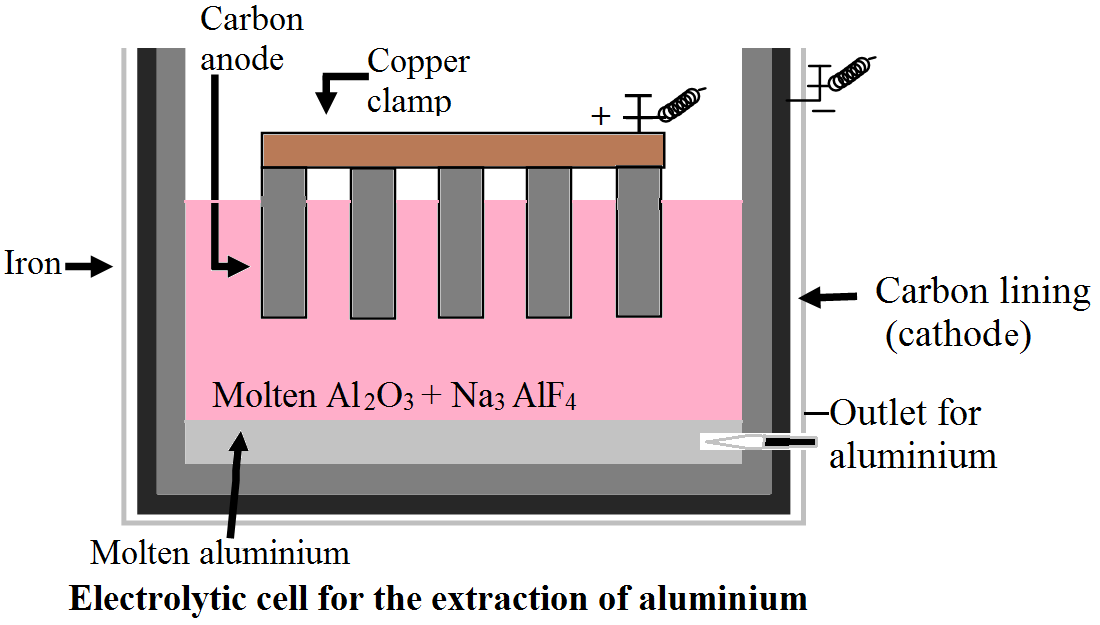
Oxides of sodium, magnesium and aluminium are very strong oxides as these metal are very reactive metals, but carbon is not a strong reducing agent and hence cannot reduce the reactive metal oxides to metals. In the reactivity series, sodium, magnesium and aluminium are placed in the upper portion which means these metals are very reactive in nature and carbon is less reactive. K > Na > Ca > Mg > Al > C > Zn > Fe. Oxides of reactive metals are directly put for electrolytic reduction process to obtain the pure metal. For the oxide of a reactive metal like aluminium oxide, as the metal is already in its oxide state so, it is directly put for the electrolytic reduction process. In this process, graphite electrodes are used as anode and cathode in the electrolytic chamber. The pure aluminium is attracted to the cathode, which is a lining of graphite. The oxygen is attracted to the anode, and bubbles through the solution. Cathode reaction: At cathode reduction of aluminium takes place and thus aluminium is discharged at the cathode.$\text{Al}^{3+}+3\text{e}^-\rightarrow\text{Al}$
Anode reaction: At anode oxidation takes place and oxygen gas is evolved.$2\text{O}^{2-}\rightarrow\text{O}_2+4\text{e}^-$
View full question & answer
Question 125 Marks
  1. List in tabular from three chemical properties on the basis of which we can differentiate between a metal and a non-metal.
  2. Give reasons for the following:
  1. Most metals conduct electricity well.
  2. The reaction of iron (III) oxide $\left[ Fe _2 O _3\right]$ with heated aluminium is used to join cracked machine parts.
Answer
  1.  
Metals
Non-Metals
Metals react with oxygen to produce basic oxides.
Non-Metals react with oxygen to produce acidic or neutral oxides.
Metals react with water to produce metal hydroxide and hydrogen gas.
Non-Metals do not react with water to produce hydrogen gas.
Generally, metals do not combine with hydrogen except sodium, potassium, calcium, and magnesium which form ionic hydrides on reacting with hydrogen.
Non-Metals react with hydrogen to form covalent hydrides.
  1.  
  1. Metals are good conductors of electricity because they contain free electrons which can move easily through the metal and conduct electric current.
  2. The reaction of iron (III) oxide with heated aluminium is a displacement reaction which is highly exothermic in nature. The amount of heat evolved is so large that the metals are produced in the molten state due to which this reaction is used to join cracked machine parts.
$\text{Fe}_2\text{O}_3(\text{s})+2\text{Al(s)}\xrightarrow{\ \ \ \ \ \ }2\text{Fe(l)}+\text{Al}_2\text{O}_3(\text{s})+\text{heat}$
View full question & answer
Question 135 Marks
A non-metal A which is the largest constituent of air, when heated with $H_2$ in 1 : 3 ratio in the presence of catalyst (Fe) gives a gas B. On heating with $O_2$ it gives an oxide C. If this oxide is passed into water in the presence of air it gives an acid D which acts as a strong oxidising agent.
  1. Identify A, B, C and D.
  2. To which group of periodic table does this non-metal belong?
Answer
  1. $N_2$ is largest constituent of air, when heated with $H_2$ in the ratio of 1 : 3.
In the presence of catalyst (Fe) gives a gas $NH_3(B).$

$\text{N}_2\text{(g)}\ \ +\ \ 3\text{H}_2\text{(g)}\ \ \xrightarrow[\text{Fe}]{773}\ \ 2\text{NH}_3\text{(s)}\\ \ \ '\text{A}'\ \ \ \ \ \ \ \ \ \text{Hydrogen}\ \ \ \ \ \ \ \ \ \ \ \ \ '\text{B}'\\ \ \ \ \ 1\ \ \ \ \ \ \ :\ \ \ \ \ \ \ 3\ \ \ \ \ \ \ \ \ \ \ \ \ \ \ \ \text{Ammonia}\\\text{Nitrogen}$

Nitrogen reacts with oxygen on heating to form nitrogen monoxide ‘C’, which gets oxidised in the presence of $O_2$ to nitrogen dioxide. Nitrogen dioxide dissolves in water in the presence of oxygen to form nitric acid which is an oxidising agent.

$\text{N}_2\text{(g) + O}_2\text{(g)}\xrightarrow{\text{heat}}2\text{NO}\\\ \ \ \ \ \ \ \ \ \ \ \ \ \ \ \ \ \ \ \ \ \ \ \ \ \ \ \ \ \ \ \ \ \ '\text{C}'$

$2\text{NO + O}_2\rightarrow2\text{NO}_2\\\ '\text{C}'$

$4\text{NO}_2+2\text{H}_2\text{O + O}_2\rightarrow4\text{HNO}_3\\\ \ \ \ \ \ \ \ \ \ \ \ \ \ \ \ \ \ \ \ \ \ \ \ \ \ \ \ \ \ \ \ \ \ \ \ \ \ \ \ \ '\text{D}'\\\ \ \ \ \ \ \ \ \ \ \ \ \ \ \ \ \ \ \ \ \ \ \ \ \ \ \ \ \ \ \ \ \ \ \ \ \ \ \text{(Nitric acid)}$
' $A$ ' is $N _2$, ' B ' is $NH _3,{ }^{\prime} C$ ' is NO and ' D ' is $HNO _3$.
  1. Group 15.
View full question & answer
Question 145 Marks
A black metal oxide XO is used as a catalyst in the preparation of oxygen gas from potassium chlorate. The oxide XO is also used in ordinary dry cells. The metal oxide XO cannot be reduced satisfactorily with carbon to form metal X.
  1. Name the metal X.
  2. Name the metal oxide XO.
  3. Which reducing agent can be used to reduce XO to obtain metal X?
  4. Name another metal which can also be extracted by the reduction of its oxide with the above reducing agent.
Answer
  1. Manganese.
  2. Manganese dioxide.
  3. Aluminium.
  4. Chromium.
View full question & answer
Question 155 Marks
Metal A burns in air, on heating, to form an oxide $A _2 O _3$ whereas another metal B burns in air only on strong heating to form an oxide BO . The two oxides $A _2 O _3$ and BO can react with hydrochloric acid as well as sodium hydroxide solution to form the corresponding salts and water.
a. What is the nature of oxide $A _2 O _3$ ?
b. What is the nature of oxide $B O$ ?
c. Name one metal like A.
d. Name one metal like B.
Answer
a. The oxide $A _2 O _3$ is amphoteric, which can react with both acids and bases to form salt and water.
b. The oxide BO is amphoteric, which can react with both acids and bases to form salt and water.
c. Aluminium is a metal like A , which forms $Al _2 O _3$ on reacting with oxygen.
d. Zinc is a metal like B which forms ZnO on strongly heating in air (oxygen).
View full question & answer
Question 165 Marks
A metal X which is resistant to corrosion is produced by the electrolysis of its molten oxide whereas another metal Y which is also resistant to corrosion is produced by the reduction of its oxide with carbon. Metal X can be used in powder form in thermite welding whereas metal Y is used in making cathodes of ordinary dry cells.
  1. Name the metals X and Y.
  2. Which of the two metals is more reactive : X or Y?
  3. Name one ore or metal X. Also write its chemical formula.
  4. Name one ore of metal Y. Also write its chemical formula.
  5. Name one alloy of metal X and one alloy of metal Y.
Answer
a. $X$ is aluminium and $Y$ is zinc.
b. X is more reactiv e than Y .
c. Bauxite; $Al _2 O _3 .2 HO$.
d. Calamine, $ZnCO _3$
e. Alloy of metal X : Duralumin ; Allo y of metal Y : Brass.
View full question & answer
Question 175 Marks
State and explain the reaction, if any, of the following metals with a solution of copper sulphate:
  1. Gold.
  2. Copper.
  3. Zinc.
  4. Mercury.
Answer
  1. Gold, being less reactive than copper, cannot displace copper from copper sulphate solution and hence, no reaction occurs.
  2. Copper reacts with copper sulphate to form copper and copper sulphate solution. So, practically no reaction occurs between them.
  3. Zinc is more reactive than copper and hence, displaces copper from its solution to form zinc sulphate solution and copper metal.$Zn ( s )+ CuSO _4( aq ) \rightarrow ZnSO _4( aq )+ Cu ( s )$
  4. Mercury, being less reactive than copper, cannot displace copper from copper sulphate solution and hence, no reaction occurs.
View full question & answer
Question 185 Marks
You are given samples of three metals — sodium, magnesium and copper. Suggest any two activities to arrange them in order of their decreasing reactivities.
Answer
  1. When sodium, magnesium and copper are left in air, sodium reacts vigorously with oxygen to form sodium oxide, magnesium reacts with oxygen to form magnesium oxide only on heating , whereas copper does not burn in air even on strong heating. It reacts only on prolonged heating. This shows that sodium is most reactive, then magnesium and copper is the least reactive among the three.
  2. Sodium reacts vigorously with cold water to form sodium hydroxide and hydrogen, magnesium does not react with cold water but reacts with hot water to form magnesium hydroxide and hydrogen but copper does not react even with steam. This shows that sodium is highly reactive; magnesium is less reactive than sodium and copper is the least reactive among the three.
View full question & answer
Question 195 Marks
An element X forms two oxides XO and $XO _2$. The oxide XO has no action on litmus solution but oxide $XO _2$ turns litmus solution red.
a. What is the nature of oxide XO ?
b. What is the nature of oxide $XO _2$ ?
c. Would you call element $X$ a metal or a non-metal? Give reason for your choice.
d. Can you give an example of element like $X$ ?
Answer
a. The oxide XO is neutral in nature as it has no action on litmus solution.
b. The oxide $XO _2$ is acidic in nature as it turns litmus solution red.
c. The element X is a non-metal because it forms an acidic and neutral oxide, which is the property of a non-metal.
d. Carbon is a non-metal like the element $X$.
View full question & answer
Question 205 Marks
When an object made of metal A is kept in air for a considerable time, it loses its shine and becomes almost black due to the formation of a layer of substance B. When an object made of another metal C is kept in damp air for a considerable time, it gets covered with a green layer of substance D. Metal A is the best conductor of electricity whereas metal C is the next best conductor of electricity.
  1. What is metal A?
  2. What is metal C?
  3. Name the substance B.
  4. Name the substance D.
  5. What type of chemical can be used to remove the green layer from metal C and clean it? Why?
Answer
  1. Silver.
  2. Copper.
  3. Silver sulphide.
  4. Basic copper carbonate.
  5. Dilute acid solution; The acid sol ution dissolves green coloured basic copper carbonate present on the corroded copper object makes it look shiny, red brown again.
View full question & answer
Question 215 Marks
Write the equations for the reactions of:
  1. Magnesium with dilute hydrochloric acid.
  2. Aluminium with dilute hydrochloric acid.
  3. Zinc with dilute hydrochloric acid.
  4. Iron with dilute hydrochloric acid.
Name the products formed in each case. Also indicate the physical states of all the substances involved.
Answer
  1. $\text{Mg(s)}+2\text{HCl(aq)}\rightarrow\text{MgCl}_2\text{(aq)}+\text{H}_2\text{(g)}$
The products formed are maginisium chloride and hydrogen.
  1. $2\text{Al(s)}+6\text{HCl(aq)}\rightarrow2\text{AlCl}_3\text{(aq)}+3\text{H}_2\text{(g)}$
The products formed are aluminium chloride and hydrogen.
  1. $\text{Zn(s)}+2\text{HCl(aq)}\rightarrow\text{ZnCl}_2\text{(aq)}+\text{H}_2\text{(g)}$
The products formed are zinc chloride and hydrogen.
  1. $\text{Fe(s)}+2\text{HCl(aq)}\rightarrow\text{FeCl}_2\text{(aq)}+\text{H}_2\text{(g)}$
The products formed are iron chloride and hydrogen.
View full question & answer
Question 225 Marks
Explain why, a salt which does not conduct electricity in the solid state becomes a good conductor in molten state.
Answer
Although solid ionic compounds are made up of ions but they do not conduct electricity in solid state. This is because in the solid ionic compound, the ions are held together in fixed positions by strong electrostatic forces and cannot move freely. However, when we dissolve the ionic solid in water or melt it, the crystal structure is broken down and ions become free to move and conduct electricity.
Thus, an aqueous solution of an ionic compound conducts electricity because there are plenty of free ions in the solution which are able to conduct electric current.
View full question & answer
Question 235 Marks
Four metals P, Q, R and S are all obtained by the reduction of their oxides with carbon. Metal P is used to form a thin layer over the sheets of metal S to prevent its corrosion. Metal Q is used for electroplating tiffin boxes made of metal S whereas metal R is used in making car batteries. Metals Q and R form an alloy called solder. What are metals P, Q, R and S? How have you arrived at this conclusion?
Answer
  • Metal P is zinc; Metal Q is tin; Metal R is lead; Metal S is iron.
  • Metal P (zinc) is used to form a thin layer on metal S (iron) by the process of galvanisation to prevent its corrosion.
  • Metal Q (tin) i s used for electroplating tiffin boxes made of metal S (iron).
  • Metal R (lead) is used in making car batteries.
  • Metals Q (tin) and R (lead) form an alloy called solder .
View full question & answer
Question 245 Marks
Compare the properties of ionic compounds and covalent compounds.
Answer
Ionic compounds
  1. Ionic compounds are usually crystalline solids.
  2. Ionic compounds have high melting and boiling points.
  3. Ionic compounds are usually soluble in water.
Covalent compounds
  1. Covalent compounds are usually liquids or gases.
  2. Covalent compounds have low melting and boiling points.
  3. Covalent compounds are usually insoluble in water.
View full question & answer
Question 255 Marks
What are alloys? How are they made? Name the constituents and uses of brass, bronze and solder.
Answer
Alloys are homogeneous mixtures of two or more metals or a metal and a non metal.
They are prepared in the following ways:
  1. Melting the primary metal.
  2. Dissolving the other elements in a definite proportion and then cooling them to room temperature.
Constituents and uses of the alloys are:
  1. Brass: It is an alloy of copper and zinc
Uses: In making utensils and scientific instruments.
  1. Bronze: It is an alloy of copper and tin.
Uses: In making statues and medals.
  1. Solder: It is an alloy of lead and tin.
Uses: In soldering (welding) electrical wires together.
View full question & answer
Question 265 Marks
State any five physical properties of metals and five physical properties of non-metals.
Answer
Properties of metals:
  1. Metals are malleable i.e. they can be beaten into thin sheets with a hammer.
  2. Metals are ductile i.e. they can be drawn into thin wires.
  3. Metals are good conductors of heat and electricity.
  4. Metals are lustrous.
  5. Metals are generally hard.
Properties of non-metals:
  1. Non-metals are non-malleable i.e. they cannot be beaten into thin sheets with a hammer.
  2. Non-metals are non-ductile i.e. they cannot be drawn into thin wires
  3. Non-m etals are bad conductors of heat and electricity.
  4. Non-m etals are non- lustrous.
  5. Non-m etals are generally soft.
View full question & answer
Question 275 Marks
With the help of a suitable example, explain how ionic compounds are formed State any three general properties of ionic compounds.
Answer
Ionic compounds are formed when a metal and a non metal react with each other.ie, positive and negative charges. eg: Na(metal) + Cl(non memtal) - NaCl
Properties: Ionic compounds have a strong electrostatic force of attraction. They have high melting and boiling points. They can dissolve in other ionic compunds like water.
View full question & answer
Question 285 Marks
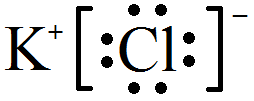
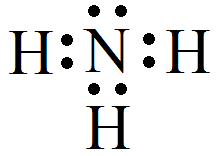
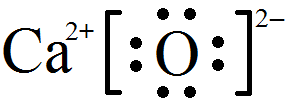
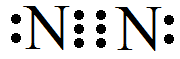
Draw the electron-dot structures of the following compounds and state the type of bonding in each case:
i. KCl
ii. $NH _3$
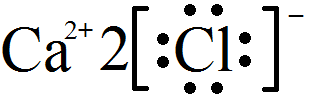
iii. CaO
iv. $N _2$
v. $CaCl _2$
Answer
  1. KCl - lonic bond
  1. $NH_3$ - Covalent bond
  1. CaO - lonic bond
  1. $N_2$ - Covalent bond
  1. $CaCl_2$ - lonic bond
View full question & answer
Question 295 Marks
Explain the following.
1. Reactivity of Al decreases if it is dipped in $HNO _3$.
2. Carbon cannot reduce the oxides of Na or Mg .
3. NaCl is not a conductor of electricity in solid state whereas it does conduct electricity in aqueous solution as well as in molten state.
4. Iron articles are galvanised.
5. Metals like $Na , K , Ca$ and Mg are never found in their free state in nature.
Answer
  1. Since nitric acid is an oxidizing agent so it reacts with aluminium and forms a layer of aluminium oxide over metal surface which further reduces the reactivity of metal.
  2. Alkali and alkaline earth metals are very reactive and readily react with oxygen to form their stable oxides. The reduction of these metallic oxides with carbon requires very high temperature and at that temperature metals react with carbon to form their corresponding carbides. Hence they cannot reduce with the help of carbon as reducing agent.
  3. NaCl is an ionic compound. In solid state, oppositely charged ions are held tightly with strong metallic bond. So neither metal ions nor free electrons can move from their position. Therefore NaCl and other ionic compounds cannot conduct electricity in their solid state. In molten state or in aqueous, the free electrons and metal ions are free enough to carry charge which makes them good conductor.
  4. Galvanisation is a process of formation of thin layer over metal surface. It prevents further contact of metal surface with atmosphere and reduces the corrosion level. So iron articles are galvanized by making a thin layer of zinc over them. Since zinc is more reactive than iron so it will react first and protect iron surface.
  5. Na, K, Ca and Mg are alkali and alkaline earth metals. They are most reactive metal and readily react with atmospheric oxygen and other gases. Therefore they are found in nature in the form of their compounds.
View full question & answer
Question 305 Marks
Give the steps involved in the extraction of metals of low and medium reactivity from their respective sulphide ores.
Answer
Extraction of Metals present low in the Activity series:
Silver (Ag), gold (Au) and platinum (Pt) generally occur in the free or native state. This means that they can be isolated rather easily. Metals like copper (Cu) and mercury (Hg) are comparitively more reactive and occur in combined states. For example, the ore of mercury is cinnabar (HgS) while that of copper is copper glance ($Cu_2S$). Both are converted into metallic form upon heating in air or oxygen.

$2\text{HgS(s)}\ \ \ \ \ \ \ +\ \ \ \ \text{ 3O}_2\text{(g)}\ \ \ \ \xrightarrow{\text{heat}}\ \ \ 2\text{HgO(s) + 2SO}_2\text{(g)}\\\text{Mercuric sulphide}\ \ \ \ \ \ \ \ \ \ \ \ \ \ \ \ \ \ \ \ \ \ \ \ \ \text{Mercuric oxide}$

$2\text{HgO(s)}\xrightarrow{\text{heat}}2\text{Hg(l) + O}_2\text{(g)}$

Similarly,

$2\text{Cu}_2\text{S(s)}\ \ \ \ \ \ \ \ +\ \ \ \ \ \ \text{ 3O}_2\text{(g)}\ \ \xrightarrow{\text{heat}}\ \ 2\text{Cu}_2\text{O(s) + 2SO}_2\text{(g)}\\\text{Cuprous sulphide}\ \ \ \ \ \ \ \ \ \ \ \ \ \ \ \ \ \ \ \ \ \ \ \ \ \ \ \ \text{Cuprous oxide}$

$2\text{Cu}_2\text{O(s) + Cu}_2\text{S(s)}\xrightarrow{\text{heat}}6\text{Cu(s) + SO}_2\text{(g)}$
Extraction of Metals present in the middle of the Activity series:

The metals present in the middle of the series are zinc, iron, chromium, nickel, cobalt, lead etc. These are usually present as sulphides or carbonares in nature. However, it is quite easy to obtain a metal from its oxide form which is then reduced to the metallic state. The various steps involved in the process of extraction are briefly discussed.
  1. Calcination:
Calcination may be defined as the process of heating the ore below its melting point in the absence of air.

As a result of calcination, the following changes take place.

Moisture is driven out and the ore becomes dry.

$\text{CuSO}_4.5\text{H}_2\text{O}\xrightarrow{\text{heat}}\text{CuSO}_4+5\text{H}_2\text{O}\\\text{Blue vitriol}\ \ \ \ \ \ \ \ \ \ \ \ \ \ \text{White}$

$\text{Fe}_2\text{O}_3.3\text{H}_2\text{O}\xrightarrow{\text{heat}}\text{Fe}_2\text{O}_3\ \ \ +\ \ \ 3\text{H}_2\text{O}\\\text{Limonite}\ \ \ \ \ \ \ \ \ \ \ \ \ \ \text{Ferric Oxide}$

Some hydrated ores decompose and become anhydrous by losing molecules of water of crystallisation. For example, heat

$\text{ZnCO}_3\xrightarrow{\text{heat}}\text{ZnO}+\text{CO}_2$

$\text{PbCO}_3\xrightarrow{\text{heat}}\text{PbO}+\text{CO}_2$

$\text{CaCO}_3.\text{MgCO}_3\xrightarrow{\text{heat}}\text{CaO}+\text{MgO}+2\text{CO}_2\\ \ \ \ \ \ \ \text{Dolomite}$
  1. Roasting:
Roasting may be defined as the process of heating the ore below its melting point with excess of air.

As a result of roasting, the following changes occur:
  • Any organic matter if present, gets destroyed.
  • Impurities of non-metals such as sulphur, arsenic or phosphorus are converted into their volatile oxides which are removed. For example,
$\text{S}_8+8\text{O}_2\xrightarrow{\text{heat}}8\text{SO}_2\text{(g)}\\ \ \ \ \ \ \ \ \ \ \ \ \ \ \ \ \ \ \ \ \ \ \ \ \ \ \text{Sulphur dioxide}$

$\text{P}_4+5\text{O}_2\xrightarrow{\text{heat}}\text{P}_4\text{O}_{10}\text{(s)}\\ \ \ \ \ \ \ \ \ \ \ \ \ \ \ \ \ \ \ \ \ \ \ \text{Phosphorus (V) oxide}$

$4\text{As}+3\text{O}_2\xrightarrow{\text{heat}}2\text{As}_2\text{O}_3\text{(s)}\\ \ \ \ \ \ \ \ \ \ \ \ \ \ \ \ \ \ \ \ \ \ \ \ \ \ \text{Arsenic oxide} $
  • Sulphides of the metals are converted into their oxides. For example,
$2 ZnS+3 O_2 \rightarrow 2 ZnO+2 SO_2(g)$
$2 PbS+3 O_2 \rightarrow 2 PbO+2 SO_2(g)$
  • Small amounts of sulphides may also be converted into sulphates asresult of roasting. For example,
$ZnS+2 O_2 \rightarrow ZnSO_4$
$PbS+2 O_2 \rightarrow PbSO_4$
View full question & answer
Question 315 Marks
State one use each of the following metals:
Copper, Aluminium, Iron, Silver, Gold, Mercury
Answer
  1. Copper – Copper is used to make wires to carry electric current.
  2. Aluminium – Aluminium foils are used in packaging of food materials.
  3. Iron – Iron is used to make utensils.
  4. Silver – Silver is used to make jewellery.
  5. Gold – Gold is used to make jewellery.
  6. Mercury – Mercury is used in thermometers.
View full question & answer
Question 325 Marks
An element A which is a part of common salt and kept under kerosene reacts with another element B of atomic number 17 to give a product C. When an aqueous solution of product C is electrolysed then a compound D is formed and two gases are liberated.
  1. What are A and B?
  2. Identify C and D.
  3. What will be the action of C on litmus solution? Why?
  4. State whether element B is a solid, liquid or gas at room temperature.
  5. Write formula of the compound formed when element B reacts with an element E having atomic number 5.
Answer
  1. A is sodium and B is chlo rine.
  2. C is sodium chloride and D is sodium hydroxide.
  3. C will have no effect on litmus solution since it is neutral in nature.
  4. B is a gas at room temperature.
  5. EB3.
View full question & answer
Question 335 Marks
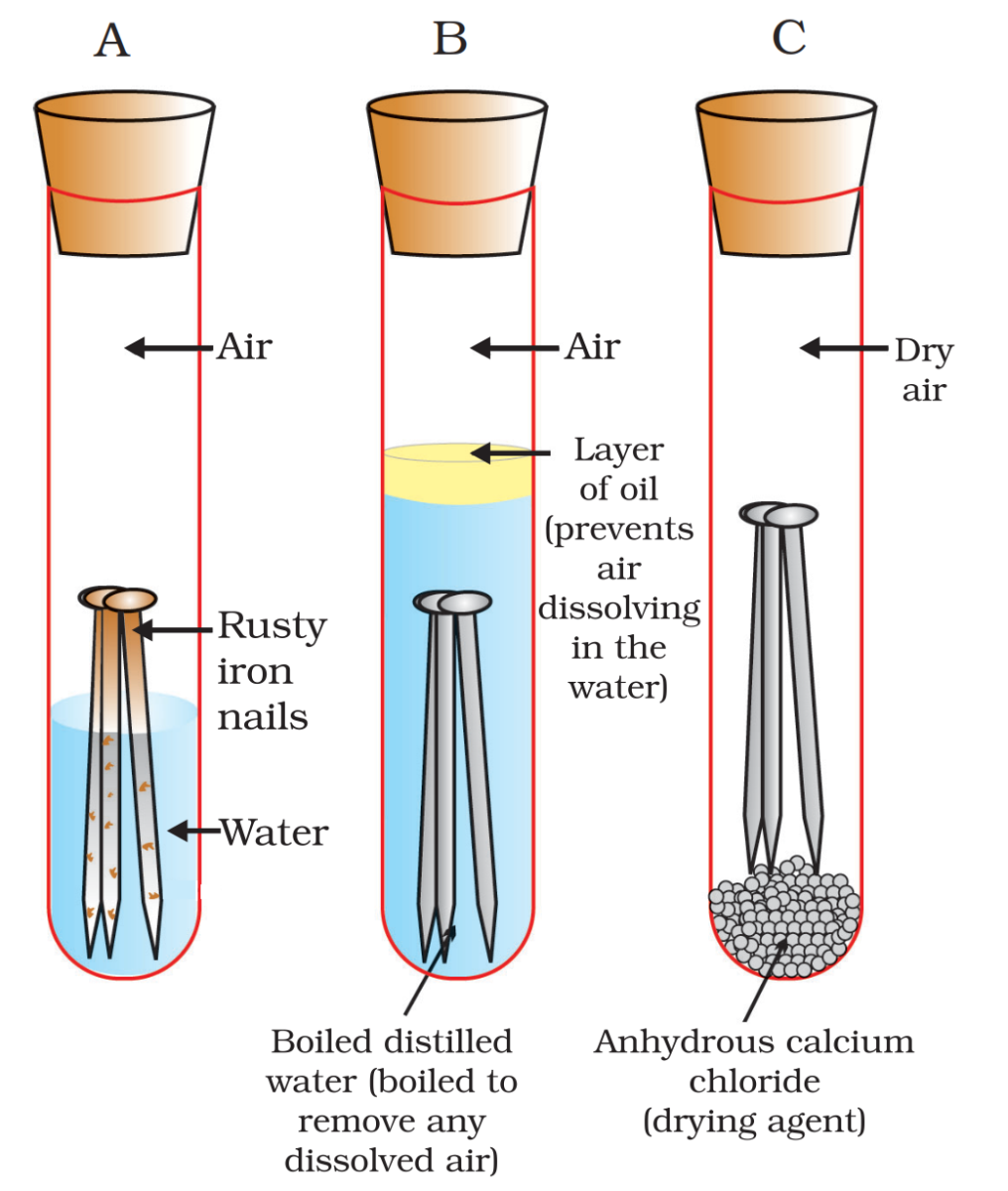
What is meant by ‘rusting of iron’? With the help of labelled diagrams, describe an activity to find out the conditions under which iron rusts.
Answer
When an iron object is left in damp air (or water) for a considerable time, it gets covered with a red-brown flaky substance called rust. This is called rusting of iron. Experiment to show that rusting of Iron requires both, air and water: We take three test-tubes and put one clean iron nail in each of the three test-tubes:
  1. In the first test-tube containing iron nail, we put some anhydrous calcium chloride and close its mouth with a tight cork . Anhydrous calcium chloride absorbs water moisture from the damp air present in the test-tube and make it dry. In this way, the iron nail in the first test-tube is kept in dry air (having no water vapour in it).
  2. In the second test-tube containing iron nail , we put boiled distilled water. Boiled water does not contain any dissolved air (or oxygen) in it (this is because the process of boiling removes all the dissolved air from it). A layer of oil is put over boiled water in the test-tub e to prevent the outside air from mixing with boiled water. In this way, the iron nail in the second test-tube is kept in air free boiled water.
  3. In the third test-tube containing an iron nail, we put unboiled wa ter so that about two-thirds of nail is immersed in water and the rest is a bove the water, exposed to damp air. In this way , the iron nail in the third test-tube has been placed in air and water together.
The mouth of all three test tube s is cl osed with a cork and it is kept aside for about one week.
After one week, we observe the iron nails kept in all the three test-tubes, one by one. We find that,
  1. No rust is seen on the surface of iron nai l kept in dry air (water-f ree air) in the first test-tube. This tells us that rusting of iron does not take place in air alone.
  2. No rust is seen on the surface of iron nail kept in air-free, boiled water in the second testtube. This tells us that rusting of iron does not take place in water alone.
  3. Red-brown rust is seen on the surface of iron nail kept in the presence of both air and water together the third test-tube. This tells us that rusting of iron takes pla ce in the presence of both air and water together.
View full question & answer
Question 345 Marks
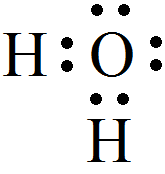
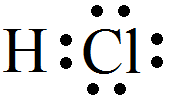
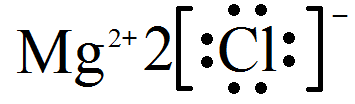
Draw the electron-dot structures of the following compounds and state the type of bonding in each case:
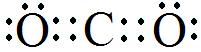
i. $CO _2$
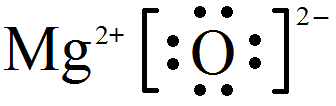
ii. MgO
iii. $H , O$
iv. HCl
v. $MgCl _2$
Answer
  1. $CO _2$ - Covalent bond
  1. MgO - lonic bond
  1. $H_2O$ - Covalent bond
  1. HCl - Covalent bond
  1. $MgCl_2$ - lonic bond
View full question & answer
Question 355 Marks
Sample of five metals ‘A’, ‘B’, ‘C’, ‘D’ and ‘E’ was taken and added to the following solution one by one. The results obtained have been tabulated as follows.
Metal $FeSO _4$ $CuSO _4$ $ZnSO _4$ $AgNO _3$ $Al _2\left( SO _4\right)_3$ $MgSO _4$
A No reaction Displacement No reaction Displacement No reaction No reaction
B Displacement Displacement No reaction Displacement No reaction No reaction
C No reaction No reaction No reaction Displacement No reaction No reaction
D No reaction No reaction No reaction No reaction No reaction No reaction
E Displacement Displacement Displacement Displacement No reaction No reaction
Use the above table to answer the following questions about the given metals.
  1. Which of them is most reactive and why?
  2. What would you observe if ‘B’ is added to $CuSO_4$?
  3. Arrange ‘A’, ‘B’, ‘C’, ‘D’ and ‘E’ in the increasing order of reactivity.
  4. Container of which metal can store zinc sulphate and silver nitrate solution?
  5. Which of the above solution(s) can be stored in a container made of any of these metals and why?
Answer
  1. E is most reactive. Because it react with most substances.
  2. Reddish brown deposit of copper will be formed since displacement has taken place.
  3. E > B > A > C > D reason: The more it reacts the more reactive it is. Just count a number of displacements a metal will give.
  4. Container of metal D can be used for this purpose as it does not react with any of them.
  5. Aluminium and magnesium sulphates can be used to store in any container because the react with none.
View full question & answer
Question 365 Marks
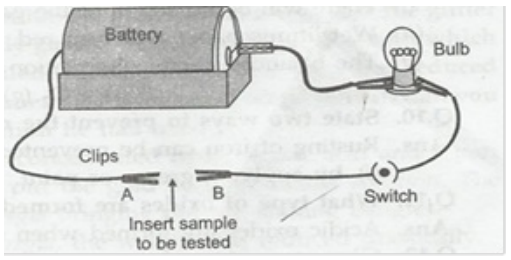
You are given a hammer, a battery, a bulb, wires and a switch.
  1. How could you use them to distinguish between samples of metals and non-metals?
  2. Assess the usefulness of these tests in distinguishing between metals and non-metals.
Answer
  1. with the hammer, we can beat the sample and if it can be beaten into thin sheets (that is, it is malleable), then it is a metal otherwise a non-metal. Similarly we can use the battery, bulb, wires and a switch to set up a circuit with the sample. If the sample conductss electricity, then it is a metal otherwise a non-metal.
  1. The above test are useful in distinguishimng between metals and non-metals as these are based on the physical properties. no chemical reactions are invloved in these test. Hammer is a reliable method because no non-metal can be spread into sheet because non-metal carbon in the form of graphite is a conductor of electricity.
View full question & answer
Question 375 Marks
What is meant by refining of a metal? Name the most widely used method for the refining of impure metals obtained by various reduction processes. Describe this method with the help of a labelled diagram by taking the example of any metal.
Answer
The process of purifying impure metals is called refining of metals. Electrolytic refining is the most widely used method for the refining of impure metals obtained
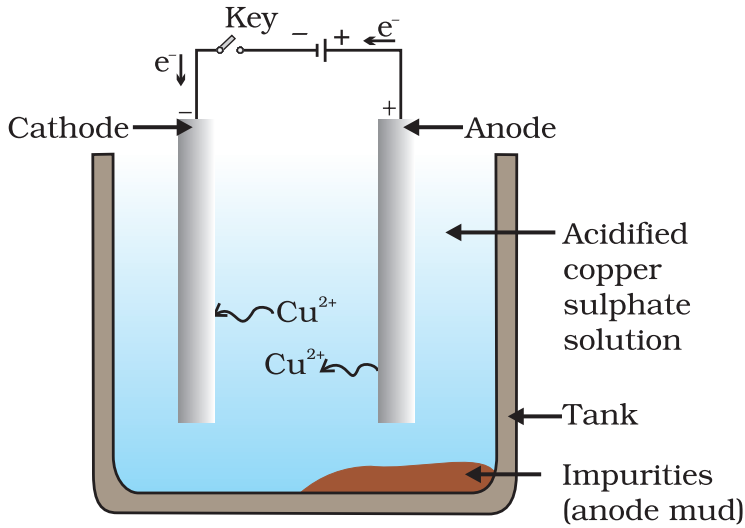
by various reduction processes. In an electrolytic tank, acidified copper sulphate $\left( CuSO _4{ }^{+}\right.$dil ute $\left.H _2 O _4\right)$ solution forms the electrolyte. A block of impure copper is made into an anode by connecting the positive terminal of a power supply (battery). A thin strip of highly pure copper metal is the cathode of the cell. The negative terminal of the power supply is connected to it.
A small electric curr ent is passed through the cell. Atoms from the anode enter the electrolyte. The copper from the anode gets converted into copper sulphide. An equal number of copper atoms from the solution get deposited on the cathode. This is to keep the concentration of the solution constant. Impurities from the anode block either remain in solution or collect below the anode, as they are unable to displace copper from the sulphate solution. The insoluble impurities remain in the electrolyte and are called anode mud. Copper sulphate solution contains ions of $Cu ^{2+}$ and $SO _4{ }^{2-}$  The following reactions take place at the anode and cathode when an electric current is passed.$\text{At cathode:}\ \ \ \ \ \ \ \ \ \ \ \ \ \text{Cu}^{2+}\ \ \ \ \ \ \ \ \ \ \ \ \ \ \ \ \ \ \ \xrightarrow[\text{(Reduction)}]{+2\text{electrons}}\ \ \ \ \ \ \ \ \ \ \ \ \ \ \ \ \ \ \text{Cu}\\\ \ \ \ \ \ \ \ \ \ \ \ \ \ \ \ \ \ \ \ \ \ \ \ \ \ \ \text{Copper ion}\ \ \ \ \ \ \ \ \ \ \ \ \ \ \ \ \ \ \ \ \ \ \ \ \ \ \ \ \ \ \ \ \ \ \ \ \ \ \ \ \ \ \ \ \text{Copper atom}\\\ \ \ \ \ \ \ \ \ \ \ \ \ \ \ \ \ \ \ \ \ \text{(From electrolyte)}\ \ \ \ \ \ \ \ \ \ \ \ \ \ \ \ \ \ \ \ \ \ \ \ \ \ \ \ \ \ \ \ \text{(Deposits on cathode)}$
$\text{At anode:}\ \ \ \ \ \ \ \ \ \ \ \ \ \ \ \ \ \ \ \ \ \ \text{Cu}\ \ \ \ \ \ \ \ \ \ \ \ \ \ \ \ \ \ \ \xrightarrow[\text{(oxidation)}]{-2\text{electrons}}\ \ \ \ \ \ \ \ \ \ \ \ \ \ \ \ \ \ \text{Cu}^{2+}\\\ \ \ \ \ \ \ \ \ \ \ \ \ \ \ \ \ \ \ \ \ \ \ \ \ \ \ \text{Copper atom}\ \ \ \ \ \ \ \ \ \ \ \ \ \ \ \ \ \ \ \ \ \ \ \ \ \ \ \ \ \ \ \ \ \ \ \ \ \ \ \ \ \ \ \ \text{Copper ion}\\\ \ \ \ \ \ \ \ \ \ \ \ \ \ \ \ \ \ \ \text{(From impure anode)}\ \ \ \ \ \ \ \ \ \ \ \ \ \ \ \ \ \ \ \ \ \ \ \ \ \ \ \ \ \ \ \ \text{(Goes into electrolyte)}$
Pure copper is scraped or removed from the cathode. Anode becomes thinner as the electrolysis process proceeds. Some important metals like gold and silver are present in the anode mud. These can be recovered separately.
View full question & answer
Question 385 Marks
State five uses of metals and five of non-metals.
Answer
Uses of metals:
  1. Lead metal is used in making car batteries.
  2. Zinc is used for galvanizing iron to protect it from rusting.
  3. Iron, copper and aluminium are used to make utensils.
  4. Copper and aluminium metals are used to make electrical wires.
  5. Aluminium is used to make aluminium foil for packaging materials.
Uses of non-metals:
  1. Hydrogen is used in the hydrogenation of vegetable oils.
  2. Carbon is used to make electrodes of electrolytic cells and dry cells.
  3. Nitrogen is used in the manufacture of ammonia, nitric acid and fertilizers.
  4. Sulphur is used for producing sulphuric acid.
  5. Liquid hydrogen is used as rocket fuel.
View full question & answer
Question 395 Marks
  1. Given below are the steps for extraction of copper from its ore. Write the reaction involved.
    1. Roasting of copper (1) sulphide.
    2. Reduction of copper (1) oxide with copper (1) sulphide.
    3. Electrolytic refining.
  2. Draw a neat and well labelled diagram for electrolytic refining of copper.
Answer
  1. Given below are the steps.
  1. Roasting:
$2\text{Cu}_2\text{S(s) + 3O}_2\text{(g)}\xrightarrow{\text{heat}}2\text{Cu}_2\text{O(s) + 2SO}_2\text{(g)}$
  1. Reduction:
$2\text{Cu}_2\text{O(s) + Cu}_2\text{S(s)}\xrightarrow{\text{heat}}6\text{Cu}\text{(s) + SO}_2\text{(g)}$
This reaction in which one of the reactants $\left( Cu _2 S\right)$ carries the reduction of the product $\left( Cu _2 O \right)$ is known as auto-reduction.
3. Reactions taking place in electrorefensing are:

At cathode (reduction): $Cu ^{2+}( aq )+2 e ^{-} \rightarrow Cu ( s )$

At anode (oxidation): $Cu ( s ) \rightarrow Cu ^{2+}( aq )+2 e ^{-}$
  1. For the diagram of electro-refining,
View full question & answer
Question 405 Marks
A metal which exists as a liquid at room temperature is obtained by heating its sulphide ore in the presence of air.
  1. Name the metal and write its chemical symbol.
  2. Write the name and formula of the sulphide ore.
  3. Give the equations of chemical reactions involved in the production of metal from its sulphide ore.
  4. Name a common device in which this metal is used.
  5. Can this metal displace copper from copper sulphate solution? Why?
Answer
  1. Mercury, Hg.
  2. Cinnabar, HgS.
  3. $\ \ \ \ \ \ \ \ \ 2\text{HgS}\text{(s)}\ \ \ \ \ \ \ \ \ \ \ \ \ \ +\ \ \ \ \ \ \ \ \ \ \ 3\text{O}_2\xrightarrow{\ \ \ \ \text{Rcesting}\ \ \ }\ \ \ \ \ \ \ 2\text{Hg(s)}\ \ \ \ \ \ \ \ \ \ +\ \ \ \ \ \ \ \ \ \ \ \text{2SO}_2\text{(g)}\\\text{Mercury (II) Sulphide}\ \ \ \ \ \ \ \ \ \ \ \text{Oxygen}\ \ \ \ \ \ \ \ \ \ \ \ \ \ \text{Mercury (II) Oxide}\ \ \ \ \ \ \ \ \text{Sulphur dioxide}$
$\ \ \ \ \ \ \ \ \ \ \ \ 2\text{HgO}\text{(s)}\ \ \ \ \ \ \ \ \ \ \xrightarrow[\text{Rcesting}]{\ \ \ \ \text{Heat}\ \ \ }\ \ \ \ \ \ \ \ \ 2\text{Hg(l)}\ \ \ \ \ +\ \ \ \ \ \text{O}_2\text{(g)}\\\text{Mercury (III) Oxide}\ \ \ \ \ \ \ \ \ \ \ \ \ \ \ \ \ \ \ \ \text{Mercury metal}\ \ \ \ \ \ \ \text{Oxygen}$
  1. Thermometer.
  2. No; Because it is less reactive than copper.
View full question & answer
Question 415 Marks
Four metal A, B, C and D are added to the following aqueous solutions one by one. The observations made are tabulated below:
Metal
Iron (II) sulphate
Copper (II) sulphate
Zinc sulphate
Silver nitrate
A
No reaction
Reddishbrown deposit
________
________
B
Grey deposit
________
No reaction
________
C
No reaction
No reaction
No reaction
White shining deposit
D
No reaction
No reaction
No reaction
No reaction
Answer the following questions based on the above observations:
  1. Which is the most active metal and why?
  2. What would be observed if B is added to a solution of copper (II) sulphate and why
  3. Arrange the metal A, B, C and D in order of increasing reactivity.
  4. The container of which metal can be used to store both zinc sulphate solution and silver nitrate solution?
  5. Which of the above solutions can be easily stored in a container made up of any of these metals?
Answer
  1. Metals lying low in the reactivity series are obtained by just heating their oxides alone. Mercury is obtained by heating mercurous oxide. Metals high up in the reactivity series are obtained by electrolytic reduction. Sodium is obtained by the electrolysis of their molten chlorides.
  2. Formation of sodium chloride by electronic dot structure.
  • Na = 2, 8, 1
  • Cl = 2, 8, 7
  1. When a highly reactive metal is dropped in water:
  • Reaction will be highly exothermic and the hydrogen gas evolved catches fire immediately.
  • Metal starts floating.
OR
  • B is the most active metal because it displaces iron from its salt solution.
  • B will displace Cu from $CuSO_4$ since it is more reactive than copper.
  • D < C < A < B
  1. d. Container of metal D can be used to store both $ZnSO _4$ and $AgNO _3$ solution because it cannot displace Zn and Ag from their salt solutions.
    e. $ZnSO _4$ can be stored in a container made up of any of these metals.
View full question & answer
Question 425 Marks
State one use each of the following non-metals:
Hydrogen, Carbon (as Graphite), Nitrogen, Sulphur
Answer
  1. Hydrogen – Hydrogen is used in the hydrogenation of vegetable oils.
  2. Carbon is used to make electrodes of electrolytic cells and dry cells.
  3. Nitrogen is used in the manufacture of ammonia, nitric acid and fertilizers.
  4. Sulphur is used in making sulphuric acid.
View full question & answer
Question 435 Marks
How are metals refined by the electrolytic process? Describe the electrolytic refining of copper with the help of a neat labelled diagram.
Answer
For the refining of an impure metal by the process of electrolysis, a thick block of impure metal is made anode (connected to +ve terminal of the battery) and a thin strip of the pure metal is made cathode (connected to -ve terminal of battery). A water soluble salt (of the metal to be refined) is taken as electrolyte. On passing current, impure metal dissolves from the anode and goes into the electrolyte solution. And pure metal from the electrolyte deposits on the cathode. Electrolytic refining of copper: In an electrolytic tank, acidified copper sulphate ( $CuSO _4^{+}$dilute $\left.H _2 O _4\right)$ solution forms the electrolyte. A block of impure copper is made into an anode by connectig the positive terminal of a power supply (battery). A thin strip of highly pure copper metal is the cathode of the cell. The negative terminal of the power supply is connected to it. cathode of the cell. The negative terminal of the power supply is connected to it.
A small electric curr ent is passed through the cell. Atoms from the anode enter the electrolyte. The copper from the anode gets converted into copper sulphide. An equal number of copper atoms from the solution get deposited on the cathode. This is to keep the concentration of the solution constant. Impurities from the anode block either remain in solution or collect below the anode, as they are unable to displace copper form the sulphate solution.

The insoluble impurities remain in the electrolyte and are called anode mud. Copper sulphate solution contains ions of $Cu ^{2+}$ and $SO _4{ }^{2-}$. The following reactions take
place at the anode and cathode when an electric current is passed..$\text{At cathode:}\ \ \ \ \ \ \ \ \ \ \ \ \ \text{Cu}^{2+}\ \ \ \ \ \ \ \ \ \ \ \ \ \ \ \ \ \ \ \xrightarrow[\text{(Reduction)}]{+2\text{electrons}}\ \ \ \ \ \ \ \ \ \ \ \ \ \ \ \ \ \ \text{Cu}\\\ \ \ \ \ \ \ \ \ \ \ \ \ \ \ \ \ \ \ \ \ \ \ \ \ \ \ \text{Copper ion}\ \ \ \ \ \ \ \ \ \ \ \ \ \ \ \ \ \ \ \ \ \ \ \ \ \ \ \ \ \ \ \ \ \ \ \ \ \ \ \ \ \ \ \ \text{Copper atom}\\\ \ \ \ \ \ \ \ \ \ \ \ \ \ \ \ \ \ \ \ \ \text{(From electrolyte)}\ \ \ \ \ \ \ \ \ \ \ \ \ \ \ \ \ \ \ \ \ \ \ \ \ \ \ \ \ \ \ \ \text{(Deposits on cathode)}$
$\text{At anode:}\ \ \ \ \ \ \ \ \ \ \ \ \ \ \ \ \ \ \ \ \ \ \text{Cu}\ \ \ \ \ \ \ \ \ \ \ \ \ \ \ \ \ \ \ \xrightarrow[\text{(oxidation)}]{-2\text{electrons}}\ \ \ \ \ \ \ \ \ \ \ \ \ \ \ \ \ \ \text{Cu}^{2+}\\\ \ \ \ \ \ \ \ \ \ \ \ \ \ \ \ \ \ \ \ \ \ \ \ \ \ \ \text{Copper atom}\ \ \ \ \ \ \ \ \ \ \ \ \ \ \ \ \ \ \ \ \ \ \ \ \ \ \ \ \ \ \ \ \ \ \ \ \ \ \ \ \ \ \ \ \text{Copper ion}\\\ \ \ \ \ \ \ \ \ \ \ \ \ \ \ \ \ \ \ \text{(From impure anode)}\ \ \ \ \ \ \ \ \ \ \ \ \ \ \ \ \ \ \ \ \ \ \ \ \ \ \ \ \ \ \ \ \text{(Goes into electrolyte)}$
Pure copper is scraped or removed from the cathode. Anode becomes thinner as the electrolysis process proceeds. Some important metals like gold and silver are present in the anode mud. These can be recovered separately.
View full question & answer
Question 445 Marks
A non-metal $A$ which is the largest constituent of air, when heated with $H _2$ in $1: 3$ ratio in the presence of catalyst ( Fe ) gives a gas B . On heating with $O _2$, it gives an oxide C . If this oxide is passed into water in the presence of air, it gives an acid D which acts as a strong oxidizing agent.
i. Identify A, B, C and D.
ii. To which group of the periodic table, does this non-metal belongs?
Answer
  1. The non metal A is nitrogen, the largest constituent of air. When heated with hydrogen (not He) in the ratio 1:3 in the presence of iron catalyst it gives a gas B that is ammonia.
$\text{N}_2+3\text{H}_2\rightarrow2\text{NH}_3$

On treatment with $O_2$ it gives an oxide C that is nitrogen dioxide.

$\text{N}+\text{O}_2\rightarrow\text{NO}_2$

When this oxide is passed into water in the presence of air it gives an acid D that is nitric acid which act as strong oxidising agent.

$3\text{ NO}_2+\text{H}_2\text{O}\rightarrow2\text{ HNO}_3+\text{NO}$​

Therefore from above reactions we can easily state that,
  • A is Nitrogen.
  • B is Ammonia.
  • C is Nitrogen Dioxide.
  • D is Nitric Acid.
  1. The non-metal that is nitrogen belongs to the group 15 of the periodic table.
View full question & answer
Question 455 Marks
No chemical reaction takes place when granules of a rusty-brown solid A are mixed with the powder of another solid B. However, when the mixture is heated, a reaction takes place between its components. One of the products C is a metal and settles down in the molten state while the other product D floats over it. It was observed that the reaction is highly exothermic.
  1. What could the solids A and B be?
  2. What are the products C and D most likely to be?
  3. Write the chemical equation for the reaction between A and B leading to the formation of C.and D. Mention the physical sates of all the reactants and products in this equation and indicate the heat change which takes place.
  4. What is the special name of such a reaction? State one use of such a reaction.
  5. Name any two types of chemical reactions under which the above reaction can beclassified.
Answer
  1. A is iron ( III ) oxide and B is aluminium powder.
  2. C is molten iron metal and D is aluminium oxide.
  3. $\ \ \ \ \ \ \ \text{Fe}_2\text{O}_3\text{(s)}\ \ \ \ \ +\ \ \ \ \ 2\text{Al(s)}\ \ \ \ \ \ \ \ \ \xrightarrow{\ \ }\ \ \ \ \ \ \ \ 2\text{Fe(l)}\ \ \ \ \ \ \ +\ \ \ \ \ \ \ \ \text{Al}_2\text{O}_3\text{(s)}\ \ \ \ \ \ \ +\ \ \ \ \text{Heat}\\\text{Iron(III)}\text{Oxide}\ \ \ \text{Aluminium powder}\ \ \ \ \ \ \ \text{Iron metal}\ \ \ \ \ \ \ \ \text{Aluminium oxide}$
  4. This reaction is called thermite reaction. It is used for welding of broken pieces of heavy iron objects like railway tracks, etc.
  5. Displacement reactions and oxidation-reduction reactions.
View full question & answer
Question 465 Marks
  1. Name the following:
  1. Metal that can be cut by knife.
  2. Lustrous non-metal.
  3. Metal that exists in liquid state at room temperature.
  4. Most malleable and ductile metal.
  5. Metal that is best conductor of electricity.
  6. Non-metal that can exist in different forms.
  1. How are alloys better than metals? Give composition of solder and amalgam.
Answer
  1. Sodium (Na)/ Potassium (K)
  2. Iodine (I)
  3. Mercury (Hg)
  4. Gold (Au)
  5. Silver/ Copper
  6. Carbon/ Sulphur/ Phosphorous
  1. They are generally stronger/ have high tensile strength/ high electrical resistivity/ resistant to corrosion.
    Solder: Lead + Tin/ Pb + Sn. Amalgam - an alloy in which mercury is one of the constituent/ Any metal + mercury.
View full question & answer
[5 marks Questions] - Science STD 10 Questions - Vidyadip