Question
You may have seen in a circus a motorcyclist driving in vertical loops inside a ‘deathwell’ (a hollow spherical chamber with holes, so the spectators can watch from outside). Explain clearly why the motorcyclist does not drop down when he is at the uppermost point, with no support from below. What is the minimum speed required at the uppermost position to perform a vertical loop if the radius of the chamber is 25m?
Answer

The motorcyclist does not drop down when he is at the uppermost point if centrifugal force on motorcyclist is greater or equal to the weight of motorcyclist. i.e. $\frac{\text{mv}^2}{\text{R}}\ge\text{mg}$ $\Rightarrow\text{v}\ge\sqrt{\text{rg}}$ The minimum speed of motorcyclist not to fall from uppermost point is given by, $\text{v}_\text{min}=\sqrt{\text{rg}}$ Here, given $\text{r}=25,$ $\text{g}=9.8\text{m/s}^2$ $\therefore\text{v}_\text{min}=\sqrt{25\times9.8}=15.7\text{m/s}$

Need a full question paper?

Generate a complete, print-ready paper with questions like this in minutes — across 16+ boards, with answer keys.

Start Generating Free

Similar questions

The driver of a three-wheeler moving with a speed of 36km/h sees a child standing in the middle of the road and brings his vehicle to rest in 4.0s just in time to save the child. What is the average retarding force on the vehicle ? The mass of the three-wheeler is 400kg and the mass of the driver is 65kg.
A thin rod having length $L_0$ at $0°C$ and coefficient of linear expansion $\alpha$ has its two ends maintained at temperatures $\theta_1$ and $\theta_2,$ respectively. Find its new length.
A U-tube having unequal arm-lengths has water in it. A tuning fork of frequency $440Hz$ can set up the air in the shorter arm in its fundamental mode of vibration and the same tuning fork can set up the air in the longer arm in its first overtone vibration. Find the length of the air columns. Neglect any end effect and assume that the speed of sound in air = $330m/s$.
A stone loses $\frac{1}{10}\text{th}$ of its velocity on passing through a sand bag of length x. For its velocity to be made zero, how many more similar bags are to be placed on its path?
Two identical billiard balls strike a rigid wall with the same speed but at different angles, and get reflected without any change in speed, as shown in Fig. 4.6. What is (i) the direction of the force on the wall due to each ball? (ii) the ratio of the magnitudes of impulses imparted to the balls by the wall ?
Image
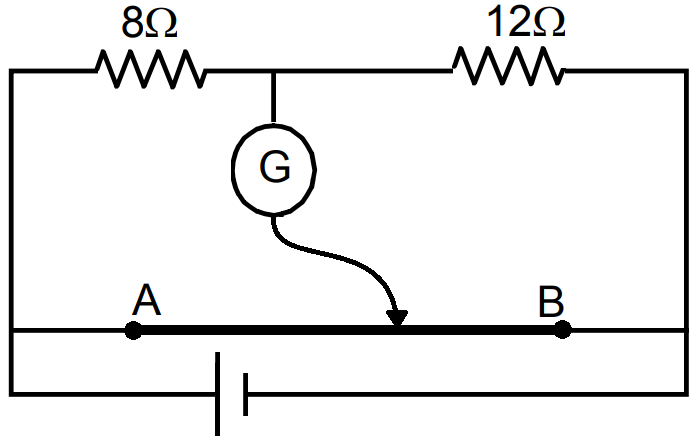
The potentiometer wire AB shown in the figure. is 40cm long. Where should the free end of the galvanometer be connected on AB so that the galvanometer may show zero deflection?
A particle on a stretched string supporting a travelling wave, takes 5.0ms to move from its mean position to the extreme position. The distance between two consecutive particles, which are at their mean positions, is 2.0cm. Find the frequency, the wavelength and the wave speed.
An inductor-coil of inductance 20mH having resistance $10\Omega$ is joined to an ideal battery of emf 5.0V. Find the rate of chenge of the induced emf at:
  1. t = 0
  2. t = 10ms
  3. t = 1.0s.
Two vector forces 5 N and 3 N are acting on a particle. Find the magnitude and direction of resultant force.(a) When both the forces are in same direction.(b) When both the forces are at right angles.(c) When both the forces are inclined at angle $60^{\circ}$.
What is the kinetic theory of gases? Explain the hypothesis of this theory and point out its limitations.