Particles of masses $1g, 2g, 3g, ........, 100g$ are kept at the marks $1cm, 2cm, 3cm, ........, 100cm$ respectively on a metre scale. Find the moment of inertia of the system of particles about a perpendicular bisector of the metre scale.
Download our app for free and get started
Masses of $1gm, 2gm ........ 100gm$ are kept at the marks $1cm, 2cm, ......... 1000cm$ on he x axis respectively. A perpendicular axis is passed at the $50^{th}$ particle.

Therefore on the L.H.S. side of the axis there will be 49 particles and on the R.H.S. side there are 50 particles.
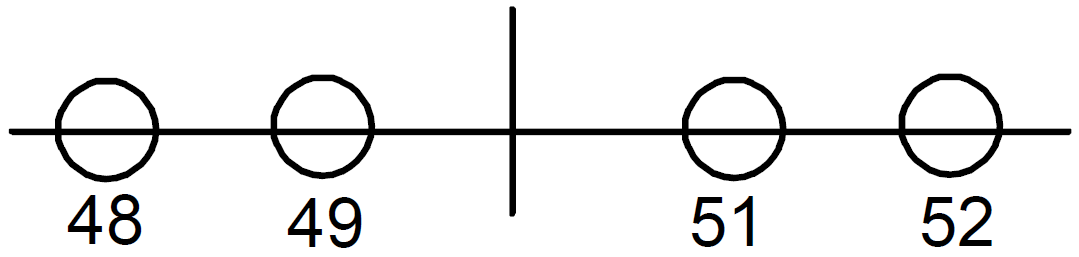
Consider the two particles at the position 49 cm and 51 cm . Moment inertial due to these two particle will be $=49 \times$ $1^2+51+1^2=100 \mathrm{gm}-\mathrm{cm}^2$ Similarly, if we consider $48^{\text {th }}$ and $52^{\text {nd }}$ term we will get $100 \times 2^2 \mathrm{gm}-\mathrm{cm}^2$ Therefore we will get 49 such set and one lone particle at 100 cm . Therefore total moment of inertia $=100\big\{1^2+2^2+3^2+\dots+49^2\big\}+100(50)^2$ $=100\times\frac{(50\times51\times101)}{6}=4292500\text{gm}\text{-cm}^2$ $=0.429\text{kg}-\text{m}^2=0.43\text{kg}\text{-m}^2$
Therefore on the L.H.S. side of the axis there will be 49 particles and on the R.H.S. side there are 50 particles.
Consider the two particles at the position 49 cm and 51 cm . Moment inertial due to these two particle will be $=49 \times$ $1^2+51+1^2=100 \mathrm{gm}-\mathrm{cm}^2$ Similarly, if we consider $48^{\text {th }}$ and $52^{\text {nd }}$ term we will get $100 \times 2^2 \mathrm{gm}-\mathrm{cm}^2$ Therefore we will get 49 such set and one lone particle at 100 cm . Therefore total moment of inertia $=100\big\{1^2+2^2+3^2+\dots+49^2\big\}+100(50)^2$ $=100\times\frac{(50\times51\times101)}{6}=4292500\text{gm}\text{-cm}^2$ $=0.429\text{kg}-\text{m}^2=0.43\text{kg}\text{-m}^2$

Download our appand get started for free
Experience the future of education. Simply download our apps or reach out to us for more information. Let's shape the future of learning together!No signup needed.*
Similar Questions
- 1A $2kg$ body and a $3kg$ body are moving along the x-axis. At a particular instant, the $2kg$ body is $1m$ from the origin and has a velocity of $3ms^{-1}$ and the $3kg$ body is $2m$ from the origin and has velocity of $-1 ms^{-1}$. Find the position and velocity of the centre of mass and also find the total momentum.View Solution
- 2View Solution
- Prove the theorem of perpendicular axes.
- Prove the theorem of parallel axes.
- 3A hoop of radius $2m$ weighs $100kg$. It rolls along a horizontal floor so that its centre of mass has a speed of $20cm/s$. How much work has to be done to stop it?View Solution
- 4View SolutionA 3m long ladder weighing 20 kg leans on a frictionless wall. Its feet rest on the floor 1 m from the wall as shown in Fig.6.27. Find the reaction forces of the wall and the floor.
- 5From a uniform disk of radius R, a circular hole of radius $\frac{\text{R}}{2}$ is cut out. The centre of the hole is at $\frac{\text{R}}{2}$ from the centre of the original disc. Locate the centre of gravity of the resulting flat body.View Solution
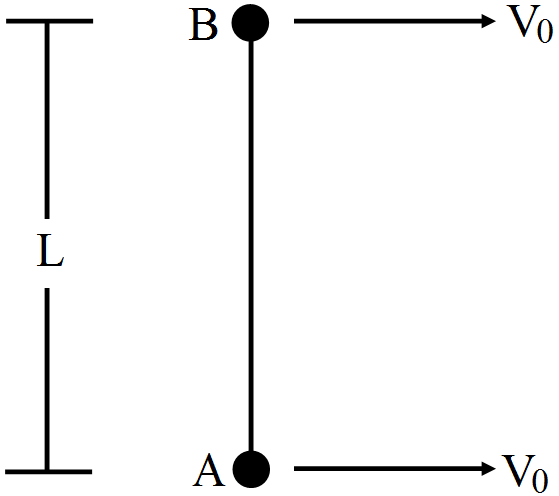
- 6View SolutionTwo small balls A and B, each of mass m, are joined rigidly to the ends of a light rod of lengh L (figure). The system translates on a frictionless horizontal surface with a velocity vo in a direction perpendicular to the rod. A particle P of mass m kept at rest on the surface sticks to the ball A as the ball collides with it. Find:
- The linear speeds of the balls A and B after the collision.
- The velocity of the centre of mass C of the system A + B + P.
- The angular speed of the system about C after the collision.
- 7Point masses $m_1$ and $m_2$ are placed at the opposite ends of a rigid rod of length L, and negligible mass. The rod is to be set in rotation about an axis perpendicular to it. Find the position on this rod through which the axis should pass in order that the work required to set the rod in rotation with angular velocity $\omega_0$ should be minimum.View Solution
- 8View SolutionA disc of radius R is cut out from a larger disc of radius 2R in such a way that the edge of the hole touches the edge of the disc. Locate the centre of mass of the residual disc.
- 9View SolutionDefine radius of gyration and give the physical significance of moment of inertia.
- 10View SolutionA cylinder is suspended by two strings wrapped around the cylinder near each end, the free ends of the string being attached to hooks on the ceiling, such that the length of the cylinder is horizontal. From the position of rest, the cylinder is allowed to roll down as suspension strings unwind. Calculate: (i) the downward linear acceleration of the cylinder and (ii) tension in the strings. Mass of cylinder is 12kg.