MCQ
When a battery is connected to a $P$ - type semiconductor with a metallic wire, the current in the semiconductor $(predominantly)$, inside the metallic wire and that inside the battery respectively due to
  • Holes, electrons, ions
  • B
    Holes, ions, electrons
  • C
    Electrons, ions, holes
  • D
    Ions, electrons, holes

Answer

Correct option: A.
Holes, electrons, ions
a
(a) Charge carriers inside the $P$ - type semiconductor are holes $(mainly)$. Inside the conductor charge carriers are electrons and for cell ions are the charge carriers.

Need a full question paper?

Generate a complete, print-ready paper with questions like this in minutes — across 16+ boards, with answer keys.

Start Generating Free

Similar questions

The Truth table  given in fig. represents
$A$ $B$ $Y$
$0$ $0$ $0$
$0$ $1$ $1$
$1$ $0$ $1$
$1$ $1$ $1$
Two long parallel wires whose centres are $a$ distance $d$ apart carry equal currents in opposite directions. If the flux within wires is neglected, the inductance of such arrangement of wire of length $l$ and radius $a$ will be
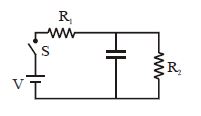
At $t = 0$ , switch $S$ is closed. The charge on the capacitor is varying with time $t$ as $Q\ =\ {Q_0}\left( {1 - {e^{ - \alpha t}}} \right)$ . Find the value of $Q_0$
Two uniformly charged spherical conductors $A$ and $B$ of radii $5 mm$ and $10 mm$ are separated by a distance of $2 cm$. If the spheres are connected by a conducting wire, then in equilibrium condition, the ratio of the magnitudes of the electric fields at the surface of the sphere $A$ and $B$ will be .
The magnetic dipole moment of a magnetic dipole is given by the formula $.......$.
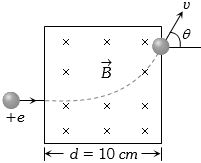
A proton accelerated by a potential difference $500\;KV$ moves though a transverse magnetic field of $0.51\;T$ as shown in figure. The angle $\theta $through which the proton deviates from the initial direction of its motion is......$^o$
If in a nuclear fusion process the masses of the fusing nuclei be ${m_1}$ and ${m_2}$ and the mass of the resultant nucleus be ${m_3}$, then
The thermionic emission of electron is due to
Suppose we consider a large number of containers each containing initially $10000$ atoms of a radioactive material with a half life of $1$ year. After $1$ year:
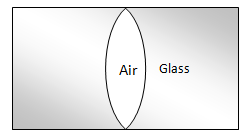
In the figure, an air lens of radii of curvature 10 cm ($\mathrm{R}_1=\mathrm{R}_2=10 \mathrm{~cm}$) is cut in a cylinder of glass (μ = 1.5). The focal length and the nature of the lens is