MCQ
When a lamp is connected in series with capacitor, then
  • Lamp will not glow
  • B
    Lamp will burst out
  • C
    Lamp will glow normally
  • D
    None of these

Answer

Correct option: A.
Lamp will not glow
a
(a) When a lamp is connected to $D.C.$ line with a capacitor. If will form an open circuit. Hence, the lamp will not glow.

Need a full question paper?

Generate a complete, print-ready paper with questions like this in minutes — across 16+ boards, with answer keys.
Start Generating Free

Similar questions

A galvanometer coil has a resistance $90\, \Omega$ and full scale deflection current $10\, mA$ . A $910\,\Omega$ resistance is connected in series with the galvanometer to make a voltmeter. If the least count of the voltmeter is $0.1\,V$, the number of divisions on its scale is
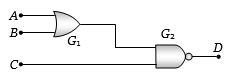
For the given combination of gates, if the logic states of inputs $ A, B, C$ are as follows $A = B = C = 0$ and $A = B = 1, C = 0$ then the logic states of output $D $ are
The pn junction can be formed by which of the following methods?
Assertion : Between any two given energy levels, the number of absorption transitions is always less than the number of emission transitions.
Reason : Absorption transitions start from the lowest energy level only and may end at any higher energy level. But emission transitions may start from any higher energy level and end at any energy level below it.
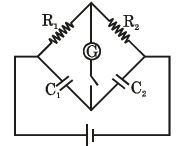
Circuit shown is in steady state, now when switch is closed, galvanometer shows no deflection, then correct relation is
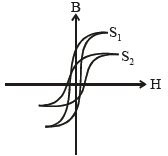
The $B-H$ curves $S_1$ and $S_2$ in the adjoining figure are associated with 
In a Young's double slit experiment, the distance between the two identical slits is $6.1$ times larger than the slit width. Then the number of intensity maxima observed with in the central maximum of the single slit diffraction pattern is
In a good conductor the energy gap between the conduction band and the valence band is
Two galvanometers A and B require 3mA and 5mA respectively to produce the same deflection of 10 divisions. Then
Identify the direction in which a thin long piece of magnet comes to rest when suspended freely.