MCQ
When a lens is dipped into the water its focal length :
  • increases
  • B
    decreases
  • C
    remains the same
  • D
    none of these

Answer

Correct option: A.
increases
A

Need a full question paper?

Generate a complete, print-ready paper with questions like this in minutes — across 16+ boards, with answer keys.

Start Generating Free

Similar questions

A magnet is suspended in the magnetic meridian with an untwisted wire. The upper end of wire is rotated through $180^{\circ}$ to deflect the magnet by $30^{\circ}$ from magnetic meridian. When this magnet is replaced by another magnet, the upper end of wire is rotated through $270^{\circ}$ to deflect the magnet $30^{\circ}$ from magnetic meridian. The ratio of magnetic moments of magnets is
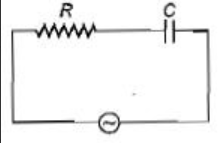
A 50 Hz, 20 V AC source is connected across R series circuit as shown in Figure If the voltage across R is 12V then voltage across capacitor is.
Image
Length of a magnetic iron wire is / and its magnetic moment is m. If on moulding it in the form of L, its all arms are of equal sizes, then magnetic moment of new shape will be:
Which among the following is an example of a semiconductor?
A capacitor $4\ \mu F$ charged to $50 V$ is connected to another capacitor of $2\ \mu F$ charged to $100 V$ with plates of like charges connected together. The total energy before and after connection in multiples of $(10^{-2} J)$ is
The energy required to charge a capacitor of 5μF  by connecting a d.c. source of 20 kV is(a) 10 kJ  (b) 5 kJ(c) 2 kJ    (d) 1 kJ
       
When we double the radius of a coil keeping the current through it unchanged, what happens to the magnetic field directed along its axis at far off points?
The electrical conductivity of pure germanium can be increased by:
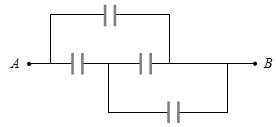
In the circuit shown in figure, each capacitor has a capacity of $3μF$. The equivalent capacity between $A$ and $B$ is
The magnetic field at the origin due to a current element $\text{i}\text{d}\ \vec{\text{l}}$ placed at a position $\overrightarrow{\text{r}}$ is:
  1. $\frac{\mu_0\text{i}}{4\pi}\frac{\text{d}\overrightarrow{\text{l}}\times\overrightarrow{\text{r}}}{\text{r}^3}$
  2. $-\frac{\mu_0\text{i}}{4\pi}\frac{\overrightarrow{\text{r}}\times​​\text{d}\overrightarrow{\text{l}}}{\text{r}^3}$
  3. $\frac{\mu_0\text{i}}{4\pi}\frac{\overrightarrow{\text{r}}\times​​\text{d}\overrightarrow{\text{l}}}{\text{r}^3}$
  4. $-\frac{\mu_0\text{i}}{4\pi}\frac{\text{d}\overrightarrow{\text{l}}\times\overrightarrow{\text{r}}}{\text{r}^3}$