When a light ray passes from air into glass, what happens to its speed? Draw a diagram to show which way the ray of light bends.
Download our app for free and get started
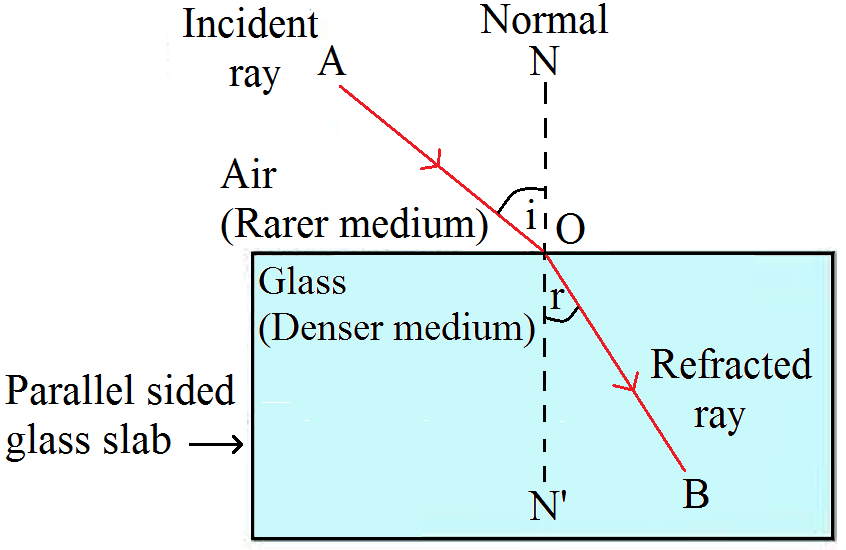 The ray of light bends towards the normal.
Download our appand get started for free
Experience the future of education. Simply download our apps or reach out to us for more information. Let's shape the future of learning together!No signup needed.*
Similar Questions
- 1View SolutionIt is desired to obtain an erect image of an object, using concave mirror of focal length of 12cm.
Will the image be smaller or larger than the object? Draw ray diagram to show the formation of image in this case. - 2View SolutionIf the image formed by a spherical mirror for all positions of the object placed in front of it is always erect and diminished, what type of mirror is it? Draw a labelled ray diagram to support your answer.
- 3View SolutionDiscuss the case when a convex lens forms a virtual and enlarged image.
- 4View SolutionWhen a fork is seen through lenses A and B one by one, it appears as shown in the diagrams. What is the nature of (i) lens A, and (ii) lens B? Give reason for your answer.
- 5View SolutionAn extended object in the form of an arrow pointing upward has been placed in front of plane mirror. Draw a labelled ray-diagram to show the formation of its image.
- 6View SolutionWrite the word AMBULANCE as it would appear when reflected in a plane mirror. Why is it sometimes written in this way (as its mirror image) on the front of an ambulance?
- 7View SolutionA student focuses the image of a candle flame, placed at about 2 m from a convex lens of focal length 10 cm, on a screen. After that he moves gradually the flame towards the lens and each time focuses its image on the screen.
- In which direction does he move the lens to focus the flame on the screen?
- What happens to the size of the image of the flame formed on the screen?
- What difference is seen in the intensity (brightness) of the image of the flame on the screen?
- What is seen on the screen when the flame is very close (at about 5 cm) to the lens?
- 8View SolutionAn object of height 4.0cm is placed at a distance of 30cm from the optical centre ‘O’ of a convex lens of focal length 20cm. Draw a ray diagram to find the position and size of the image formed. Mark optical centre ‘O’ and principal focus ‘F’ on the diagram. Also find the approximate ratio of size of the image to the size of the object.
- 9The refractive index of water with respect to vacuum is $\frac{4}{3}$ and refractive index of vacuum with respect to glass is $\frac{2}{3}$ If the speed the speed of light in glass is $2 \times 10^8 ms^{-1}$, find the speed of light in (i) vacuum, (ii) water.View Solution
- 10View SolutionA doctor has prescribed a corrective lens of power +1.5 D. Find the focal length of the lens. Is the prescribed lens diverging or converging?