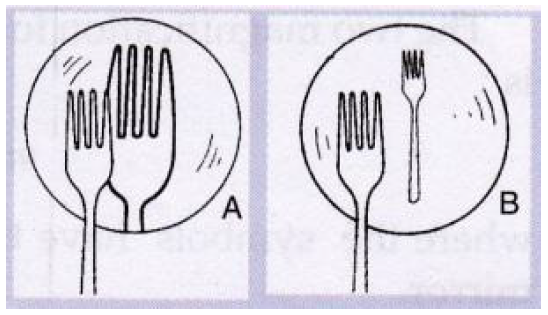
When a fork is seen through lenses A and B one by one, it appears as shown in the diagrams. What is the nature of (i) lens A, and (ii) lens B? Give reason for your answer.
Download our app for free and get started
When the fork is seen through lens A, it appears to be diminished. Such diminished object is observed when it is placed near a concave lens. Therefore, lens A is concave, i.e., diverging in nature. When the fork is seen through lens B, it appears to be enlarged. Such enlarged image is formed by a convex lens when an object is placed between the lens and its focus. Therefore, lens B is a convex, i.e., converging in nature.

Download our appand get started for free
Experience the future of education. Simply download our apps or reach out to us for more information. Let's shape the future of learning together!No signup needed.*
Similar Questions
- 1Redraw the following diagram on your answer sheet and show the path of the reflected ray. Also mark the angle of incidence $(\angle\text{i})$ and the angle of reflection $(\angle\text{r})$ on the diagram.View Solution
- 2View SolutionWrite down the magnification formula for a lens in terms of object distance and image distance. How does this magnification formula for a lens differ from the corresponding formula for a mirror?
- 3View SolutionIf the magnification of a body of size 1m is 2, what is the size of the image?
- 4Redraw the following diagram on your answer-sheet and show the path of the reflected ray. Also mark the angle of incidence $(\angle\text{i})$ and the angle of reflection $(\angle\text{r})$ on the diagram.View Solution
- 5View SolutionDraw ray diagrams showing the image formation by a convex mirror when an object is placed:
At finite distance from the mirror. - 6View SolutionA 4 cm tall object is placed on the principal axis of a convex lens. The distance of the object from the optical centre of the lens is 12cm and its sharp image is formed at a distance of 24cm from it on a screen on the other side of the lens. If the object is now moved a little away from the lens, in which way (towards the lens or away from the lens) will he have to move the screen to get a sharp image of the object on it again? How will the magnification of the image be affected?
- 7View SolutionA ray of light travelling in air enters obliquely into water. Does the light ray bend towards the normal or away from the normal? Why?
- 8View SolutionDescribe the nature of image formed when the object is placed at a distance of 20cm from a concave mirror of focal length 10cm.
- 9View SolutionWhat do you understand by the power of a lens? Name one factor on which the power of a lens depends.
- 10View SolutionThe diagrams show the appearance of a fork when placed in front of and close to two mirrors A and B, turn by turn.
- Which mirror is convex.
- Which mirror is concave.