Question
When an object is thrown to a height h from the earth's surface, calculate the value of its projection velocity.
Answer

self

Need a full question paper?

Generate a complete, print-ready paper with questions like this in minutes — across 16+ boards, with answer keys.

Start Generating Free

Similar questions

Derive an expression for the velocity of the two masses $m_1$ and $m_2$ moving with speeds $u_1$ and $u_2$ undergoing elastic collision in one dimension.
A hole is drilled in a copper sheet. The diameter of the hole is $4.24cm$ at $27.0 °C$. What is the change in the diameter of the hole when the sheet is heated to $227°C$? Coefficient of linear expansion of copper = $1.70 \times 10–5 K^{-1}$.
Let us assume that our galaxy consists of $2.5 \times 10^{11}$ stars each of one solar mass. How long will a star at a distance of $50,000 \mathrm{ly}$ from the galactic centre take to complete one revolution? Take the diameter of the Milky Way to be $10^5 \mathrm{ly}$.
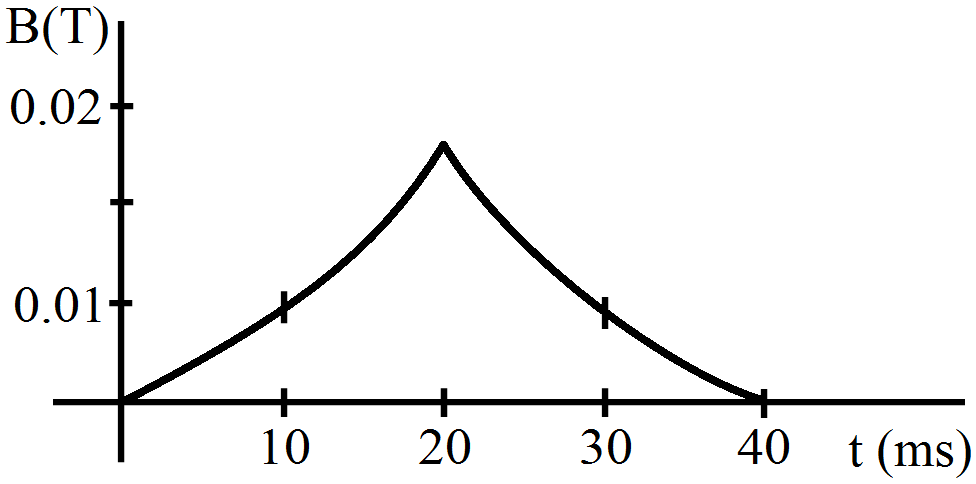
  1. The magnetic field in a region varies as shown in figure. Calculate the average induced emf in a conducting loop of area $2.0 \times 10^{-3}m^2$ placed perpendicular to the field in each of the $10ms$ intervals shown.
  2. In which intervals is the emf not constant? Neglect the behaviour near the ends of 10ms intervals.
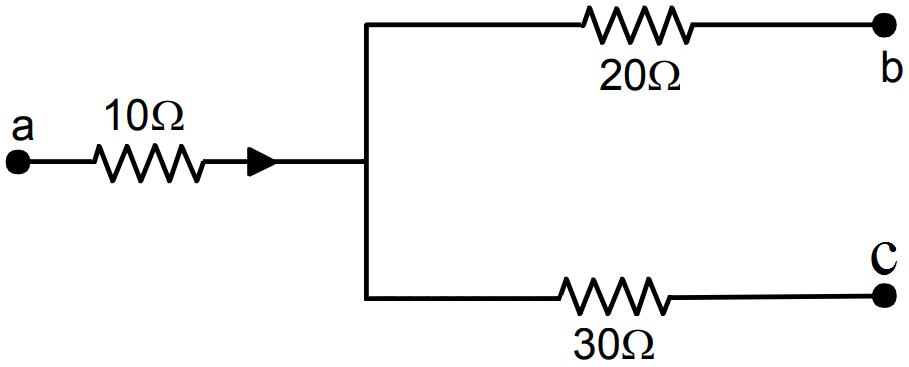
Figure. showa a part of an electric circuit. The potentials at the point a, b and c are 30V, 12V and 2V respectively. Find the currents through the three resistors.
An aluminium plate fixed in a horizontal position has a hole of diameter 2.000 cm . A steel sphere of diameter 2.005 cm rests on this hole. All the lengths refer to a temperature of $10^{\circ} \mathrm{C}$. The temperature of the entire system is slowly increased. At what temperature willl the ball fall down? Coefficient of linear expansion of aluminium is $23 \times$ $10^{-6}{ }^{\circ} \mathrm{C}^{-1}$ and that of steel is $11 \times 10^{-6}{ }^{\circ} \mathrm{C}^{-1}$.
Using mathematical methods and algorithms, derive kinetic equations for uniformly accelerated motion
Consider the situation of the previous problem.
  1. Calculate the force needed to keep the sliding wire moving with a constant velocity $v$.
  2. If the force needed just after $t = 0$ is $F_0$, find the time at which the force needed will be $\frac{\text{F}_0}{2}.$
A disc of radius R is cut out from a larger disc of radius 2R in such a way that the edge of the hole touches the edge of the disc. Locate the centre of mass of the residual disc.
Toricelli’s barometer used mercury. Pascal duplicated it using French wine of density $984kg m^{–3}$. Determine the height of the wine column for normal atmospheric pressure.