A disc of radius R is cut out from a larger disc of radius 2R in such a way that the edge of the hole touches the edge of the disc. Locate the centre of mass of the residual disc.
Download our app for free and get started
Let ‘0’ be the origin of the system. R = radius of the smaller disc. 2R = radius of the bigger disc. The smaller disc is cut out from the bigger disc. As from the figure: 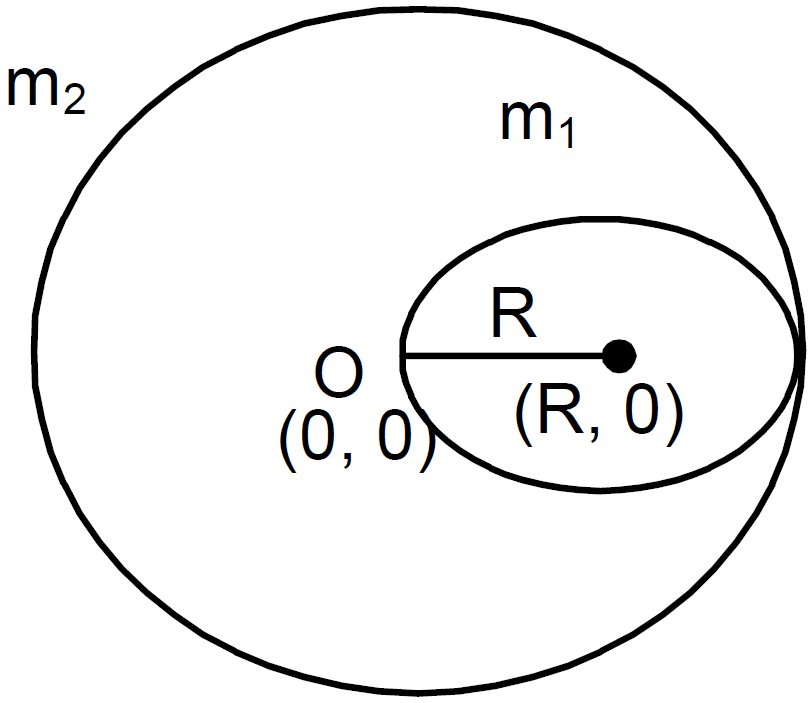 $\text{m}_1=\pi\text{R}^2\text{T}\rho,\ \text{x}_1=\text{R},\ \text{y}_1=0$ $\text{m}_2=\pi(\text{2R})^2\text{T}\rho,\ \text{x}_2=0,\ \text{y}_2=0$ $\Big(\frac{-\pi\text{R}^2\text{T}\rho\text{R}+0}{\pi\text{R}^2\text{T}\rho+\pi(2\text{R})^2\text{T}\rho\text{R}},\frac{0+0}{\text{m}_1+\text{m}_2}\Big)$ $=\Big(\frac{-\pi\text{R}^2\text{T}\rho\text{R}}{3\pi\text{R}^2\text{T}\rho},0\Big)=\Big( -\frac{\text{R}}{3},0\Big)$ C.M. is at $\frac{\text{R}}3{}$ from the centre of bigger disc away from the centre of the hole.
$\text{m}_1=\pi\text{R}^2\text{T}\rho,\ \text{x}_1=\text{R},\ \text{y}_1=0$ $\text{m}_2=\pi(\text{2R})^2\text{T}\rho,\ \text{x}_2=0,\ \text{y}_2=0$ $\Big(\frac{-\pi\text{R}^2\text{T}\rho\text{R}+0}{\pi\text{R}^2\text{T}\rho+\pi(2\text{R})^2\text{T}\rho\text{R}},\frac{0+0}{\text{m}_1+\text{m}_2}\Big)$ $=\Big(\frac{-\pi\text{R}^2\text{T}\rho\text{R}}{3\pi\text{R}^2\text{T}\rho},0\Big)=\Big( -\frac{\text{R}}{3},0\Big)$ C.M. is at $\frac{\text{R}}3{}$ from the centre of bigger disc away from the centre of the hole.
Download our appand get started for free
Experience the future of education. Simply download our apps or reach out to us for more information. Let's shape the future of learning together!No signup needed.*
Similar Questions
- 1A disc of radius R is rotating with an angular speed $\omega_\text{o}$ about a horizontal axis. It is placed on a horizontal table. The coefficient of kinetic friction is $\mu_\text{k}{:}$View Solution
- What was the velocity of its centre of mass before being brought in contact with the table?
- What happens to the linear velocity of a point on its rim when placed in contact with the table?
- What happens to the linear speed of the centre of mass when disc is placed in contact with the table?
- Which force is responsible for the effects in (b) and (c).
- What condition should be satisfied for rolling to begin?
- Calculate the time taken for the rolling to begin.
- 2A mass m is allowed to roll down an inclined plane $(\theta)$ If the vertical height is h, find.View Solution
- Acceleration along the inclined plane.
- Velocity down the plane.
- 3View SolutionTwo particles, each of mass m and speed v, travel in opposite directions along parallel lines separated by a distance d. Show that the angular momentum vector of the two particle system is the same whatever be the point about which the angular momentum is taken.
- 4A disc of mass $5kg$ and radius $50cm$ rolls on the ground at the rate of $10ms^{-1}$. Calculate the K.E. of the disc. $\Big(\text{Given}:\text{I}=\frac{1}{2}\text{MR}^2\Big)$View Solution
- 5View SolutionA metre stick is balanced on a knife edge at its centre. When two coins, each of mass 5g are put one on top of the other at the 12.0cm mark, the stick is found to be balanced at 45.0cm. What is the mass of the metre stick?
- 6Three point masses m,, m, and m, are located at the vertices of an equilateral triangle of side length a. What is the moment of inertia about an axis along the altitude of the triangle passing through $m_1$?View Solution
- 7Two blocks of masses $400g$ and $200g$ are connected through a light string going over a pulley which is free to rotate about its axis. The pulley has a moment of inertia $1.6 \times 10^{-4}kg-m^2$ and a radius 2.0cm. Find:View Solution
- The kinetic energy of the system as the $400g$ block falls through $50cm$.
- The speed of the blocks at this instant.
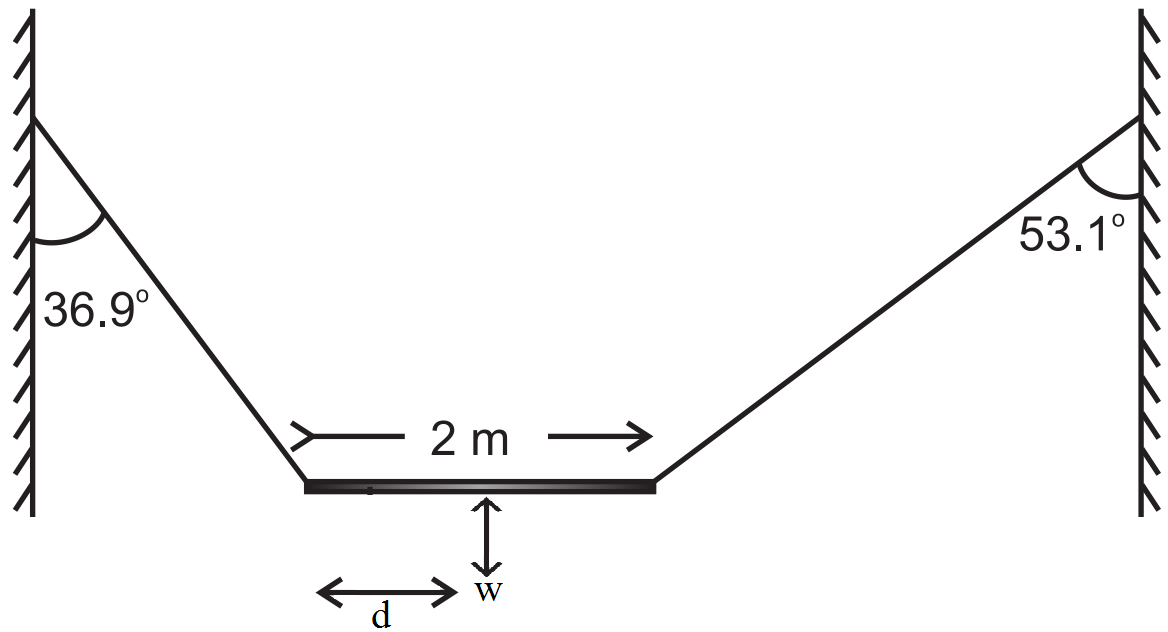
- 8A non-uniform bar of weight W is suspended at rest by two strings of negligible weight as shown in. The angles made by the strings with the vertical are $36.9°$ and $53.1°$ respectively. The bar is $2m$ long. Calculate the distance d of the centre of gravity of the bar from its left end.View Solution
- 9A car weighs $1800kg$. The distance between its front and back axles is $1.8m$. Its centre of gravity is $1.05m$ behind the front axle. Determine the force exerted by the level ground on each front wheel and each back wheel.View Solution
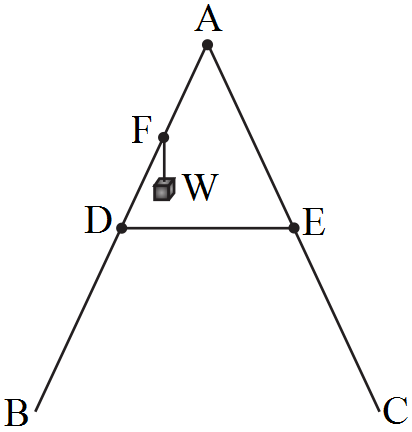
- 10As shown in the two sides of a step ladder BA and CA are 1.6m long and hinged at A. A rope DE, 0.5m is tied half way up. A weight 40kg is suspended from a point F, 1.2m from B along the ladder BA. Assuming the floor to be frictionless and neglecting the weight of the ladder, find the tension in the rope and forces exerted by the floor on the ladder. (Take $g = 9.8m/s^2$) (Hint: Consider the equilibrium of each side of the ladder separately).View Solution