MCQ
When heat $Q$ is supplied to a diatomic gas of rigid molecules at constant volume its temperature increases by $\Delta T.$ The heat required to produce the same change in temperature, at constant pressure is
  • A
    $\frac {3}{2}\,Q$
  • B
    $\frac {5}{3}\,Q$
  • $\frac {7}{5}\,Q$
  • D
    $\frac {2}{3}\,Q$

Answer

Correct option: C.
$\frac {7}{5}\,Q$
c
$Q=C v \Delta T$

$Q^{\prime}=C_{P} \Delta T$

$Q^{\prime}=\frac{C_{P}}{C_{V}} Q=\left(1+\frac{2}{5}\right) Q=\frac{7}{5} Q$

Need a full question paper?

Generate a complete, print-ready paper with questions like this in minutes — across 16+ boards, with answer keys.

Start Generating Free

Similar questions

The total internal energy of the monoatomic gas molecule is given by:
A rod of silver of $100\;cm$ is at $0^{\circ} C$ is heated to $100^{\circ} C$. Its length is increased by $0.19 \,cm .$ Coefficient of cubical expansion of the silver rod is
A ball rolls from the top of a stair way with a horizontal velocity $u\; m /s$ . If the steps are $h\; m$ high and $b\; m$ wide, the ball will hit the edge of the $n^{th}$ step, if $n=$
A uniform chain of length $L$ which hanges partially from a table, is kept in equilibrium by friction. The maximum length that can withstand without slipping is $l$ , then coefficient of friction between the table and the chain is
To what temperature should the hydrogen at room temperature $(27°C)$ be heated at constant pressure so that the $R.M.S.$ velocity of its molecules becomes double of its previous value ....... $^oC$
An organ pipe is closed at one end has fundamental frequency of $1500 Hz$. The maximum number of overtones generated by this pipe which a normal person can hear is :
A particle moves along the $X-$axis as $x = u(t - 2s) + a(t - 2s)^2$.
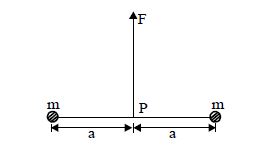
Two particles of mass $m$ each are tied at the ends of a light string of length $2a$ . The whole system is kept on a frictionless horizontal surface with the string held tight so that each mass is at a distance $'a'$ from the centre $P$ (as shown in the figure). Now, the mid-point of the string is pulled vertically upwards with a small but constant force $F$ . As a result, the particles move towards each other on the surface. The magnitude of acceleration, when the separation between them becomes $2x$ , is
Two stars of masses $3\times10^{31}\, kg$ each, and at distance $2\times10^{11}\, m$ rotate in a plane about their common centre of mass $O. A$ meteorite passes through $O$ moving perpendicular to the star’s rotation plane. In order to escape from the gravitational field of this double star, the minimum speed that meteorite should have at $O$ is : (Take Gravitational constant $G = 6.67\times10^{-11}\, Nm^2\, kg^{-2}$)
A gas is compressed isothermally to half its initial volume. The same gas is compressed separately through an adiabatic process until its volume is again reduced to half. Then