Question
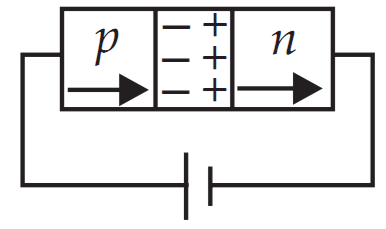

✓
Answer
- (c)
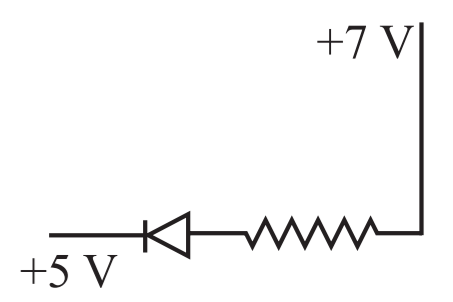
Explanation:
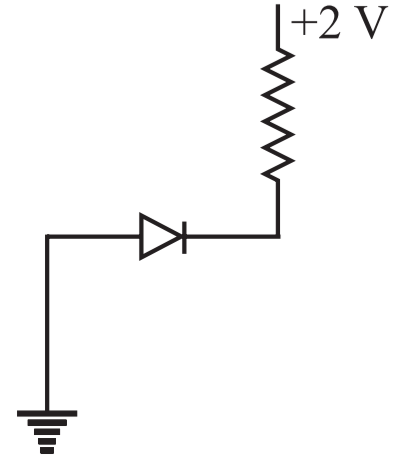
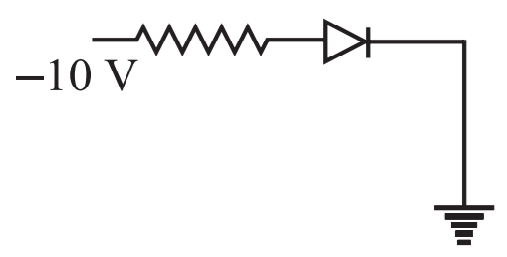
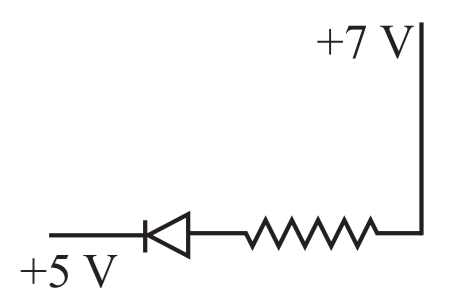
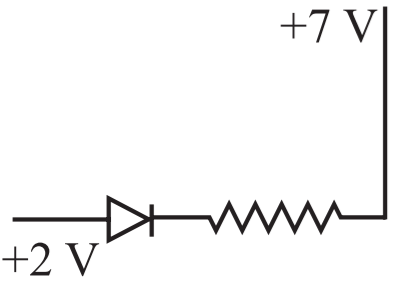
The p-n diode is forward biased when p-side is at a higher potential than n-side.
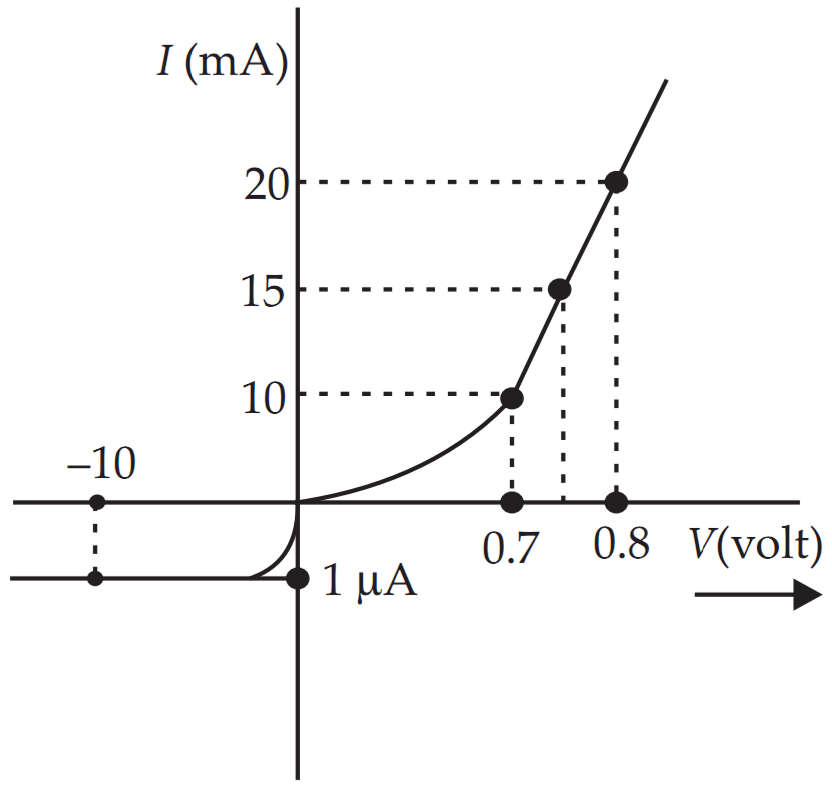
- (c) Non-ohmic device.
- (d) 10-6
Explanation:
Forward bias resistance,
$\text{R}_1=\frac{\triangle\text{V}}{\triangle\text{I}}=\frac{0.8-0.7}{(20-10)\times10^{-6}}$
$=\frac{0.1}{10\times10^{-3}}=10$
Reverse bias resistance, $\text{R}_2=\frac{10}{1\times10^{-6}}=10^7$
Then, the ratio of forward to reverse bias resistance,
$\frac{\text{R}_1}{\text{R}_2}=\frac{10}{10^7}=10^{-6}$
- (d)
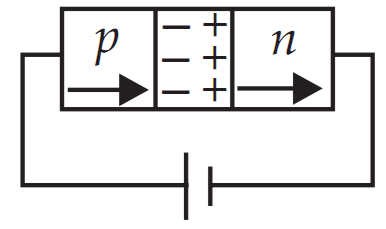
Explanation:
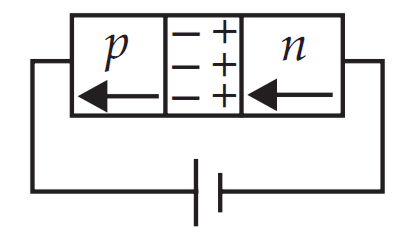
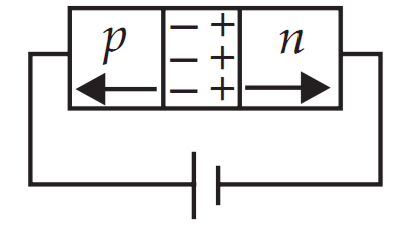
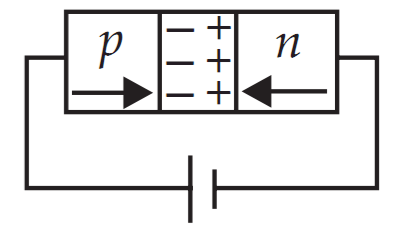
In p-region the direction of conventional current is same as flow of holes. In n-region, the direction of conventional current is opposite to the flow of electrons.
- (c) 0.01A
Explanation:
In the given circuit the junction diode is forward biased and offers zero resistance.
$\therefore$ The current, $\text{I}=\frac{\text{3V-1V}}{200\Omega}=\frac{\text{2V}}{200\Omega}=0.01\text{A}.$
Need a full question paper?
Generate a complete, print-ready paper with questions like this in minutes — across 16+ boards, with answer keys.
Explore more
More "4 Marks Questions" from Semiconductor Electronic: Material, Devices And Simple Circuits→Semiconductor Electronic: Material, Devices And Simple Circuits — all question types→Physics STD 12 Science question papers→Gujarat Board STD 12 Science question papers→Gujarat Board question paper generator→
Similar questions
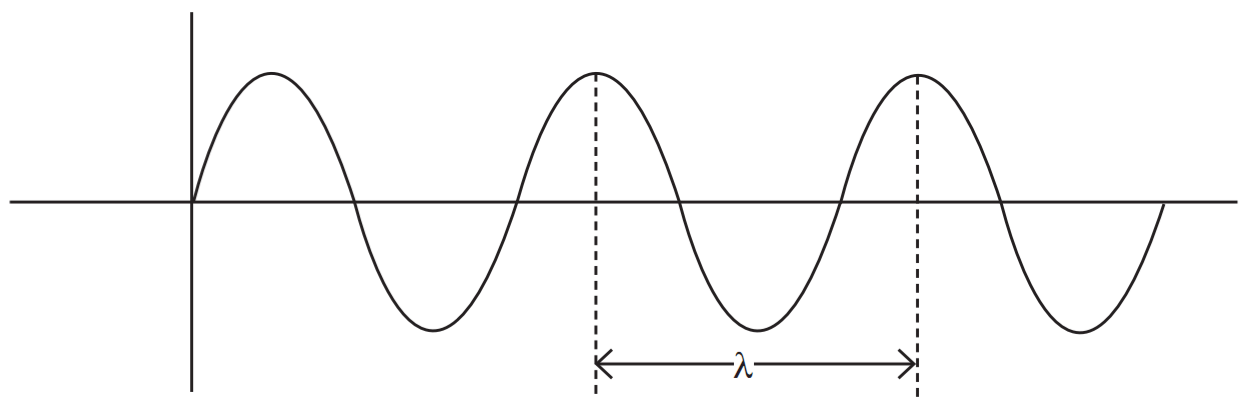
According to de-Broglie, a moving material particle sometimes acts as a wave and sometimes as a particle or a wave associated with moving material particle which controls the particle in every respect. The wave associated with moving particle is called matter wave or de-Broglie wave where wavelength called de-Broglie wavelength, rs given by $\lambda=\frac{\text{h}}{\text{mv}}$.
→- If a proton and an electron have the same de Broglie wavelength, then:
- Kinetic energy of electron < kinetic energy of proton.
- Kinetic energy of electron = kinetic energy of proton.
- Momentum of electron = momentum of proton.
- momentum of electron < momentum of proton.
- Which of these particles having the same kinetic energy has the largest de Broglie wavelength?
- Electron
- Alpha particle
- Proton
- Neutron
- Two particles A1 and A2 of masses m1, m2 (m1 > m2) have the same de Broglie wavelength. Then:
- Their momenta are the same.
- Their energies are the same.
- Momentum of A1 is less than the momentum of A1.
- Energy of A1 is more than the energy of A2.
- When the velocity of an electron increases, its de Broglie wavelength:
- Increases.
- Decreases.
- Remains same.
- May increase or decrease.
- Proton and $\alpha$ - particle have the same de-Broglie wavelength. What is same for both of them?
- Time period
- Energy
- Frequency
- Momentum
Bohr's model explains the spectral lines of hydrogen atomic emission spectrum. While the electron of the atom remains in the ground state, its energy is unchanged. When the atom absorbs one or more quanta of energy, the electrons moves from the ground state orbit to an excited state orbit that is further away.
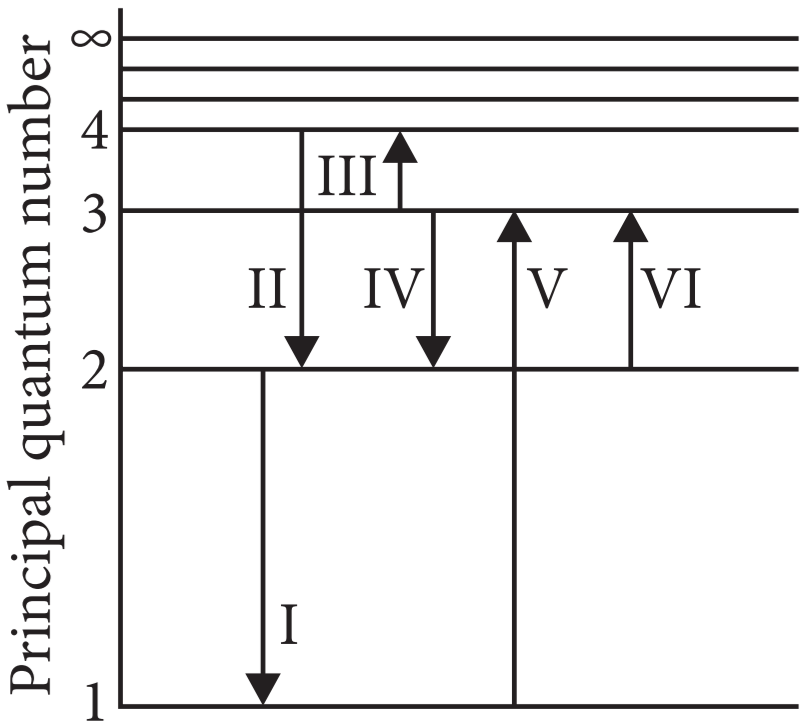
The given figure shows an energy level diagram of the hydrogen atom. Several transitions are marked as I, II, III and so on. The diagram is only indicative and not to scale.
The given figure shows an energy level diagram of the hydrogen atom. Several transitions are marked as I, II, III and so on. The diagram is only indicative and not to scale.
- In which transition is a Balmer series photon absorbed?
- II
- III
- IV
- VI
- The wavelength of the radiation involved in transition II is
- 291nm
- 364nm
- 487nm
- 652nm
- Which transition will occur when a hydrogen atom is irradiated with radiation of wavelength 103nm?
- I
- II
- IV
- V
- The electron in a hydrogen atom makes a transition from n = n1 to n = n2 state. The time period of the electron in the initial state is eight times that in the final state. The possible values of n1 and n2 are.
- n1 = 4,n2 = 2
- n1 = 8,n2 = 2
- n1 = 8,n2 = 3
- n1 = 6,n2 = 2
- The Balmer series for the H-atom can be observed
- If we measure the frequencies of light emitted when an excited atom falls to the ground state.
- If we measure the frequencies of light emitted due to transitions between excited states and the first excited state.
- In any transition in a H-atom.
- None of these.
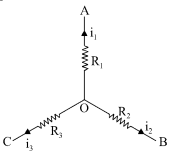
In the given figure, a part ABC of electric circuit is shown. The magnitudes of potentials at points $A, B$ and $C$ are and respectively, then find the value of potential at point $O$.
→Explain the refraction by an equilateral prism and derive the formula $\delta=i+e- A$ in case of triangular prism of glass.
→A magnetic needle is free to rotate in a vertical plane which makes an angle of 60° with the magnetic meridian. If the needle stays in a direction making an angle of $\tan^{-1}\Big(\frac{2}{\sqrt{3}}\Big)$ with the horizontal, what would be the dip at that place?
→Consider the situation shown in figure. The two slits S1 and S1 placed symmetrically around the central line are illuminated by monochromatic light of wavelength $\lambda$. The separation between the slits is d. The light transmitted by the slits falls on a screen S0 place at a distance D from the slits. The slits S3 is at the central line and the slit S4 is at a distance from S3. Another screen Sc is placed a further distance D away from Sc. 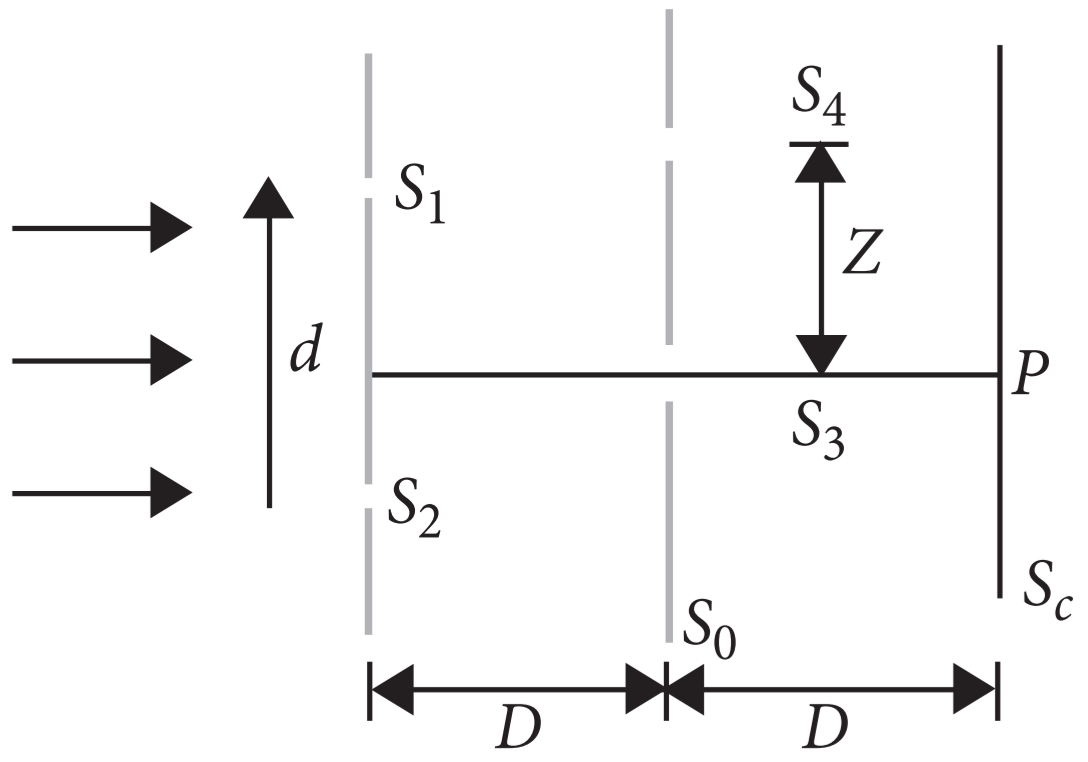
→ - Find the path difference if $\text{z}=\frac{\lambda\text{D}}{2\text{d}}$.
- $\lambda$
- $\frac{\lambda}{2}$
- $\frac{3}{2\lambda}$
- $2\lambda$
- Find the ratio of the maximum to minimum intensity observed on Sc if $\text{z}=\frac{\lambda\text{D}}{\text{d}}$
- 4
- 2
- $\infty$
- 1
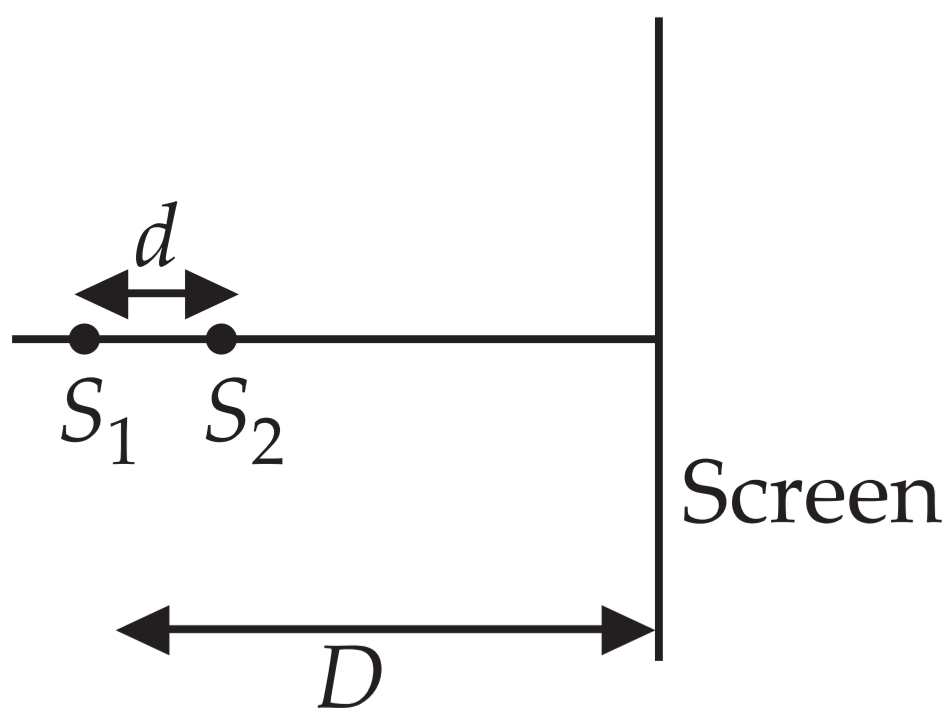
- Two coherent point sources S1 and S2 are separated by a small distanced as shown in figure. The fringes obtained on the screen will be:
- Concentric circles.
- Points.
- Straight lines.
- Semi-circles.
- ln the case of light waves from two coherent sources S1 and S2, there will be constructive interference at an arbitrary point P, if the path difference S1P - S2P is:
- $\Big(\text{n}+\frac{1}{2}\Big)\lambda$
- $\text{n}\lambda$
- $\Big(\text{n}-\frac{1}{2}\Big)\lambda$
- $\frac{\lambda}{2}$
- Two monochromatic light waves of amplitudes 3A and 2A interfering at a point have a phase difference of 60º. The intensity at that point will be proportional to:
- 5A2
- 13A2
- 7A2
- 19A2
Two point charges $5 \mu C$ and $-5 \mu C$ are kept at a distance of 1 cm from each other. Calculate the intensity of the electric field at a distance of 0.30 cm from mid-point (i) in the axial position, (ii) in neutral position.
→In pair annihilation, an electron and a positron destroy each other to produce gamma radiation. How is the momentum conserved?
TV signals broadcast by Delhi studio cannot be directly received at Patna which is about 1000km away. But the same signal goes some 36000km away to a satellite, gets reflected and is then received at Patna. Explain.
An elevator is descending with uniform acceleration. To measure the acceleration, a person in the elevator drops a coin at the moment the elevator starts. The coin is 6ft above the floor of the elevator at the time it is dropped. The person observes that the coin strikes the floor in 1 second. Calculate from these data the acceleration of the elevator.