MCQ
Which of following reaction does not involve either oxidation or reduction
  • A
    $VO^{+2} \to V_2O_3$
  • B
    $Na \to Na^+$
  • $CrO_4^{-2} \to Cr_2O_7^{-2}$
  • D
    $Zn^{+2} \to Zn$

Answer

Correct option: C.
$CrO_4^{-2} \to Cr_2O_7^{-2}$
c
$\mathop {CrO_4^{ - 2}}\limits^{ + 6}  \to \mathop {C{r_2}O_7^{ - 2}}\limits^{ + 6} $

Need a full question paper?

Generate a complete, print-ready paper with questions like this in minutes — across 16+ boards, with answer keys.
Start Generating Free

Similar questions

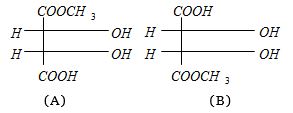
The correct statement about the compounds $A$ and $B$ is
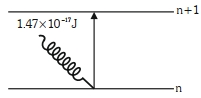
The electron in the $n ^{\text {th }}$ orbit of $Li ^{2+}$ is excited to $(n+1)$ orbit using the radiation of energy $1.47 \times 10^{-17}\,J$ (as shown in the diagram). The value of $n$ is $....$.Given $R_H=2.18 \times 10^{-18}\,J$
Standard enthalpy of vapourisation for $\mathrm{CCl}_4$ is $30.5 \mathrm{~kJ} \mathrm{~mol}^{-1}$. Heat required for vapourisation of $284 \mathrm{~g}$ of $\mathrm{CCl}_4$ at constant temperature is_______ $\mathrm{kJ}$. (Given molar mass in $\mathrm{g} \mathrm{mol}^{-1} ; \mathrm{C}=12, \mathrm{Cl}=35.5$ )
Zirconium phosphate $[Zr_3 (PO_ 4)_4]$ dissociates into three zirconium cations of charge $+ 4$ and four phosphate anions of charge $- 3$. If molar solubility of zirconium phosphate is denoted by $S$ and its solubility product by $K_{sp}$ then which of the following relationship between $S$ and $K_{sp}$ is correct?
In which of the following compounds, the $C-Cl$ bond ionisation shall give most stable carbonium ion?
$2-$ methyl $-2-$ butene will be represented as
Which of the following order is $NOT$ correct, against mentioned properties
In which of the following compound tautomerism will not takes place ?
How much ....$kJ$ energy is released when $6$ mole of octane is burnt in air ? Given $\Delta H_f^o$ for $C{O_2}(g),\,{H_2}O(g)$ and ${C_8}{H_{18}}(l)$ respectively are $-490,-240\, and + 160 \,kJ/mol$ 
The average molar mass of chlorine is $35.5\, g$ $mol ^{-1}$. The ratio of $35\, Cl$ to $37 \,Cl$ in naturally occurring chlorine is close to :