Question
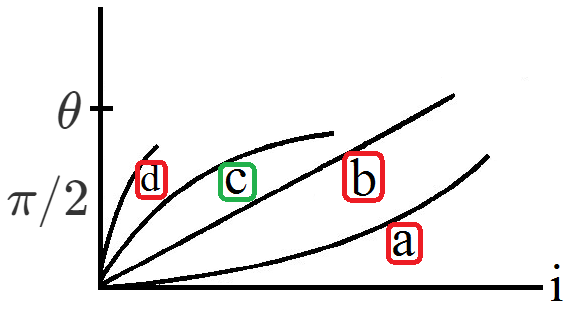
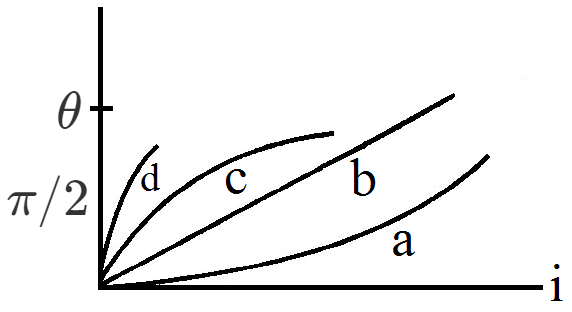
Which of the following four graphs may best represent the current-deflection relation in a tangent galvanometer?
Answer

  1. curve

Exmplanation:

Since i $\propto\tan \theta,$ the only graph that represents this correlation is curve c.

Need a full question paper?

Generate a complete, print-ready paper with questions like this in minutes — across 16+ boards, with answer keys.
Start Generating Free

Similar questions

The temperature of the hydrogen at which the average speed of its molecules is equal to that of oxygen molecules at a temperature of $31\,^oC,$ is  ........ $^oC$
An ideal gas equation can be written as $P=\frac{\rho R T}{M_{0}}$ where $\rho$ and $M_{0}$ are respectively,
An ant is moving on a plane horizontal surface. The number of degrees of freedom of the ant will be .........
A parrot sitting on the floor of a wire cage which is being carried by a boy starts flying. The boy will feel that the box is now:
The phase difference between two waves, represented by
$
\begin{aligned}
& y_1=10^{-6} \sin \left[100 t+\left(\frac{x}{50}\right)+0.5\right] m \\
& y_2=10^{-6} \cos \left[100 t+\left(\frac{x}{50}\right)\right] m
\end{aligned}
$
where x is expressed in metres and $t$ is expressed in seconds, is approximately
Four rods of same material and having the same cross section and length have been joined, as shown. The temperature of junction of four rods will be........ $^oC$
The work done by a force $\vec F = \left( { - 6{x^3}\hat i} \right)\,N$, in displacing a particle from $x = 4\, m$ to $x = -2\, m$ is  ................ $\mathrm{J}$
An ideal gas initially at pressure $1$ bar is being compressed from $30 \,m ^{3}$ to $10\, m ^{3}$ volume and its temperature decreases from $320\, K$ to $280\, K$. then find final pressure of gas (in bar)
An uniform thick string of length $8\, m$ is resting on a horizontal frictionless surface. It is pulled by a horizontal force of $8\, N$ from one end. The tension in the string at $3\, m$ from the force applied is ........ $N$
Let $\overrightarrow{\text{A}}$ be a unit vector along the axis of rotation of a purely rotating body and $\overrightarrow{\text{B}}$ be a unit vector along the velocity of a particle P of the body away from the axis. The value of $\overrightarrow{\text{A}}.\overrightarrow{\text{B}}$ is:
  1. 1
  2. -1
  3. 0
  4. None of these.