MCQ
The phase difference between two waves, represented by
$
\begin{aligned}
& y_1=10^{-6} \sin \left[100 t+\left(\frac{x}{50}\right)+0.5\right] m \\
& y_2=10^{-6} \cos \left[100 t+\left(\frac{x}{50}\right)\right] m
\end{aligned}
$
where x is expressed in metres and $t$ is expressed in seconds, is approximately
  • A
    1.07 rad
  • B
    1.5 rad
  • C
    0.5 rad
  • D
    2.07 rad

Answer

1.07 rad
$
\begin{aligned}
& \text { Explanation: } y_1=10^{-6} \sin \left[100 t+\left(\frac{x}{50}\right)+0.5\right] m \\
& y_2=10^{-6} \cos \left[100 t+\left(\frac{x}{50}\right)\right] m \\
& =10^{-6} \sin \left[100 t+\left(\frac{x}{50}\right)+\left(\frac{\pi}{2}\right)\right] \\
& \Delta \phi=\frac{\pi}{2}-0.05=\frac{3.14}{2}-0.5=1.57-0.5 \\
& =1.07 rad
\end{aligned}
$

Need a full question paper?

Generate a complete, print-ready paper with questions like this in minutes — across 16+ boards, with answer keys.

Start Generating Free

Similar questions

The density of a newly discovered planet is twice that of earth. The acceleration due to gravity at the surface of the planet is equal to that at the surface of the earth. If the radius of the earth is surface of the earth. If the radius of the earth is R, the radius of the planet would be:
A quantity $x$ is given by $\left( IF v^{2} / WL ^{4}\right)$ in terms of moment of inertia $I,$ force $F$, velocity $v$, work $W$ and Length $L$. The dimensional formula for $x$ is same as that of
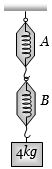
A block of mass $4 \,kg$ is suspended through two light spring balances $A$ and $B$. Then $A$ and $B$ will read respectively
A train starting from rest first accelerates uniformly up to a speed of $80 \mathrm{~km} / \mathrm{h}$ for time $t$, then it moves with a constant speed for time 3t. The average speed of the train for this duration of journey will be (in $\mathrm{km} / \mathrm{h}$ ) :
If a block moving up an inclined plane at $30^{\circ}$ with a velocity of $5 \,m / s$, stops after $0.5 s$, then coefficient of friction will be nearly
$Assertion$: A rigid disc rolls without slipping on a fixed rough horizontal surface with uniform angular velocity. Then the acceleration of lowest point on the disc is zero.
$Reason$ : For a rigid disc rolling without slipping on a fixed rough horizontal surface, the velocity of the lowest point on the disc is always zero
The mass of water rises in capillary tube of radius R is M. The mass of water that rises in tube of radius 2R is:
A solid cube is first floating in a liquid. The coefficient of linear expansion of cube is $\alpha$ and the coefficient of volume expansion of liquid is $\gamma$. On increasing the temperature of (liquid + cube) system, the cube will sink if
A mass of $6 \times {10^{24}}kg$ is to be compressed in a sphere in such a way that the escape velocity from the sphere is $3 \times {10^8}m\,/s$. Radius of the sphere should be $(G = 6.67 \times {10^{ - 11}}N - {m^2}/k{g^2})$
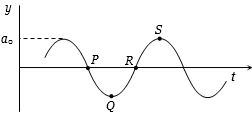
A wave motion has the function $y = {a_0}\sin (\omega \,t - kx)$. The graph in figure shows how the displacement $y$ at a fixed point varies with time $t$. Which one of the labelled points shows a displacement equal to that at the position $x = \frac{\pi }{{2k}}$ at time $t = 0$