An orbital electron in the ground state of hydrogen has magnetic moment $\mu_1$. This orbital electron is excited to $3^{rd}$ excited state by some energy transfer to the hydrogen atom. The new magnetic moment of the electron is $\mu_2$ , then
Easy


Download our appand get started for free
Experience the future of education. Simply download our apps or reach out to us for more information. Let's shape the future of learning together!No signup needed.*
Similar Questions
- 1Consider three quantities $x = E/B,$ $y =\sqrt {1/{\mu _0}{\varepsilon _0}} $ and $z = l$ . Here, $l$ is the length of a wire, $C$ is a $CR$ capacitance and $R$ is a resistance. All other symbols have standard meanings.View Solution
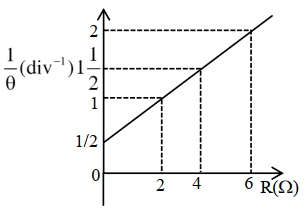
- 2In the experiment to determine the galvanometer resistance by half-deflection method, the plot of $\frac{1}{\theta}$ vs the resistance $(R)$ of the resistance box is shown in the figure. The figure of merit of the galvanometer is .............. $\times 10^{-1} \mathrm{~A} /$ division. [The source has emf 2V]View Solution
- 3A $50\,\Omega $ resistance is connected to a battery of $5\,V$. A galvanometer of resistance $100\, \Omega $ is to be used as an ammeter to measure current through the resistance, for this a resistance $r_s$ is connected to the galvanometer. Which of the following connections should be employed if the measured current is within $1\% $ of the current without the ammeter in the circuit ?View Solution
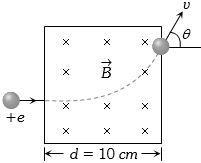
- 4A proton accelerated by a potential difference $500\;KV$ moves though a transverse magnetic field of $0.51\;T$ as shown in figure. The angle $\theta $through which the proton deviates from the initial direction of its motion is......$^o$View Solution
- 5View SolutionAn electron is travelling horizontally towards east. A magnetic field in vertically downward direction exerts a force on the electron along
- 6A proton of mass $m$ and charge $+e$ is moving in a circular orbit in a magnetic field with energy $1\, MeV$. What should be the energy of $\alpha - $particle (mass = $4m$ and charge = $+ 2e),$ so that it can revolve in the path of same radius.......$MeV$View Solution
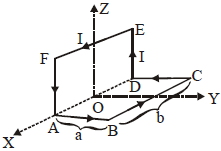
- 7A wire carrying current $I$ is bent in the shape $A\,B\,C\,D\,E\,F\,A$ as shown, where rectangle $A\,B\,C\,D\,A$ and $A\,D\,E\,F\,A$ are perpendicular to each other. If the sides of the rectangles are of lengths $a$ and $b,$ then the magnitude and direction of magnetic moment of the loop $A\,B\,C\,D\,E\,F\,A\,$ isView Solution
- 8In a moving coil galvanometer, the deflection of the coil $\theta $ is related to the electrical current $i$ by the relationView Solution
- 9${10^{ - 3}}amp$ is flowing through a resistance of $1000\,\Omega $. To measure the correct potential difference, the voltmeter is to be used of which the resistance should beView Solution
- 10A particle of charge $q$ and mass $m$ moving with a velocity $v$ along the $x$-axis enters the region $x > 0$ with uniform magnetic field $B$ along the $\hat k$ direction. The particle will penetrate in this region in the $x$-direction upto a distance $d$ equal toView Solution