Question
Which of the following is a slow process

Answer

isothermal processes are necessarily slow as they require heat transfer to remain at the same temperature which is done by being in thermal equilibrium with some reservoir. $A$ process will be isothermal only if it happens on timescales larger than the timescale required for effective heat transfer.

Need a full question paper?

Generate a complete, print-ready paper with questions like this in minutes — across 16+ boards, with answer keys.
Start Generating Free

Similar questions

A hole is drilled through the earth along a diameter Band a stone is dropped into it. The stone reaches at the centre of the earth, which of the following quantity remains constant
if Energy is given by $U = \frac{{A\sqrt x }}{{{x^2} + B}},\,$, then dimensions of $AB$ is
An $NPN$ transistor is used in common emitter configuration as an amplifier with $1\,k\Omega $ load resistance. Signal voltage of $10\,mV$ is applied across the base emitter. This produces a $3\,mA$ change in the collector current and $15\,\mu A$ change in the base current of the amplifier. The input resistance and voltage gain are
At higher temperature, iodoform reaction is given by
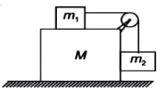
In the given arrangement all surfaces are smooth. What acceleration should be given to the system, for which the block $m_2$ doesn't slide down?
A wide vessel with a small hole at the bottom is filled with two liquids. The density and heightof one liquid are $\rho_1$ and $h_1$ and that of the otherare  $\rho_2$ and $h_2 \ (\rho_1 >\rho_2)$. The velocity of liquid coming out of the hole is :
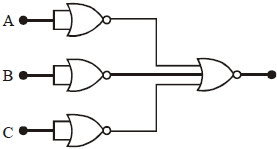
Identify the operation performed by the circuit given below
A body of mass $0.25 \,kg$ is projected with muzzle velocity $100\,m{s^{ - 1}}$ from a tank of mass $100\, kg$. What is the recoil velocity of the tank ........ $ms^{-1}$
Given that $v$ is the speed, $r$ is radius and $g$ is acceleration due to gravity. Which of the following is dimensionless?
A ball of mass $160\, g$ is thrown up at an angle of $60^{\circ}$ to the horizontal at a speed of $10 \,m / s$. The angular momentum of the ball at the highest point of the trajectory with respect to the point from which the ball is thrown is nearly $\left(g=10\, m / s ^{2}\right)$ (in $kgm ^{2} / s$)