Which of the following is true for elastic potential energy density
Easy


Download our appand get started for free
Experience the future of education. Simply download our apps or reach out to us for more information. Let's shape the future of learning together!No signup needed.*
Similar Questions
- 1View SolutionIn solids, inter-atomic forces are
- 2View SolutionAccording to Hook’s law force is proportional to
- 3A metal wire having Poisson's ratio $1 / 4$ and Young's modulus $8 \times 10^{10} \,N / m ^2$ is stretched by a force, which produces a lateral strain of $0.02 \%$ in it. The elastic potential energy stored per unit volume in wire is $[$in $J / m ^3]$View Solution
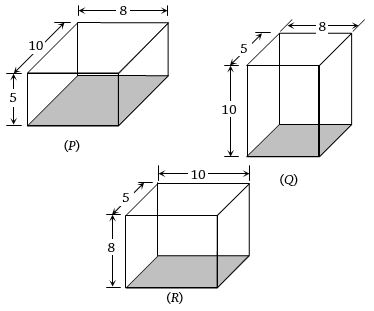
- 4A rectangular block of size $10\,cm \times 8\,cm \times 5\,cm$ is kept in three different positions $P, Q$ and $R$ in turn as shown in the figure. In each case, the shaded area is rigidly fixed and a definite force $F$ is applied tangentially to the opposite face to deform the block. The displacement of the upper face will beView Solution
- 5The elastic energy stored in a wire of Young's modulus $Y$ isView Solution
- 6View SolutionIn the three states of matter, the elastic coefficient can be
- 7View SolutionA light rod acted upon by three forces, is in equilibrium. Which of the following diagram shows the possible position and direction of the forces?
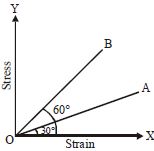
- 8The stress versus strain graphs for wires of two materials $A$ and $B$ are as shown in the figure. If $Y_A$ and $Y_B$ are the Young's modulus of the materials, thenView Solution
- 9Force constant of a spring $(K)$ is synonymous toView Solution
- 10Two steel wires of same length but radii $r$ and $2r$ are connected together end to end and tied to a wall as shown. The force stretches the combination by $10\ mm$. How far does the midpoint $A$ move ............ $mm$View Solution
