Which of the following law states that “good absorbers of heat are good emitters”
Easy


Download our appand get started for free
Experience the future of education. Simply download our apps or reach out to us for more information. Let's shape the future of learning together!No signup needed.*
Similar Questions
- 1If a piece of metal is heated to temperature $\theta$ and then allowed to cool in a room which is at temperature $\theta_0$, the graph between the temperature $T$ of the metal and time t will be closest toView Solution
- 2Four rods of indentical cross-sectional area and made from the same metal form the sides of a square. The temperature of two diagonally opposite points are $\theta$ and $\sqrt2 \theta$ respectively in the teady state. Assuming that only heat conduction takes place, what will be the temperature difference between other two points ?View Solution
- 3View SolutionWhich of the following is more closed to a black body?
- 4The maximum energy in thermal radiation from a source occurs at the wavelength $4000Å$ . The effective temperature of the source is ....... $K$View Solution
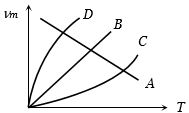
- 5Which of the following is the $\nu_m = T$ graph for a perfectly black body ($\nu_m$ =maximum frequency of radiation)View Solution
- 6The ends of a metal bas of constant cross-sectional area are maintained at temperatures $T_1$ and $T_2$ which are both higher than the temperature of the surroundings. If the bar is unlagged, which one of the following sketches best represents the variation of temperature with distance along the bar?View Solution
- 7View SolutionIf a black body is heated at a high temperature, it seems to be
- 8A rod of length $L$ with sides fully insulated is of a material whose thermal conductivity varies with $\alpha$ temperature as $ K= \frac{\alpha }{T}$, where $\alpha$ is a constant. The ends of the rod are kept at temperature $T_1$ and $T_2$. The temperature $T$ at $x,$ where $x$ is the distance from the end whose temperature is $T_1$ isView Solution
- 9A body cools from a temperature $3T$ to $2T$ in $10$ minutes. The room temperature is $T.$ Assume that Newton's law of cooling is applicable. The temperature of the body at the end of next $10$ minutes will beView Solution
- 10View SolutionIf the temperature of the sun (black body) is doubled, the rate of energy received on earth will be increased by a factor of