The ends of a metal bas of constant cross-sectional area are maintained at temperatures $T_1$ and $T_2$ which are both higher than the temperature of the surroundings. If the bar is unlagged, which one of the following sketches best represents the variation of temperature with distance along the bar?
- A
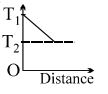
- B
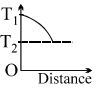
- C
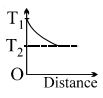
- D
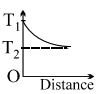
Advanced


Download our appand get started for free
Experience the future of education. Simply download our apps or reach out to us for more information. Let's shape the future of learning together!No signup needed.*
Similar Questions
- 1A certain stellar body has radius $50 \,R_{s}$ and temperature $2 \,T_{s}$ and is at a distance of $2 \times 10^{10} \,AU$ from the earth. Here, $AU$ refers to the earth-sun distance and $R_{s}$ and $T_{s}$ refer to the sun's radius and temperature, respectively. Take, both star and sun to be ideal black bodies. The ratio of the power received on earth from the stellar body as compared to that received from the sun is close toView Solution
- 2Two rods of same length and cross section are joined along the length. Thermal conductivities of first and second rod are ${K_1}\,\,{\rm{and}}\,\,{K_2}$. The temperature of the free ends of the first and second rods are maintained at ${\theta _1}\,\,{\rm{and }}{\theta _2}$ respectively. The temperature of the common junction isView Solution
- 3If temperature of $Sun =6000\, K ,$ radius of Sun is $7.2 \times 10^{5}\, Km$ radius of Earth $=6000 \,Km \&$ distance between earth and $Sum =15 \times 10^{7}\, Km .$ Find intensity of light on Earth.View Solution
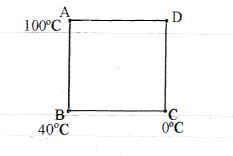
- 4Four conducting rods are joined to make a square. All rods are identical and ends $A, B$ and $C$ are maintained at given temperatures. choose $INCORRECT$ statement for given arrangement in steady state. (value of $\frac {KA}{L}$ is $1\frac{J}{{{S^o}C}}$ , symbols , have their usual meaning)View Solution
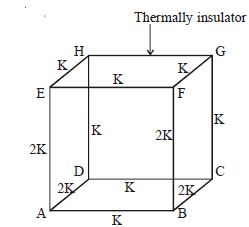
- 5Find effective thermal resistance between $A$ & $B$ of cube made up of $12$ rods of same dimensions and shown given thermal conductivity. [ $l =$ length of rod, $a =$ cross section area of rod]View Solution
- 6Consider a compound slab consisting of two different materials having equal thickness and thermal conductivities $ K$ and $2K$ respectively. The equivalent thermal conductivity of the slab isView Solution
- 7Cooling rate of a sphere of $600\,K$ at external environment $(200\,K)$ is $R$ . When the temperature of sphere is reduced to $400\,K$ then cooling rate of the sphere becomesView Solution
- 8A solid cylinder of length $L$ and radius $r$ is heat upto same temperature as that of a cube of edge length $a$. If both have same material, volume and allowed to cool under similar conditions, then ratio of amount of radiations radiated will be (Neglect radiation emitted from flat surfaces of the cylinder)View Solution
- 9A body takes $T$ minutes to cool from ${62^o}C$ to ${61^o}C$ when the surrounding temperature is ${30^o}C$. The time taken by the body to cool from ${70^o}$ to $({A_1}\,{\rm{and }}{A_{\rm{2}}})$ isView Solution
- 10The maximum wavelength of radiations emitted at $900\,K$ is $4\mu m$. What will be the maximum wavelength of radiations emitted at $1200 \,K$ ......... $\mu m$View Solution