MCQ
Which of the following parameters does not characterize the thermodynamic state of matter
  • A
    Volume
  • B
    Temperature
  • C
    Pressure
  • Work

Answer

Correct option: D.
Work
d
(d) Work does not characterise the thermodynamics state of matter, it is a path Function giving only relationship between two quantities,

Need a full question paper?

Generate a complete, print-ready paper with questions like this in minutes — across 16+ boards, with answer keys.

Start Generating Free

Similar questions

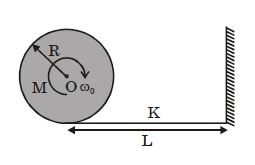
A uniform solid cylinder of mass $M$ and radius $R$ can freely rotate around its axis $O$ . There is a elastic string of relaxed length $L$ and stiffness $K$ attached to the cylinder and a static wall. Initially, the string is relaxed. As the cylinder starts rotating, the string will wind the cylinder. The surface of cylinder is very rough, so that the string does not slip on the cylinder’s surface. The minimum initial angular speed of the cylinder, ${\omega _0}$ , so that it can rotate to angle $2\pi $ is (Assume Hooke’s law to be valid.)
A source emits a sound of frequency of $400Hz,$ but the listener hears it to be $390Hz.$ Then:
At nodes in stationary waves
The acceleration of a moving object can be determined by:
In Searle's method for finding conductivity of metals, the temperature gradient along the bar
Galileo writes that for angles of projection of a projectile at angles $(45 + \theta )$ and $(45 - \theta )$, the horizontal ranges described by the projectile are in the ratio of (if $\theta \le 45)$
A body is moving in a circular path with a constant speed. It has
A stone projected with a velocity u at an angle $\theta$ with the horizontal reaches maximum height $H_1$. When it is projected with velocity u at an angle $\left( {\frac{\pi }{2} - \theta } \right)$ with the horizontal, it reaches maximum height $ H_2$. The relation between the horizontal range R of the projectile, $H_1$ and $H_2$ is
When the temperature of a metal wire is increased from $0^{\circ} \,C$ to $10^{\circ}\, C$, its length increases by $0.02 \% .$ The percentage change in its mass density will be closest to:
A ball will a speed of $9\, m / s$ collides with another identical ball at rest. After the collision, the direction of each ball makes an angle of $30^{\circ}$ with the original direction. The ratio of velocities of the balls after collision is $x : y$ where $x$ is........