Which of the following particle will describe the smallest circle when projected with the same velocity perpendicular to the magnetic field ?
Easy


Download our appand get started for free
Experience the future of education. Simply download our apps or reach out to us for more information. Let's shape the future of learning together!No signup needed.*
Similar Questions
- 1In toroid magnetic field on axis will be the radius $=0.5\, cm ,$ current $=1.5\, A ,$ turns $=250,$ permeability $=700$ (in Tesla)View Solution
- 2A square coil of side $10\; cm$ consists of $20$ turns and carries a current of $12\; A$. The coil is suspended vertically and the normal to the plane of the coil makes an angle of $30^o$ with the direction of a uniform horizontal magnetic field of magnitude $0.80 \;T$. What is the magnitude of torque (in $N\;m$) experienced by the coil?View Solution
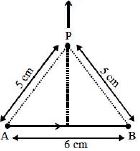
- 3Find the magnetic field at point $P$ due to a straight line segment $AB$ of length $6\, cm$ carrying a current of $5\, A$. (See figure) $(\mu _0 = 4p\times10^{-7}\, N-A^{-2})$View Solution
- 4In a circuit for finding the resistance of a galvanometer by half deflection method, a $6\,V$ battery and a high resistance of $11\,k\Omega $ are used. The figure of merit of the galvanometer $60\,\mu A/$ division. In the absence of shunt resistance, the galvanometer produces a deflection of $\theta = 9$ divisions when current flows in the circuit. The value of the shunt resistance that can cause the deflection of $\theta /2 ,$ is closest to .................. $\Omega$View Solution
- 5If $\alpha $ and $\beta - $ particles are moving with equal velocity perpendicular to the flux density $B$, then the radii of their paths will beView Solution
- 6An electron and a proton are moving on straight parallel paths with same velocity. They enter a semi-infinite region of uniform magnetic field perpendicular to the velocity. Which of the following statement$(s)$ is/are true?View Solution
$(A)$ They will never come out of the magnetic field region.
$(B)$ They will come out travelling along parallel paths.
$(C)$ They will come out at the same time.
$(D)$ They will come out at different times.
- 7A galvanometer gives full scale deflection with $0.006$ A current. By connecting it to a $4990 \ \Omega$ resistance, it can be converted into a voltmeter of range $0-30 \ V$. If connected to a $\frac{2 n }{249} \Omega$ resistance, it becomes an ammeter of range $0-1.5 \ A$. The value of $n$ is:View Solution
- 8View SolutionAssertion : The sensitivity of a moving coil galvanometer is increased by placing a suitable magnetic material as a core inside the coil.
Reason : Soft iron has high magnetic permeability and cannot be easily magnetized or demagnetized.
- 9Two charged particles, having same kinetic energy, are allowed to pass through a uniform magnetic field perpendicular to the direction of motion. If the ratio of radii of their circular paths is $6: 5$ and their respective masses ratio is $9: 4$. Then, the ratio of their charges will be.View Solution
- 10If an electron is going in the direction of magnetic field $\overrightarrow B $ with the velocity of $\overrightarrow {v\,} $ then the force on electron isView Solution