MCQ
Which of the following set has the strongest tendency to form anions
  • A
    $Ga, In$ and $Te$
  • B
    $Na, Mg$ and $Al$
  • $N, O$ and $F$
  • D
    $V, Cr$ and $Mn$

Answer

Correct option: C.
$N, O$ and $F$
c
(c) $N, O$ and $F$ have strong tendency to attract the shared pair of electrons i.e. by gaining electrons to form anions.

Need a full question paper?

Generate a complete, print-ready paper with questions like this in minutes — across 16+ boards, with answer keys.
Start Generating Free

Similar questions

If $50\,ml$ of $0.2\,M\,KOH$ is added to $40\,ml$ of $0.5\,M\,HCOOH,$ the $pH$ of the resulting solution is $({K_a} = 1.8 \times {10^{ - 4}})$
For the chemical equilibrium,  $CaC{{O}_{3}}_{(s)})$ $\rightleftharpoons$ $CaO_{(s)}+C{{O}_{2}}_{(g)},\ \Delta H_{r}^{{}^\circ }$ can be determined from which one of the following plots
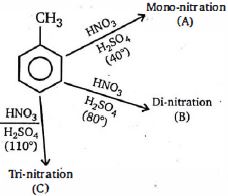
How many products are capable of beings formed from toluene in each of following reaction ?
A weak acid $HX$ has the dissociation constant $1 \times 10^{-5}\,M$ . It forms a salt $NaX$ on reaction with alkali. The percentage hydrolysis of $0.1\,M$ solution of $NaX$ is ............... $\%$
Select correct statement about hydrolysis of $BCl_3$ and $NCl_3$
In the Hoope's process for refining of aluminium, the fused materials form three different layers and they remain separated during electrolysis also. This is because
Given below are two statements.

Statement $I:$ According to Bohr's model of an atom, qualitatively the magnitude of velocity of electron increases with decrease in positive charges on the nucleus as there is no strong hold on the electron by the nucleus.

Statement $II:$ According to Bohr's model of an atom, qualitatively the magnitude of velocity of electron increases with decrease in principal quantum number.

In the light of the above statements, choose the most appropriate answer from the options given below:

In which of the following transition photon of maximum energy is absorbed
The bond angle $H-X-H$ is the greatest in the compound
When $N{H_4}Cl$ is added to $N{H_4}OH$ solution, the dissociation of ammonium hydroxide is reduced. It is due to